Coburn vs Norquist on Ethanol Subsidies: Point Coburn

In a recent blog post I wrote for the Monthly, I examined the on going battle between anti-tax fanatic Grover Norquist and Republican Senator Tom Coburn:

Coburn calls Norquist “the boogeyman” and repeatedly attacks him for refusing to even consider a grand bargain. The junior senator concludes the piece saying, “The majority of Democrats and Republicans understand the severity of our economic challenges. They know they have to put everything on the table and make hard choices. Legislators who would rather foster political boogeymen only delay those critical reforms.”

My article was in response to an Coburn’s op-ed denouncing Norquist’s pledge. Well, Norquist wasn’t going to just let that go. He struck back later. The Hill has the story:

Norquist told The Hill that the piece is filed with “lies” and said that Coburn is violating, and trying to get colleagues to violate, a pledge they made to voters.

He said Coburn is wrong to target him, a mere advocate, and should instead acknowledge to his constituents that he is betraying them.

Okay, so that’s relatively normal fighting between a politician and a leading lobbyist. What intrigued me more is the bill that Coburn specifically pointed out in his op-ed:

Consider the evidence: I recently proposed amendments to end tax earmarks for movie producers and the ethanol industry. Mr. Norquist charged that those measures would be tax hikes unless paired with dollar-for-dollar rate reductions. And yet all but six of the 41 Senate Republicans who had signed his pledge voted for my amendments.

And Norquist of course shot back against that too in The Hill‘s article: Continue reading “Coburn vs Norquist on Ethanol Subsidies: Point Coburn”
Why Are The Yankees So Much Better in Day Games

Sorry for the lack of posts. I have a bunch of stuff up on the Washington Monthly‘s site and if you click the page to the right, all the links to my articles are there. I’ll also be guest blogging a bit this week at Ryan Cooper’s site (ryanlouiscooper.com) so check that out as well.

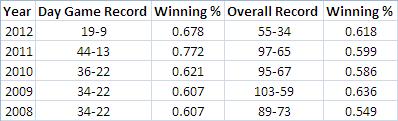
But this is just a quick one on a theme I’ve begun to notice more and more: the Yankees win an unusually high percentage of their day games. It’s not just that they win say 60 percent of them, which wouldn’t be that abnormal given how many games they win in a season. But they win a huge percentage every year. Check it out:


If you continue back a few years, the trend generally continues though it is not quite as clear cut. Except for in 2009, the Yankees have won a much higher percent of their day games each year than their overall record (which is skewed upwards by those day games as well). In fact, the Yankees have won 65.5% of their day games since 2008. That’s a huge percent.

My question is, why? I don’t understand why the Yankees play so much better in day games. Anyone have an explanation? Have their pitchers just happened to line up well for the past half-decade? Do they play more home day games each year? It’s a large enough sample that I doubt that’s the case, but it’s worth checking in to. Either that, or the Yankees have figured out something about day games that other teams haven’t

Glimmer of Hope in Jobs Report

After a few days off last week, I’m late to the party on the June jobs report. The report was bland as expected, with no change in the unemployment rate. The economy added 80,000 jobs in the month, not enough to keep up with population growth and certainly not enough to get back to full employment anytime soon. Hopefully, it will finally force the Fed to announce QE3 or a higher inflation target.

However, there was one small nugget in the report that was positive: Wages are rising

Not just wages, but the average work week also increased in June. As Sarah Kliff noted:

Working a few more hours at a slightly higher wage, means workers see a growing paycheck. They might have more bargaining power to demand a higher salary, too.

The fact that wages have been consistently ticking upwards demonstrates that workers have seen higher salaries. This is a good sign. Companies are going to slightly increase wages and their employees’ hours before hiring new employees. While the recovery is slow, firms do not need to rehire workers, but over time, simply increasing wages and hours will not be enough. The economy is not at that point yet, but it is at least on its way.

Of course, the jobs numbers have shown this nearly every month so I’m just focusing on it now, because the rest of the job numbers were so bleak.