A Panel Discussion: The Coming Asian Arms Race?

This morning, the Atlantic Council’s Brent Scowcroft Center of International Security hosted a discussion on the increased military budgets of Asian states and how the United States must react in this ever-more connected world. Barry Pavel, the Director of the Center, moderated the panel, which included Ely Ratner, Randall Schriver and Kurt Amend. Ratner, the Deputy Director of the Asia-Pacific Security Program at the Center for a New American Security, opened the discussion by warning about the limitations of looking exclusively at the defense budgets of Asian countries.

“Defense spending on its own tells us little about the regional security direction in Asia,” he said. “Diplomatic and political context is absolutely vital.” He added that it’s important to take into account the increasing connectivity of security issues in Asian states.

Schriver, the President of the Project 2049 Institute and a long-time promoter of US-Taiwan relations, stressed the importance of continued U.S. support to Taiwan, whose defense spending has decreased since 2007, in the face of continued military buildup by China. He called proposals to reduce arms sales with Taiwan “naive,” arguing that the sales act as a necessary deterrent to China and also have facilitated breakthroughs in the China-Taiwan relationship in the past. Like Ratner, Schriver emphasized that the context of China’s buildup in the face of Taiwanese disarmament is a vital consideration in planning U.S. policy in the region.

Yet, Schriver expressed skepticism that the Obama Administration is showing the same enthusiasm and committment for the rebalance of resources to the Asia-Pacific as it did in Obama’s first term.

“I’m hard-pressed to know who is the go-to position in Asia right now,” he said. It’s the first time in 20 years that Schriver said he couldn’t name a director or deputy in the U.S. government focused on Asia.

Ratner shared Schriver’s concerns.
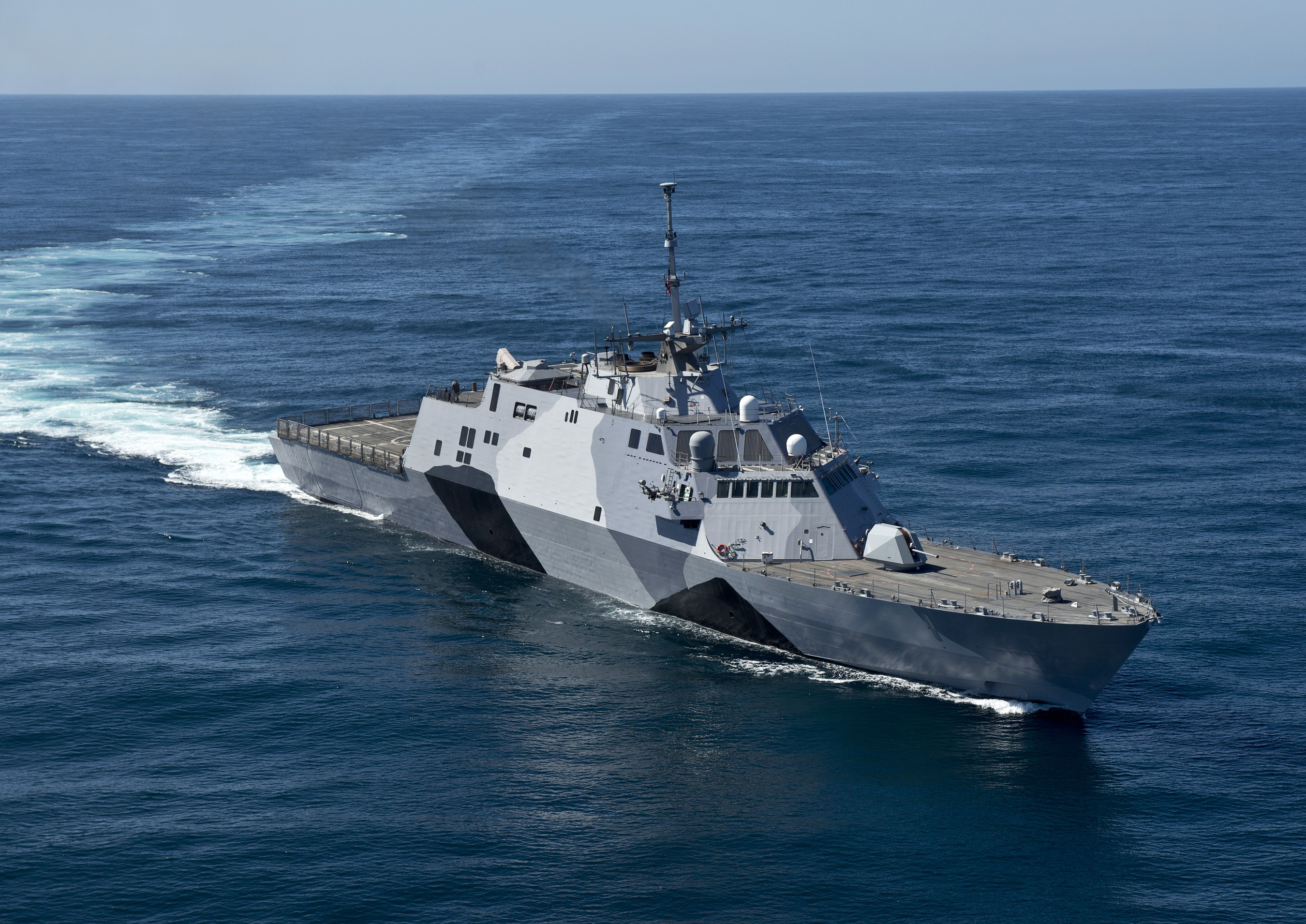
The USS Freedom departed for the Asia-Pacific in the spring.

The USS Freedom departed for the Asia-Pacific in the spring.

“Going forward, it needs to be clear that high level officials in the State and Defense Departments are interested in the ASEAN (Association of Southeast Asian Nations) region,” he said. He agreed with Schriver that there was no need or potential for forming a multilateral alliance in the area, noting that it would be unfair and harmful to Asian nations to force them to choose between a regional security alliance with the United States and their economic dependence with China.

One concern that many officials have is that U.S. committment to supporting their allies in the ASEAN region will lead those countries to become more provocative towards China. Ratner said those worries were overblown and that the U.S.’s increased presence in the region has not led to increased hostility with China. For those reasons, it’s vital that the U.S. continue to show similar levels of support to its Asian allies.

“The more secure that countries in the region feel standing up to China, the more stable the region will be,” he said. “Weakness, not strength, invites instability.”

Instead, Schriver stressed the need for the United States to develop security mechanisms that the U.S. has confidence in.

“We need to have an infrastructure of confidence building measures that actually work in the case of a crisis or an accident,” he said.

The potential for a miscalculation that causes an international incident was a theme throughout the discussion. All three panelists agreed that such an accident was one of the biggest threats to regional stability. In particular, Ratner feared the potential of a maritime accident while Schriver lamented the risk of increased corruption within the Chinese military.

Nevertheless, the panelists agreed that the increased interconnectedness between Asian nations had just as much potential to end in diplomatic agreement as it does in military conflict. Ratner stressed this fact repeatedly, emphasizing that military cooperation on defense issues and space weaponization could increase stability in the region. In either case, the U.S. must stay committed to its allies and not let other international hot spots distract it from the region, Schriver said. “The variable that is mot important and where there is the most uncertainty is the United States.”

President Obama shouldn’t forget that.

Do Obama’s Higher Ed Reforms Have a Chance in Congress?

Jonathan Chait is pessimistic:

But the comparison raises the question of whether his higher-education agenda will repel Republicans just as his health-care agenda did. Finding ways to get the government to spend less on education sounds pretty conservative.

If you put more weight on the ideological explanation [for Republican opposition to the ACA] , then Obama’s higher-education agenda stands a chance of attracting Republican support. Republicans might even take some visceral pleasure in making their cultural enemies in the academy squeal. If you put more weight on the political explanation, then Republicans will convince themselves that Obama’s plan is evil no matter what. Republicans will find themselves believing that free-market principles require that whatever money the government spends on college access must have absolutely no conditions attached.

Josh Barro is more optimistic:

I view scorched-earth Republican opposition to health care reform as having been driven mainly by neither ideology nor animus toward the president. I think the key was a desire to protect Republican constituencies who benefit from the health policy status quo: doctors and Medicare recipients.

In the case of higher education, the constituency getting its ox gored by cost control will be college professors and administrators, hardly a fixture of Republican fundraisers or Tea Party town halls. That bodes well for bipartisan compromise on this issue.

Hmm, I want to side with Barro here, but I can’t for one big reason: Republican rejection of the Medicaid expansion. A quick refresher: Obamacare expanded Medicaid to cover all individuals with income up to 133% of the federal poverty line. Since Medicaid is a state-run program, the government agreed to cover the full costs of the expansion until 2017. From 2017 to 2020, the federal government covers 95% of the costs and thereafter it’s 90%. It’s a great deal for states. But the Supreme Court ruling last summer allowed states to opt out of the expansion. This leaves a gaping hole in Obamacare. Individuals with incomes between 100 and 133 percent of the federal poverty line will still be eligible for tax subsidies, but those with incomes below 100% of the federal poverty line who aren’t eligible for Medicaid already will not receive coverage.

Why does this matter to whether Obama’s higher ed plan has a chance of passing in Congress? Because, as Barro and Chait write, it depends on whether Republicans will immediately reject the plan out of opposition to anything President proposes or whether they will be open to it. Barro’s optimism is based on the fact that Republican opposition to Obamacare was not just pure nihilism, but was also a play to protect their favored constituencies. Except Republican rejection of the Medicaid expansion shows that it was more nihilism than anything else.

That’s because rejecting the expansion will hurt one of Republicans favored constituencies: hospitals and doctors. Obamacare discontinues Disproportionate Share (DSH) payments, which were used to offset uncompensated health care costs of the uninsured pre-Obamacare. When Obamacare expanded Medicaid, those payments became unnecessary. Medicaid would now cover everyone up to 133% of the federal poverty line so uncompensated costs would basically disappear. Thus, there was no need for DSH payments to continue. Except hospitals in states that rejected the Medicaid expansion are still going to face significant costs of treating uninsured patients and now they receive no DSH payments to recoup those expenses. That’s why hospitals have been aggressively lobbying Republican states to expand Medicaid. There’s a lot of money on the line for doctors and hospitals.

But that lobbying has proved ineffective so far. Twenty one states have already rejected the expansion with six still debating it. It’s a great deal from the federal government that allows millions of poor Americans to receive health care coverage. Even more, hospitals are crying out for the expansion. Nope, Republicans are dead set against it. No matter how much hospitals and doctors favor them, Republicans aren’t budging. Republican opposition to Obamacare is less based on protecting Republican constituencies than rejecting anything the President proposes. I don’t see Republicans treating Obama’s education proposal any differently.