Cell Phone Unlocking Doesn’t Stifle Innovation

Michael Moroney is out with a confusing piece in Roll Call today arguing against allowing consumers to unlock their cell phones and use them on other plans. Earlier this year, the White House sided with a grassroots petition that received more than 114,000 signatures to allow cell phone unlocking. A current bill in Congress proposes to do just that but for the moment, it is still illegal. In his column today, Moroney argues that such regulation allows tech companies to recoup the huge amounts of money they spend towards R&D to create such products:

The DMCA is supposed to prevent digital piracy by making it illegal to disable digital rights management software, and it applies to the device locks that carriers put on cellphones — primarily to prevent phones they sell from being used on other carrier networks. When tech companies spend billions of dollars on research and development, they have to recoup those costs and make a profit to stay on the cutting edge of innovation.

Moroney continues on to note that the exclusivity agreement Apple had with AT&T allowed Steve Jobs’s firm to recoup their investment while AT&T had the ability to sell its customers high-cost data plans. Did Apple really need the exclusivity deal with AT&T to profit off the iPhone? Of course not! It makes a huge profit margin on the product alone. Moroney’s basic argument is that without the ability to agree to such deals, Apple would have had no incentive to invent the iPhone and consumers would be worse off today.

Does anyone actually believe that?

All that exclusivity deal did was force consumers to pay higher data fees, part of which AT&T paid to Apple in the form of subsidies as part of the agreement. Consumers are the main losers. In a world where cell phone unlocking is legal, consumers can shop around for the best data plan and carriers must compete on price. Apple earns less without the exclusivity deal, but it still makes a tidy profit that encourages them to continue investing in new products. Consumers save a bit of money overall and no innovation is lost. This is how intellectual property laws are supposed to function.

Instead, our copyright laws protect the profits of Apple and AT&T at the expense of consumers. The companies’ desire to keep cell phone unlocking illegal is pure rent-seeking. Moroney’s article only helps them get away with it.

Is Economic Inequality A Problem? Yes, But It’s Not So Simple

Former economic adviser to Mitt Romney, Greg Mankiw published an essay (PDF) recently titled “Defending the One Percent.” In it, he argues that growing economic inequality in and of itself is not a bad thing. He writes that the Left has three main arguments in favor of higher taxation for the rich and attempts to refute each one.

First, he argues that liberals believe the current tax system is regressive. Um, not sure where Mankiw got this one: I don’t know of any liberals who believe this. As he points out, the top 20% of homeowners paid significantly more in taxes than the middle fifth and massively more than the bottom quintile. Those are facts – our current tax system is progressive. But that doesn’t mean it’s progressive enough. As for why liberals don’t believe it’s progressive enough, let’s move to his second and third arguments.

Next, Mankiw suggests that liberals do not believe that compensation for the rich accurately represents “their contributions to society.” He also notes that the rich earning their income through rent-seeking behavior is inequitable and inefficient:

The key issue is the extent to which the high incomes of the top 1 percent reflect high productivity rather than some market imperfection. This question is one of positive economics, but unfortunately not one that is easily answered. My own reading of the evidence is that most of the very wealthy get that way by making substantial economic contributions, not by gaming the system or taking advantage of some market failure or the political process.

Finally, he argues that liberals believe the rich should pay a greater share in taxes, because they benefit from the social, legal, and physical infrastructure more than others. Mankiw does not refute that belief, but argues that the rich already pay enough. His main reasoning is that government expenditures have gone more and more towards transfer payments than towards infrastructure over the past few decades. Given all that, the rich have to be paying more than their fair share:

As I pointed out earlier, the average person in the top 1 percent pays more than a quarter of income in federal taxes, and about a third if state and local taxes are included. Why isn’t that enough to compensate for the value of government infrastructure?

How much value the rich receive from government infrastructure is not an easy question and I don’t have a simple answer. But Mankiw completely dismisses it, assuming instead that the rich must be paying too much. Maybe they are. Maybe they aren’t. But he offers zero evidence here to backup his complaint.

However, I want to return to the second argument as Mankiw ends his essay by offering his “just desserts” philosophy of income distribution:

According to this view, people should receive compensation congruent with their contributions. If the economy were described by a classical competitive equilibrium without any externalities or public goods, then every individual would learn the value of his or her own marginal product, and there would be no need for government to alter the resulting income distribution. The role of government arises as the economy departs from this classical benchmark. Pigovian taxes and subsidies are necessary to correct externalities, and progressive income taxes can be justified to finance public goods based on the benefits principle. Transfer payments to the poor have a role as well, because fighting poverty can be viewed as a public good.

In large part, I agree with this framework (with the glaring exception of us having a moral obligation to provide basic living conditions and equal opportunity for all Americans). People should be paid based on their contributions to society, but those contributions are not always priced into the economy. Are teachers salaries in line with what they add to society? What about stay-at-home moms? Of course not! The free market doesn’t take into account many of the ways that people contribute to society. Thus, I agree that we should aim for perfectly competitive markets with the government correcting externalities and fixing any other market failure. But we also need to take into account non-capitalistic ways people add to society.*

Here’s where Mankiw and I differ: He believes our current system lives up to this philosophy. I don’t.

This disagreement results from the difficulties in ascertaining how much an individual contributes to society. Estimating those numbers is very challenging. In October 2011, the CBO released a report on changes in after-tax household income between 1979 and 2007 (PDF). Here’s the most important finding:

The share of after-tax household income for the 1 percent of the population with the highest income more than doubled, climbing from nearly 8 percent in 1979 to 17 percent in 2007.

That stat also takes into account government transfers. If we assume that Mankiw is correct and our current system accurately represents individual’s contributions to society, that means that during that period, the top one percent became more than twice as valuable to society while the bottom eighty percent all became less valuable. Does that sound like a legitimate depiction of how our society has changed over the past 30 years? The top 1% contribute twice as much as they did in 1979?
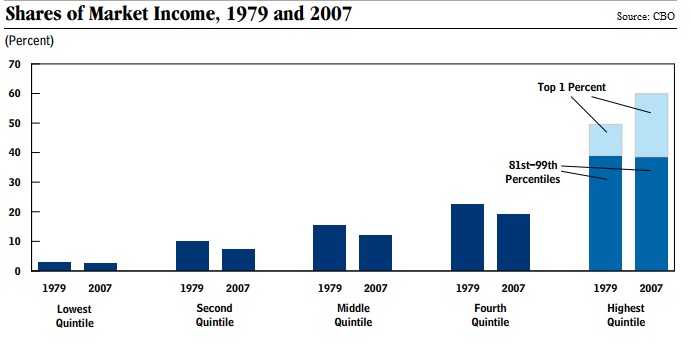
Share of Market Income

However, just because that isn’t true doesn’t mean that the income levels of the top 1% are too high. It’s possible that in 1979, the top 1% were paid only half as much as they contributed to society. Thus, even if their contributions hadn’t changed over those three decades, their growth in after-tax income led to a more accurate representation of each quintile’s value to society. That’s certainly a possibility, though I don’t believe that’s the case either.

On a more fundamental level, do you believe that the top 1% equal 17% of the value of our economy and thus deserve 17% of the after-tax, post-transfer income? Do the top 20% contribute 53% of value to society? I find that extraordinarily hard to believe. Based on his conclusion, Mankiw doesn’t. Unfortunately, deciding who is right is not so simple. There’s no easy way to estimate how much each quintile is worth. That’s a main reason that Mankiw’s essay lacks specific numbers – those numbers are hard to come by. But I have trouble believing that most Americans look at that distribution of after-tax income (to say nothing of wealth) and believe it’s an accurate representation of value-added to society. I certainly don’t.

*I edited this paragraph up to make it more clear that I advocate for people earning what they contribute to society in all forms, not just economic ones.
A Terrorist Attack from a Plane is More Likely than One from a Bus

Matt Yglesias has a good post up on his blog arguing that intelligence agencies should be required to perform cost-benefit analyses of potential security policies before implementing them. Josh Barro wrote a similar column yesterday. Within Yglesias’s post, he notes that buses have no security yet terrorists do not routinely blow them up:

As I’m going to be boarding a flight to Brussels soon, I’ve just had the opportunity to reaquaint myself with the banal aspects of the post-9/11 national security state—liquids out of your bags, full-body scans, etc. The purpose, as ever, is security. After all, if airplanes were no more secure than city buses then we’d see terrorists blowing up airplanes about as often as they blow up city buses.

At any rate, that’s my view. Approximately zero lives per year are saved by airport security measures. Some amount of economic cost is directly inflicted, and then there’s a secondary cost as people substitute dangerous driving for safe flying.

While I wholeheartedly agree that the Department of Transportation should be required to estimate the costs and benefits of new security policies, I don’t agree with the above analogy. Certain security measures may not be worth their costs, but if we reduced airport security to the levels seen on buses, would-be terrorists would have strong incentives to carry out an attack.

First, an airplane can be used as a weapon in a way a bus can’t. If a terrorist were to hijack a bus and attempt to drive it into a major building, there are a number of ways that law enforcement can stop the attack from succeeding. In many situations, police will find out quickly about such an incident and can respond in kind. They can set-up blockades, shut down parts of the city and track the vehicle easily. On an airplane though, law enforcement have few methods to respond. They cannot simply shoot the plane down and sacrifice the Americans on it. There is no way to set up a blockade.

Second, bus riders can text or phone friends to alert the authorities if the attack is not clear. In the air however, passengers cannot easily communicate with friends and family on the ground. Notifying the authorities of the attack is much more difficult from the sky than from the ground.

Third, a terrorist attack from a plane has the potential to be much more deadly than one on a bus.  At the very least, there are more people on a plane than on a bus. But terrorists can also inflict significantly more damage crashing a plane into a tall building or a secure location than they can running a bus into a similar target. Planes can crash into locations that cars and buses cannot even travel to (for example, the White House). This makes a hijacked plane much more dangerous than a hijacked bus.

Fourth, an attack from the sky is more emotionally damaging than one from the ground. We are unfortunately becoming more used to mass shootings and other threats on the ground. Part of the reason that 9/11 scared Americans so much was that it was the first time that we were attacked from the sky. That’s part of what makes drones so scary for Middle Easterners. You can’t see them and don’t know that they’re there – but they can strike at any moment. Before 9/11, we didn’t think twice about such a threat. Afterwards, we are now all alert and aware that we are not immune. A bus bombing would terrify us, but we can see a bus coming from a distance and can attempt to avoid it if it’s heading right at you. If you are so scarred from such an event, you can avoid buses for the rest of your life. You can’t avoid a plane striking your home or office out of nowhere. You don’t see it coming until it’s too late and there’s no way to fully protect yourself. That fear sticks with you for the rest of your life.

For all those reasons, terrorists have greater incentives to hijack a plane than a bus. That’s why Yglesias’s analogy doesn’t work. Now, there are some TSA policies that almost certainly have costs greater than their benefits (banning pocket knives) and Yglesias is right that we need agencies to conduct cost-benefit analyses more often. With specific estimates of the costs and benefits of a proposed policy, politicians will have more confidence in supporting less security. After all, no politician wants to risk advocating for reduced security and then face voters if a terrorist attack does happen. This biases the entire system towards excessive security. At least with a cost-benefit analysis, Congressmen will have specific statistics to show their constituents for why they voted for such a policy. If that alone can reduce the bias in the system, it’s worth a shot.