Extend the Payroll Tax Cut!

Fiscal Cliff

Does Boehner have to accept a compromise?

Yesterday, I wrote a post arguing that liberals are overestimating the President’s leverage on the fiscal cliff. There were a couple of reasons for this, but the biggest one was that the Republicans were now apparently willing to raise taxes on people earning more than a $1,000,000. Turns out, that’s not true.

House Speaker John Boehner was unable to convince his caucus to pass such a bill. It’s clear now: Tea Party Republicans are never going to vote for a tax increase, even if such a vote would actually avoid raising taxes on the majority of Americans. It’s not going to happen.

President Obama does not have to worry about convincing Americans that Republicans are holding the middle class tax cuts hostage. It’s painfully obvious without him saying so. If we go over the fiscal cliff, the Republicans will be blamed.

In addition, if Boehner wants to avoid going over the cliff, he’s going to need support from lots of House Democrats and that means compromising with Obama.

Either way, Obama now has all the leverage in the negotiations and I’m hoping he uses it.

However, unlike other Democrats, I’m not looking for the President to walk back from his most recent offer. As Ezra Klein wrote earlier today, that’s not entirely an option. It will look bad for Democrats and risk hurting the economy. Instead, the President should demand the inclusion of an extension to the payroll tax cuts.

The economy is still barely recovering and extending the payroll tax cuts will prevent an unnecessary and untimely increase on middle class taxes. According to the Tax Policy Center, it would raise taxes mostly on the bottom 80 percent of households:Pay Roll Tax Cut Expiration
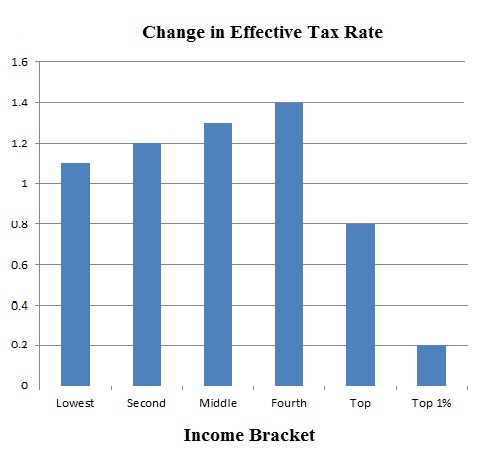
Extending the payroll tax cut will help out these families the most. Now that Obama has the full leverage on the fiscal cliff and isn’t at risk to lose it, it’s time he uses it to help out the middle class. This is the way to do it. (Image via)

S.E. Cupp’s Absurd Argument

I rarely have time to watch TV during the day, but over break, I caught a bit of MSNBC’s The Cycle yesterday. At the end, conservative host S.E. Cupp gave her take on the current gun control argument in America. It’s online as well. Here’s the most infuriating part:

If you truly believe that guns are the problem, then the only intellectually honest argument is to eliminate them all. Focusing only on assault weapons is a cop-out. In 2010, a mere 2.8% of homicides were committed with an assault weapon, while 42.6% were committed with handguns. And during the 10-year federal ban on assault weapons, numerous mass shootings–including Columbine–still took place. Making it harder to obtain a gun is (sorry about the wording) half-assed. Adam Lanza apparently stole his guns from his mother, who legally purchased and owned them. Gun control advocates should want her guns, and all legal guns, banned, too.

“Gun free” zones don’t cut it either. Because would-be murderers like Cho Seung-Hui, Lanza, and Major Nidal Hassan, don’t respect those artificial boundaries. But aside from the constitutional impossibility of eliminating all guns, prohibition hasn’t proven to be useful in eliminating, well, much of anything, including illicit drugs and, yes, illegal weapons. There are mass shootings even in countries with the strictest of gun laws. And someone intent on killing a lot of people doesn’t need a gun to do it. So if we know that banning certain guns won’t stop gun violence, that gun-free zones don’t protect the people inside them, and that eliminating all guns is impossible and ineffective, then what workable solutions are gun control advocates actually bringing to the table when they say they want to have a “real conversation?”

She then goes on to focus on mental health care for a bit. But hearing that part made my blood boil.

First off, it’s not intellectually dishonest to argue for stricter gun control policies without trying to eliminate them all gun. It’s a remarkably idiotic remark from Cupp (normally I refrain from name-calling, but Cupp’s argument is just too insulting). Her argument basically boils down to “If stricter gun regulations won’t eliminate all shootings, why even bother?”

No gun control advocate is arguing that guns are the only cause of mass shootings. Nor are they arguing that gun control measures will eliminate all gun violence. The goal is to reduce shootings while protecting second amendment rights. And Cupp asks for some workable solutions. Well here you go:

  • A ban on high-capacity magazines accomplishes that goal.
  • Stricter background checks and closing the “gun show” loophole accomplishes that goal.
  • An assault-weapons ban accomplishes that goal.
  • Better access to mental health care accomplishes that goal.

In addition, there are gun-control advocates who want to eliminate all guns (I’m not one of them). But they understand that the elimination of all guns is, as Cupp says, a “constitutional impossibility.” So, instead, they propose realistic policies. What is intellectually dishonest about advocating for a practical, realistic policy to reduce gun violence, even if it’s not your preferred policy?

And just because a policy wouldn’t stop certain past mass shootings is not a reason for not adopting that policy. That argument is what’s really a cop-out.

Liberals Overestimate Obama’s Leverage on the Fiscal Cliff

The Fiscal Cliff is still unresolved.

The Fiscal Cliff is still unresolved.

Over the past couple of days, the White House has taken a lot of heat from liberals for agreeing to using chained-CPI in Social Security. Different writers have lashed out at such a deal and argued that the President is back to “negotiating with himself.” Many of these liberals see going over the fiscal cliff as better than the deal Obama is currently offering. They believe that going over the cliff will give Obama more leverage in the negotiations and allow him to extract a better deal from Republicans. However, I’m very skeptical of this for three reasons:

First, the President is in such a great position now because Republicans really don’t want the Bush tax cuts to expire for anyone. The President wants to extend the tax cuts as well, just not for those making $250,000 a year or more (his most recent offer upped this amount to $400,000). In his counteroffer, House speaker John Boehner agreed to raise rates on those making more than a $1,000,000.

But the rates on everyone automatically rise on January 1st (though its effects don’t occur for a few months). This where the President’s leverage comes from. He would sign a bill extending the tax cuts for the middle class, but Republicans won’t because they want to extend rates for the upper class (and small businesses) as well. That’s why the President can say:

It’s unacceptable for some Republicans in Congress to hold middle class tax cuts hostage simply because they refuse to let tax rates go up on the wealthiest Americans

The polling has largely backed up the President, with the American people blaming Republicans for not compromising.

The thing that many liberals have overlooked is that this can change quickly. Boehner’s offer to raise rates on those making over a $1,000,000 may not be much substantively, but it represents a big shift in the Republican party. For years now, the Republicans have adamantly refused to raise taxes. Period. End of question.

Now, the Speaker is finally offering to let taxes rise on the wealthiest Americans. The American people may see this as a major compromise for Republicans and believe that the President is now holding the middle tax cuts hostage. I haven’t seen any polling since Boehner submitted this offer to the President,  but I’d be very interested in it. If we go over the fiscal cliff, it’s possible that Obama could receive much of the blame. That would certainly put him in a much worse bargaining position. Continue reading “Liberals Overestimate Obama’s Leverage on the Fiscal Cliff”