The Fed’s Real Mistake: Tapering Too Soon

Last week, I argued that the Federal Reserve had not made a communication error when it announced in its June FOMC statement that it would begin tapering later in the year if the economy continued to improve at a moderate pace. The problem was that the market did not listen to the Fed correctly. The Fed’s non-taper was not to correct a miscommunication. It was to correct the market’s misreading of that statement. That’s not to say that the Fed’s policies have been optimal. On the contrary, while the Fed did not make a mistake in its communication strategy, its’ making an even worse one in tapering prematurely.

When Ben Bernanke announced that the Fed was going to start a new round of quantitative easing (QE3), the unemployment rate stood at 8.1%. Today, it’s down to 7.3%, but this overstates the extent to which the economy has improved in that time. In particular, workers have dropped out of the labor market at an alarming rate, causing the unemployment rate to drop for the wrong reasons. Some of those workers are baby boomers retiring, but many more are simply people who are so discouraged that they give up looking for a job.

A better indicator of the state of the labor market is the employment-to-population ratio:
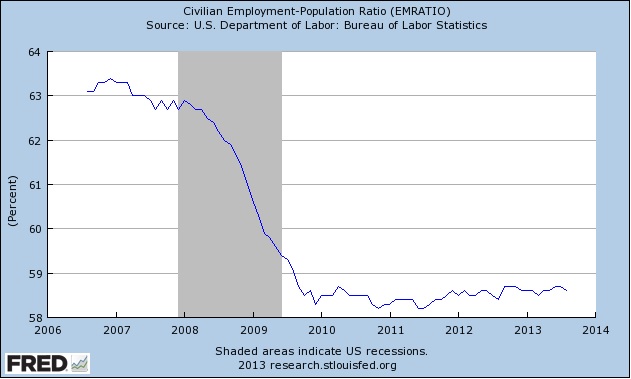
Employment to Population Ratio.
As you can see, the employment-to-population ratio crashed during the Great Recession as millions of workers lost their jobs. Since then, the economy has muddled along. It’s unlikely that we’ll return to a ratio of 63-64% anytime soon, because as the country gets older, we will have fewer working-age Americans. Nevertheless, the current rate of 58.6% is unacceptable. In June, the rate was 58.7%. Before that, the economy was certainly not growing at a quick enough pace for the Fed to begin reducing its pace of bond-buying.

That’s the Fed’s real mistake.

Bernanke should have announced that the Fed would continue its asset purchases until the economy showed substantial, consistent improvement. He should’ve said that the Fed always follows the unemployment rate closely, but would track a number of economic indicators. It would continue its unconventional monetary policy until either inflation began creeping upwards or the economy returned to full employment. In a perfect world, the Fed should implement NGDP targeting, but given that such a policy is not happening anytime soon, the Fed should focus on using its current unconventional policy to provide support for the economy. That means not reducing the rate of asset purchases when the economy is barely improving.

Except that is exactly what the Fed intends to do. That was what Bernanke announced in June. Unfortunately, economic growth over the past three months has been below the Fed’s forecast so it adjusted its policy and delayed tapering. But when the economy does improve more and the Fed decides to taper, it will make a big mistake. The Fed could correct its policy and decide to continue its bond-buying for a longer period of time until the economy grows stronger. But that would be an entirely different message than the one Bernanke delivered in June. Then, the miscommunication criticism would ring true.

However, there are no signs that this will be the case. Everything Bernanke said at this past press conference indicates that the Fed is ready to begin tapering once the economy grows at a slightly faster rate. It’s not a mistake of miscommunication. It’s a policy mistake. And since it’s going to hurt economic growth and weaken an already weak labor market, that’s a much worse mistake to make.

Everyone Is Misreading The Fed Again

Well almost everyone. The conventional wisdom right now is that the Fed delayed tapering to fix its miscommunication in its June statement. The argument goes that the Fed should never have mentioned tapering and it was correcting itself by not cutting back its bond-buying. Here’s Bloomberg’s Justin Wolfers:

Chairman Ben Bernanke promised that future quantitative easing would depend on the incoming economic data. Those data clearly have been weaker than most analysts, including the Fed, had hoped. The only way for the Fed to convince markets that its policies are data-dependent is to make data-dependent decisions. Let’s hope this episode has helped rebuild some of the Fed’s credibility.

This whole taper debate is one that should never have happened. It’s the result of a failed communication strategy.

The point is that “taper off” doesn’t really represent an interesting new policy easing, but rather its main function is to undo the damaging tightening in financial conditions that occurred following the initial taper talk.

Wolfers analyzes the underlying situation correctly, but gets to the wrong conclusion. He says that the Fed is data-dependent and the economy worsened slightly over the three months in between the Fed’s June FOMC statement and its one two days ago. That should lead the market and investors to believe that the Fed would not taper, but it didn’t because none of them truly believed the Fed would adjust its policy based on the data.

The failed communications strategy wasn’t a Fed error. It was a forecaster error. I went back and read through the transcript of Bernanke’s June press conference last night. Every single time he mentioned tapering, he prefaced it by saying something like “if the incoming data support the view that the economy is able to sustain a reasonable cruising speed” or “[i]f the incoming data are broadly consistent with this forecast.” And guess what? The incoming data was NOT broadly consistent with this economic forecast.

This is where Tim Duy and I disagree. He writes:

I think this means that, in general, the data was broadly consistent with the Fed’s expectations.  That is, we weren’t reading the data wrong.  They just decided that they could wait until longer before initiating the taper.

The September FOMC statement did not do a good job of indicating that the data came in slightly below the Fed’s economic forecast. But Bernanke laid it out clearly in his prepared remarks:

in evaluating whether a modest reduction in the pace of asset purchases would be appropriate at this meeting, however, the Committee concluded that the economic data do not yet provide sufficient confirmation of its baseline outlook to warrant such a reduction. Moreover, the Committee has some concern that the rapid tightening of financial conditions in recent months could have the effect of slowing growth, as I noted earlier, a concern that would be exacerbated if conditions tightened further. Finally, the extent of the effects of restrictive fiscal policies remains unclear, and upcoming fiscal debates may involve additional risks to financial markets and to the broader economy. In light of these uncertainties, the Committee decided to await more evidence that the recovery’s progress will be sustained before adjusting the pace of asset purchases.

The Chairman is saying two things here: (1) the rise in interest rates since June have already lead to a tightening in financial conditions and (2) the potential for a government shutdown/default makes the Fed cautious. Overall, the Fed reduced its economic growth forecast slightly. Bernanke is explicitly saying that the financial data is not consistent with their June economic forecast. The Fed is adjusting its policy as the state of the labor market changes.

That’s why I think Duy and other journalists are misreading the data. The job reports have been mediocre at best. The labor force participation rate has declined. Average hourly earnings and average weekly hours have barely budged. The Commerce Department first revised its GDP numbers down from a 2.4% annual rate to one of 1.8% and then revised them back up to 2.5%. Mortgage rates have risen quite a bit.  All of these are indicators of a barely growing economy, one growing slower than the Fed expected in June.

In particular, the rise in mortgage rates happened as a result of the Fed’s June FOMC statement. Slate’s Matt Yglesias writes that “[t]he punchline is that the tightening of financial conditions in recent months was caused by … rumors that the Fed was going to taper.” Except there weren’t any rumors. There was the June statement that explicitly repeated over and over again that the Fed would only taper if economic data was positive. The market read that to mean that the Fed was going to taper no matter what and interest rates rose. Because interest rates rose, the economic data worsened and the Fed followed through on its promise to adjust its policy based on the labor market. If the market had read the Fed correctly and not assumed the taper was coming, rates wouldn’t have risen as much and the Fed’s economic forecast would have been sunnier. That may not have been enough to overshadow the other mediocre economic data, but the market also wouldn’t have completely expected the Fed to scale back its bond-buying. The non-taper wouldn;t have been a shock. The Fed and market would’ve been in sync. Instead, the market’s blind assumption that the Fed wouldn’t react to the data forced the Fed to do just that. Bernanke’s remarks didn’t cause the tightening of financial conditions. The market’s misreading of them did.

Once again, journalists are misreading what the Fed is saying. Bernanke isn’t saying that he regrets mentioning tapering in June. He regrets that the market misread him. That’s what the Fed was trying to correct this week. It was trying to tell the markets that it really is going to listen to the underlying data. It was trying to regain its credibility by precisely adhering to the statement it laid out in June. But, no one is hearing that. Everyone is misreading the Fed yet again.

Where Does the Increase in Entitlement Spending Come From?

On Monday, I penned a post arguing that Sen. Orrin Hatch (R-UT) was wrong when he commented that we have a spending problem and more revenue is not part of the solution. I used Congressional Budget Office (CBO) data from its 2012 Long Term Budget Outlook to make my point, but that data is a bit out of date. Luckily, the CBO released its 2013 Long Term Budget Outlook two days ago and guess what it showed? Our deficit is magically disappearing!

That’s thanks to the Fiscal Cliff deal that raised taxes on the highest earners, which increased projected revenues. As for spending, health care costs are growing at a much slower rate than expected, not only due to the recession, but also because we seem to have bent the cost curve permanently. That’s a huge improvement. In addition, the sequester is looking more and more like permanent policy. Thus, overall spending has dropped significantly compared to last year.

Nevertheless, entitlement spending is still projected to rise from 9.6% of GDP in 2013 to 14.3% of GDP in 2038. That’s still a large gap. The only reason the budget deficit doesn’t rise a similar amount is because the CBO projects other spending – the stuff the sequester mostly cuts – to fall from 10% of GDP to 7.1%. The increase in entitlement spending (4.7 percentage points) in the 2013 report is less than in last year’s (6.2 percentage points), but it’s still substantial. So, what’s driving that increase? The CBO breaks it down:

  1. 54% Aging: This is an unavoidable aspect of our future budget. Baby boomers are retiring and will start collecting Social Security and Medicare. There’s nothing we can do about that. As America gets older, our retirement programs are going to cost more. Not surprisingly, that’s what the CBO found to be the largest driver of entitlement spending growth. Of that 4.7% increase, 2.5 percentage points is due to aging. It’s not out of control spending on entitlements. It’s just Americans getting older. We can’t pretend that’s not the case.
    .
  2. 28% Excess Cost Growth: Excess cost growth is the increase in health care spending beyond the rate of inflation. It’s an area we have made significant progress on in recent years, but we can still do better. However, this doesn’t require cutting benefits or changing the eligibility requirements for different programs. It requires bending the health care cost curve even more so that health care is provided more efficiently. Obamacare includes a number of different experiments to try to find ways to do just that.
    .
  3. 19% Medicaid Expansion and Exchange Subsidies: This is the area that conservatives are dying to cut. but of the main drivers of long-term entitlement spending, the Medicaid expansion and exchange subsidies account for less than one-fifth of it. In addition, excess cost growth is increases spending due to rising costs of programs. It doesn’t mean that seniors receive more benefits or that more people are eligible for the programs. It just means health care is getting more expensive. The Medicaid expansion and exchange subsidies do more than that though. They bring healthcare to millions of people. Eliminating them may have a positive impact on the long-term budget, but it has serious side effects as well.

Unlike my post on Monday, my main point here is not that we need more revenue. The main point is that we have solved a large part of our budget deficit and of the part we haven’t solved, most of it is due to demographic changes and millions of more people getting health care. Republicans can yell about how entitlement spending is running out of control, but the fact of the matter is that it isn’t. It’s on an unsustainable path, but one that is caused mainly by an aging population. Policymakers shouldn’t forget that.