Boehner Can’t Betray The Tea Party

Salon’s Brian Beutler is out with an article this morning advising House Speaker John Boehner to give up waging repeated fights over the government budget and debt ceiling and instead agree to fund both for a lengthy period of a time. These fights do nothing, but divide the Republican party and hurt its imagine nationally. So, Beutler’s logical advice to the Speaker is to no longer pass stopgap fixes and get them off his plate until at least the midterm elections.

This makes a lot of sense on political grounds for the Republican party. The GOP wouldn’t have to revisit every few months whether they’re going to bankrupt the government or allow it to default, both political losers for the party. As for the country, these nasty fights unnecessarily hold back the economy and crowd out other important Congressional legislation such as immigration and tax reform.

The problem with Beutler’s strategy is that it would probably cost Boehner his speakership. Beutler says that if Boehner is worried about this, he could make a deal with House Minority Leader Nancy Pelosi that Democrats will support him if he’s challenged by his conservative base.

Speaker Boehner has no good options.

Speaker Boehner has no good options.

But this doesn’t actually accomplish much for the Speaker. He keeps his title while losing all of his power.

If the Speaker faces a rebellion from within his ranks and turns to Pelosi for help, it effectively makes her de-facto Speaker. As we’ve seen repeatedly, Tea Party Republicans aren’t going to sit idly by while the Speaker betrays their most deeply held interests: cutting government spending and defunding Obamacare. In reality, the House doesn’t have a chance of accomplishing either of those, but House Republicans don’t live in reality. They will see Boehner’s betrayal not as a practical solution to improve the image of the party, but as a validation of their not-to-secret belief that the Speaker is a RINO. And they won’t accept that.

Whoever rises up to challenge Boehner for his speakership – whether it be the Majority Leader, Eric Cantor, or someone well outside Republican leadership such as Justin Amash – will have the support from Tea Party groups around the country and many members of the Republican caucus. If Democrats come to Boehner’s aid and save his speakership, the Tea Party will not simply give up the fight. The Tea Party doesn’t give up fights, even ones they’ve lost repeatedly (see, Obamacare). They will continue to fight against everything Boehner does, if just to send a message to future speakers that the Tea Party is not to be messed with.

If Boehner hopes to accomplish anything else in this Congress, it will require large Democratic support and it will be up to Pelosi to provide that support. Anything Boehner wants to pass, he’ll have to run by the Minority Leader to see if she can whip the votes for it. That gives Pelosi all the power. That’s great for Democrats, but horrible for Republicans and even worse for Boehner. He’ll have no power in Congress and a Republican base that will never forgive him. That’s not a strategy the Speaker should pursue.
Richmond Officially Approves Eminent Domain Plan

Sigh.

Last night, Richmond, California’s city council approved the plan to use eminent domain to help underwater borrowers by a vote of 4-3. The plan is pure fraud. Mortgage Resolution Partners (MRP), an advisory firm, rounded up investors to supply capital to Richmond so that it could purchase the mortgages of underwater borrowers in the area. The city would then right down the value of the loan so that the borrowers could refinance at a lower rate. However, MRP wasn’t just helping out the city. It was looking to make a profit. And how was it doing that? By paying investors well below fair market value for the loans.

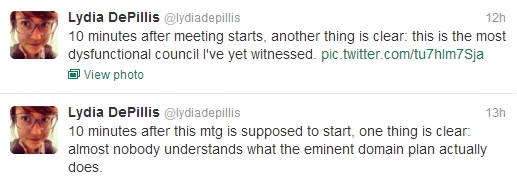
I’ve said repeatedly that I have no idea how Richmond fell for this plan. These two tweets from Wonkblog’s Lydia DePillis, who was at the meeting, may explain it a bit:
.

Eminent Domain Tweet.
A dysfunctional city council that doesn’t understand what they’re voting on is about the best explanation I’ve heard for why the city is implementing MRP’s plan. Still, I was hoping someone would talk some sense into the council members and explain to them why this is such a bad idea. Unfortunately, that hasn’t happened.

The Age Old Question of Technology and Job Loss

The Information Technology and Innovation Foundation hosted a debate this morning on whether technological advancement has led to persistent job losses in the economy. The Foundation’s President, Robert Atkinson, faced off against Andrew McAfee, the author of a recent book on the topic and a researcher at MIT’s Sloan School of Management.

McAfee began the debate by running through a number of economic trends that could be linked to technological change. He explained that over the past 30 years, only college graduates have seen growth in wages, while everyone has seen their wages stagnate. At the same time, corporate profits have skyrocketed while labor’s share of income is at all time lows. The top 0.1%’s share of income has increased substantially over the past half-century as well.

These trends, McAfee argued, demonstrate the decoupling of productivity from wage and job growth. In particularly the disruptive advancements in information and technology, most notably with the advent of the personal computer, is a major driver of this decoupling. As productivity has continued to grow, wages have stagnated and the rate of job growth has decreased.

Atkinson pushed back on a number of these points.

“There is zero relationship logically between job growth and productivity,” he said. McAfee presented a correlation between those economic indicators, but had not proven causation. Atkinson joked that it was as if saying that job growth was strong during the 1990s when the New York Yankees consistently won the World Series, but fell off afterwards when the Yankees were no longer winning. But no one would argue that the Yankees recent struggles are the cause of poor job growth. It’s just a coincidence.

Atkinson noted that many people believe technological growth is to blame for poor job growth, because it is an appealing explanation. But these theories only look at first-order effects.

“The reason why we see productivity leading to more jobs is second-order effects,” he said. These second-order effects include such things as new industries that pop up from technological growth or the lower prices that consumers see around the economy, leading to more consumption and stronger job growth in other sectors.

This debate comes up every time job growth falls off, Atkinson said, with each generation thinking that its technological advancement is a new phenomenon wreaking havoc on the labor market.

“We always think our own era of technological progress is the best,” he said. “In fact, it is not the best.”

This was a major point of contention between the participants. McAfee argued that we are rapidly heading for a world where robots replace a large portion of the jobs in the American economy, even for such hard-to-automate positions as airline pilots or doctors. Atkinson could not imagine such a world where airline pilots didn’t exist. They will always have to be on airplanes in case something goes wrong, he said.

But even more than this, Atkinson argued, is that looking at specific industries ignores the effect on technology on the entire labor market.

“You can’t look at individual sectors and extrapolate to the whole economy,” he said.

McAfee emphasized that his analysis was not focused on individual industries, but on the labor market as a whole. Atkinson may be unable to imagine a world with robot airplane pilots, but McAfee would not rule anything out.

“The only thing I’ve learned about technological progress after studying it for a while is never say never,” he said.