Does a Longer Copyright Term Reduce the Availability of Books?

Georgia law professor Paul Heald’s new working paper suggests so:

By examining what is for sale “on the shelf,” the analysis of this data reveals a striking finding that directly contradicts the under-exploitation theory of copyright: Copyright correlates significantly with the disappearance of works rather than with their availability. Shortly after works are created and proprietized, they tend to disappear from public view only to reappear in significantly increased numbers when they fall into the public domain and lose their owners. For example, more than three times as many new books originally published in the 1850’s are for sale by Amazon than books from the 1950’s, despite the fact that many fewer books were published in the 1850’s.

Copyright law provides artists with a limited monopoly over their work to incentivize the creation of such works. Many copyright owners want the copyright length extended so that they can have a monopoly over both their past works and future works for a longer period (See the Mickey Mouse Curve). But extending the copyright term for past works has no effect on incentives – after all those works have already been created. Congress should have no reason to grandfather in those artistic creations.

In return, lobbyists have argued that increasing the duration of copyright protection will allow owners to profit from their work for a longer period and give them greater incentive to make their works widely accessible. They maintain that extending the copyright term for past works is in the public’s best interest even if it has no effect on incentives.

Heald’s paper pushes back on this argument, finding that works in the public domain are more widely available than those still under copyright protection. He took a random sample of 7000 books on Amazon and matched them up with their year of publication in the Library of Congress. For a couple of technical reasons, he was only able to match 2317 of the 7000. Here’s the distribution of when those books were published:

Copyright Term Extension

All books published before 1923 are currently in the public domain. All those afterward are not. The graph shows that when a book enters the public domain, its availability spikes.

The usual caveats apply here. There’s nothing that suggests with certainty that copyright law causes this distribution. Correlation does not equal causation. The sample size is not huge and Amazon does not represent all retailers. Amazon probably finds it most profitable to license and sell recently published books as well as those that are in the public domain (no license necessary). Books in the middle – not recently published but still copyrighted – are least profitable. There certainly could be many other factors that caused this distribution as well.

Heald continues on to look the availability of songs in the public domain versus songs that are not. That analysis is less convincing thanks to some strange proxies. Nevertheless, Heald’s analysis of Amazon’s book offerings stands. It’s not decisive empirical proof by any means, but at the very least, the next time someone says that a longer copyright term will increase the availability of a work, take it with a grain of salt.
CPI Is A Technical Fix, Let’s Keep It That Way

President Obama unveiled his budget yesterday and liberal groups have responded angrily to the inclusion of Chained-CPI in the proposal. A quick recap: currently Social Security benefits increase each year to keep pace with inflation according to the Consumer Price Index (CPI). The current calculation for inflation does not take into account that when the price of one product increases, people will switch to a lower-priced substitute instead of paying the higher price. The classic example is that when the price of beef rises, people buy more chicken and less meat, so the actual increase in the cost-of-living is not equal to the rise in the price of meat. Chained-CPI takes this into account. Since Chained-CPI is a low measure of inflation, Social Security benefits will grow at a slower rate. Thus, liberals argue that Chained-CPI is a benefit cut.

However, both CPI and chained-CPI estimate inflation for the average person. But Social Security beneficiaries are not average people. Most of them are elderly and much of their consumption comes in the form of health care and housing. Since health care and housing prices have risen faster than the rest of economy, the cost-of-living for seniors has increased at a quicker rate as well. That means that CPI and Chained-CPI both actually underestimate inflation for Social Security beneficiaries. Their benefits should actually rise quicker than inflation.

Nevertheless, much of the discussion right now centers on the fact that Chained-CPI is a benefit cut. The Washington Post‘s Dylan Matthews outlines everything I’ve said above and more, but finishes his piece by saying:

But ultimately, the question of which you prefer likely has more to do with whether you think Social Security benefits need to be pared back to ensure the program’s long-run solvency, or whether you think the elderly need, if anything, a benefit bump. Those are policy questions, not technical ones, and all the debate in the world about chained CPIs and CPI-Es relative methodological merits won’t resolve them.

Slate’s Matt Yglesias has a slightly better take:

As a technical matter, the best way to express this would be to start with the most accurate possible measurement of the price level (I might prefer the PCE deflator) and then inflate it by a fixed amount. But using a measurement of the price level that slightly overstates inflation works too.

If we want to have real benefits increases slowly each year for beneficiaries, then let’s use Yglesias’s technical fix. But, let’s start by getting the level of inflation right. CPI is not correct. Chained-CPI is also not correct. The closest measure right now may be CPI-E, but it’s still experimental and not ready for use.

In the end, I’m with Kevin Drum: let’s budget a small bit of money to research and develop a precise measure of inflation and then implement it. After that, we can start talking about inflating it by a fixed amount (as Yglesias advocates) or pairing benefits back altogether (as many Republicans advocate). First, though, let’s get it right.

The Graph That Made (Almost) Everyone Hate Deficits

Kevin Drum penned a post last night about why people hate deficits so much. He runs through a few options, but settles on the following:

Liberals have done an abysmal job of explaining why deficits are good during periods of high unemployment, so ordinary citizens have no reason to think deficits are anything other than bad.

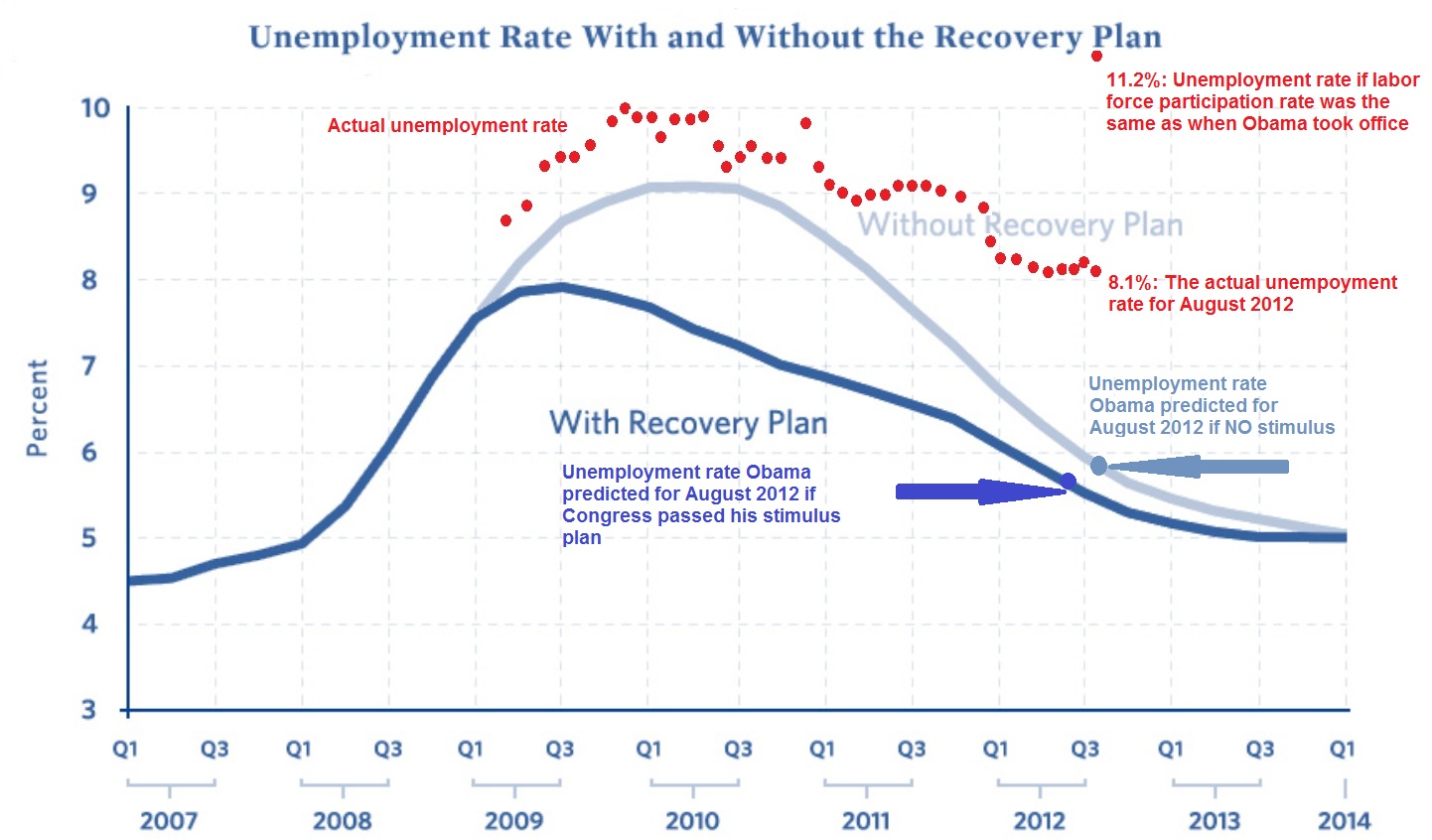
I think this all hearkens back to the graph from Obama Administration economists Jared Bernstein and Christina Romer in January 2009 showing the expected unemployment rate with and without the stimulus. American Enterprise Institute’s James Pethokoukis has updated the graph with the actual unemployment rate (this is his update from September of last year):RomerBernsteinAugust1

It’s tough to prove that deficit spending in times of high unemployment works when the stimulus seems to have failed so badly. Of course, Bernstein and Romer’s graph was so far off because the economy was much weaker than anyone realized at the time, not because the stimulus failed (it didn’t). But, try telling that to your average person. For most people, that graph is confirmation that deficit spending does not work. That’s a very deep hole for liberals to start in.