Why Obama’s Lie About Keeping Your Health Insurance Infuriates People

Over the last day, liberals have been on the defensive explaining why so many Americans are finding out their insurance plans have been discontinued. These explanations have been fundamentally correct, but they have failed to grasp why Americans are so infuriated by this. The Washington Examiner’s Phillip Klein gets closest to it in a piece yesterday:

When Obama took office and made health care his top priority, he understood that one of his main tasks was to convince Americans that he had a plan that could improve the health care system for those who it wasn’t currently working well for (such as those with pre-existing conditions) while leaving it untouched for those who were satisfied.

This is exactly right. Obama sold the law on the idea that for all those who liked their coverage, nothing would change. For those that didn’t or didn’t have coverage, it would be an improvement. Sure, there would be losers, but Obama assured Americans that they could keep the insurance they had.

If he was being honest, this is what he would’ve said:

For the vast majority of Americans, the Affordable Care Act won’t disrupt your health coverage. You’ll get to keep your plan and your doctor. But there are some people for whom I can’t make that guarantee, because your current health insurance is too weak to provide adequate protection. In creating this law, we set out not just to ensure Americans have access to the most basic coverage that leaves them on the hook for huge out-of-pocket costs. We sought to make health care coverage more comprehensive and that required creating a minimum benchmark that insurers must meet.

This will only affect the individual market where around 5% of Americans purchase health insurance. Plans that existed before 2010 will be grandfathered in, but we know insurers change these plans frequently and will likely do so again. That means they will have to comply with these new standards and that will require discontinuing some plans that they currently offer. I can’t guarantee that everyone will keep their plan, but I can guarantee that your new plan will be more comprehensive and provide a greater safety net in case catastrophe strikes.

Does that sound like a speech that would garner huge support? Of course not. You know what sounds a lot better? This:

[N]o matter how we reform health care, we will keep this promise: If you like your doctor, you will be able to keep your doctor. Period. If you like your health care plan, you will be able to keep your health care plan. Period. No one will take it away. No matter what.

That’s what President Obama told the American Medical Association in 2009. It’s straightforward, comforting and a lie.

That’s why many Americans are furious at the administration right now. They were promised they could keep their plan and they can’t. They don’t care about “the big picture,” the more comprehensive coverage or the subsidies that may reduce their premiums. They don’t like change and they don’t like navigating the confusing health care market. Now they are forced to do both. Most importantly, they didn’t expect this to happen. They are shocked and angry.

Liberals have done a good job explaining why this change is necessary and beneficial for Americans, but they have not done a good job understanding why this lie is so infuriating. It convinced Americans to support the law and allow its passage. It gave Americans comfort that if they had coverage, nothing would change. Finding out that such a critical component of Obamacare was a lie is a startling realization, especially for a law that has gone through such a turbulent few years. Supporters need to step back and let that sink in for a second. Instead of cramming an explanation down Americans’ throats and declaring that conservatives simply aren’t engaging with the policy arguments, liberals need to understand that anger over these cancellations does not stem from partisan bickering. It comes from a promise Obama broke. The blame lays squarely at his feet.
The Disadvantage Liberals Face With Judging Obamacare

For the past couple of months, arguments surrounding the Affordable Care Act have centered on how the law will affect premiums for the majority of Americans. Then, something funny happened. The date when open enrollment started and people could first see what they would actually pay for health insurance came and went and all the talk of “rate shock” disappeared. It was replaced first by coverage of the government shutdown and then by the federal health exchange’s major problems. Almost a month later, we are finally starting to talk about the real effects of Obamacare.

Stories about rate shock abound and there hasn’t been time for a more comprehensive overview of how Obamacare is affecting premiums. What has happened though is that President Obama’s oft-repeated line that if you like your health care, you can keep it has proven to be an outright lie and supporters of the law have found themselves on the defensive.

For years, Obama assured Americans that his health care law wouldn’t force them to change insurance if they liked the coverage they had. It was an easy line to tell audiences, but it was clearly not going to be true. Obamacare requires insurance companies to cover 10 “essential health benefits” such as maternity and mental health care. Many plans didn’t cover those services before. The law also mandates that plans limit out-of-pocket expenses to $6,350. There was simply no way that insurance companies could comply with all the new requirements in the law and offer the same insurance plans. It was never a possibility, despite Obama’s repeated assurance that it was a certainty. The president was lying.

Conservatives have jumped on this lie to demonstrate that Obamacare isn’t working. President Obama promised you that you can keep your plan and now you can’t. That’s a fair criticism in and of itself, but it’s not an argument against the law. Just because some Americans can no longer keep their plans does not make the law a failure.

The same is true of conservative remarks about “rate shock.” This was the fundamental argument heading into October 1st. Would most Americans see higher premiums (after factoring the in the subsidies)? That answer is unclear, but liberals have nevertheless found themselves conceding that point while defending other aspects of it. Story after story have emphasized that Americans around the country are seeing higher premiums, not lower ones. Under that framework, it’s tough for the law’s supporters to argue that Americans are not facing “rate shock.” Instead, they’ve hard to argue that the complex nature of the law means higher premiums are not telling the entire story.

This is exactly right. The fact is that many Americans will witness “rate shock.” Their premiums are going to increase, but this isn’t a flaw or a failure of the law. It’s a feature. The law asks healthy, young people to pay more so that unhealthy, older ones have access to affordable coverage. It asks men to pay more so that women pay less. It asks the rich to pay more so that the poor pay less. It’s a law built on making the system fairer.

This doesn’t show up in “rate shock,” but it’s there. The problem is that during the past couple of months, conservatives have framed the success or failure of the law around the cost of premiums. Liberals bought into that framework and argued that premiums would be lower when you factored in the subsidies. That meant that the law would not be judged on the millions of people becoming eligible for Medicaid or Americans with pre-existing conditions finally having the opportunity to purchase affordable health insurance. It would be judged on “rate shock.”

The greater challenge here is that the media has an appetite for digging out and finding stories of people facing higher premiums. Never mind that many of these people are young, middle class Americans – the exact people who Obamacare asks to pay more. The framework ensures that the media treats this “rate shock” as a condemnation of the law.

Obamacare supporters always faced an uphill battle here. It’s easy to judge a law based on premiums. It’s much more difficult to judge it based on newly required services that insurers must cover, reduced discrimination, lower risk of financial catastrophe and the ability of Americans with pre-existing conditions to purchase coverage. This difficulty is not limited to liberals. Conservatives have argued that the law will greatly reduce consumer choices of doctors and hospitals. This doesn’t come up in the “rate shock” framework as well. But that framework is still overwhelmingly tilted in favor of the Republican argument.

Like Obama’s lie above, the existence of “rate shock” does not mean the law is a failure. It was bound to happen and the media was bound to hunt for instances of it and put them on a national stage. They were always much less likely to search out the 55-year old women with diabetes who finally can purchase health insurance. This has put liberals in the precarious situation of emphasizing the nuances about how “rate shock” is a necessity to ensure the many benefits of the law can take place.

The framework has put Obamacare supporters at an inherent disadvantage. In many ways, that disadvantage was unavoidable, but by buying into the use of “rate shock” as the benchmark for analyzing the law, they also brought it upon themselves. Now, they have to find a way to reshape the conversation so that the analysis of the law focuses not on premiums, but on the vastly fairer health insurance environment that will soon exist.

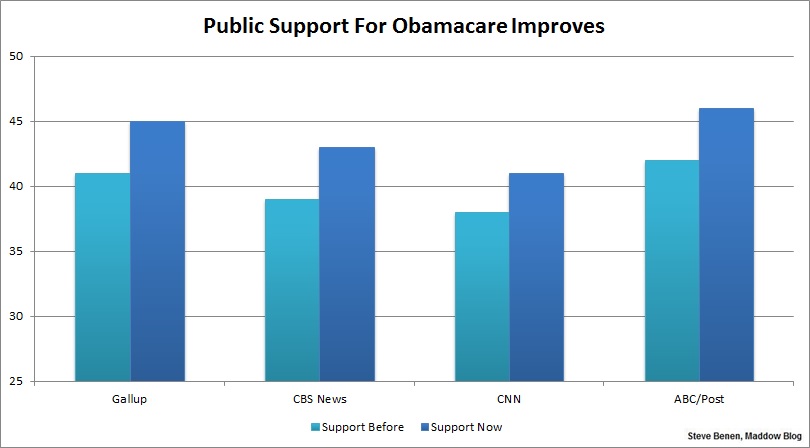
Chart of the Day: Obamacare More Popular

From Steve Benen, Obamacare’s popularity has risen in four different polls released this week:

polls.
I’m pretty confused why this is the case. Is it a backlash against Republicans for the government shutdown and debt ceiling brinksmanship? Maybe it simply reflects falling support for the Republican Party. Maybe from the Medicaid expansion? It’s surprising, given what a disaster the first couple weeks have been for HealthCare.gov. You wouldn’t expect the law’s popularity to be rising. Is this just a post-October 1st bump for Obamacare before the media began covering HealthCare.gov’s many major problems? Will support crater as the public hears more about it? I have no idea, but it’s an interesting and surprising dynamic.