PolitiFact vs. the Liberal Blogosphere

There was a bit of a dust-up between liberal bloggers and the fact checking site PolitiFact yesterday over House Majority Leader Eric Cantor’s (R-VA) comment this weekend that the government should be “focused on trying to deal with the ultimate problem, which is this growing deficit.” The deficit isn’t growing. It’s shrinking at a rapid pace, but PolitiFact rated the statement as “half-true.” So, what gives? How can the deficit be shrinking and Cantor’s statement be half-true? Let’s take a look:

Steve Benen, one of the first bloggers to jump on PolitiFact today, wrote about Cantor’s comments the day before. In fact, he quoted the following exchange in his post:

CANTOR: Here is the problem. What we need to have happen is leadership on the part of this president and White House to come to the table finally and say, we’re going to fix the underlying problem that’s driving our deficit. We know that is the entitlement programs and unfunded liability that they are leaving on this generation and the next.

WALLACE: So, are you’re saying you are willing to get — you’re willing, if you could get a compromise on entitlements, then you would give up on the sequestration?

CANTOR: What we have said in the House as Republicans, leadership and members alike, is that we want to fix the real problem. The real problem is entitlements. We’ve also said sequester is not the best way to go about spending reductions. It was, as you know, a default mechanism because Congress couldn’t do the job it was supposed to a couple of years ago. We’ve always said that. But, in fact —

WALLACE: You’re willing to give up on sequestration?

CANTOR: But, in fact, Chris, we’ve always said, president, come join us.

The full interview is here. That exchange is right before Cantor made his false “growing deficit” comment. But clearly, Cantor isn’t talking about the current debt. He’s talking about the long-term deficit. Entitlements are driving our long-term deficit while our current deficit is the result of two wars, the Bush tax cuts, and increased spending on the safety net during the recession. That’s the context of Cantor’s comment and if you are going to grade its truthfulness, you have to take that into account.

That’s what PolitiFact did. They realized that Cantor’s remark was 100% false, but in the context of what he was talking about, Cantor is right. The ultimate problem with the deficit is entitlement spending. Cantor misspoke and that’s why his statement isn’t correct. But it also can’t be called a “Pants on Fire” lie. PolitiFact responded to the criticisms today and pointed all of this out.

Kevin Drum explained this as well and noted that this is the problem with fact-checking in general. When most people think about fact-checking, they want the specific comment checked for accuracy. But this isn’t really fair. How can you analyze something without including the context? Cantor’s comment taken out-of-context is flatly wrong. In context, it makes much more sense and is more Cantor mis-speaking than anything else.

What’s most frustrating about this is that as soon as Benen posted his critique of PolitiFact, it spread around the blogosphere quickly. Paul Krugman, Ed Kilgore, Greg Sargent and Brian Beutler all criticized the fact-checking. All of those are well-respected journalists whose work I read daily. But they chose to look at Cantor’s quote out of context (except for Sargent, who put it in context of the debt ceiling when it actually referred to the problems driving the long-term deficit). Kilgore relied upon Benen’s analysis while Sargent quoted Krugman’s. It’s easy to jump on PolitiFact and make fun of Cantor for his remark, but it just creates more partisan bickering and further harms PolitiFact’s reputation. That’s not helpful for anyone.
Have Fed Chair Odds Really Changed?

First, current Federal Reserve Vice-President Janet Yellen was President Obama’s likely selection to take over for Ben Bernanke when his term expires next year.

Then, Ezra Klein reported that the race was between Yellen and Larry Summers with Summers the current odds-on favorite.

Then, Senate Democrats revolted and the liberal blogosphere exploded against Summers.

Last Friday, Klein posited that a dark horse candidate could emerge, such as Roger Ferguson.

Let’s take a moment to calm down, ignore “inside sources,” and look at what has really changed over the past couple of weeks.

1. Liberals are as hardened as ever against Summers
2. Summers’s few statements on monetary policy indicate he’d be more hawkish than Yellen.
3. WSJ analysis showed that Yellen’s economic predictions have been correct more than anyone else’s at the FOMC.
4. Wall Street overwhelmingly wants Yellen over Summers.

Numbers 1, 3 and 4 there overwhelmingly favor a Yellen selection. For most liberals, number 2 would also work in Yellen’s favor, but Obama’s recent interview with the New York Times indicates that he’s still concerned about inflation and may want a more hawkish Fed Chair, as Summers would be.

So, given all that, how can Yellen not be the favorite? Klein is well-connected within the Administration and if anyone had an inkling on which direction Obama was leaning, it’d be him. But it’s worth remembering how secretive this selection is. Here’s Wonkblog’s Neil Irwin just a few weeks ago:

The most important thing to know at this stage is this: The people who know aren’t talking, and the people who are talking don’t know.

For a decision of this much importance and sensitivity, the president is likely to rely on a very small number of senior advisers to come up with a short list of candidates and advise him on their strengths and weaknesses. For the Fed chairmanship, the process is reportedly being led by treasury secretary Jack Lew, and likely also includes Denis McDonough, the chief of staff. It probably includes Gene Sperling, the top economic adviser in the White House, and possibly Jason Furman, who has been nominated to lead the Council of Economic Advisers. Perhaps a close Obama adviser like Valerie Jarrett gets a seat at the table, and somebody from the ever-discreet presidential personnel office in the White House.

Whoever makes that exact list, those are the only people who actually know the state of play on the decision — who’s up, who’s down, what attributes the president really cares about. The details of the decision-making will remain closely held even within the White House until an announcement is imminent. And those on that short list of people actually in the know will reliably clam up and reveal absolutely nothing when the topic comes up, whether it is with a former colleague outside government or a reporter, even when off the record.

Former White House economic adviser Jared Bernstein said the same thing last week:

No one knows who it will be.  Sure, there’s a short list and Summers and Yellen top it–btw, I wrote those names in no other order than alphabetical.  I would very heavily discount anything you read that says anything much more than what I’ve just told you.

I’m actually a bit surprised to see Klein buying into all of this back-and-forth about who’s leading the race. Maybe he has great sources or the Administration was using him to see potential reaction to choosing Summers. Either way, the developments over the past few weeks would seem to increase the chances of Obama choosing Yellen, not hurt them. Will Yellen be the eventual selection? Maybe. Maybe not. We’re not going to know for a while. But don’t discount her because a few rumors hint at the President leaning in a different direction. The fundamentals still point to her and if anything, have only improved over the past few weeks. She’s still the odds-on favorite to be the next Fed Chair.

Rolling Stone’s Despicable Cover

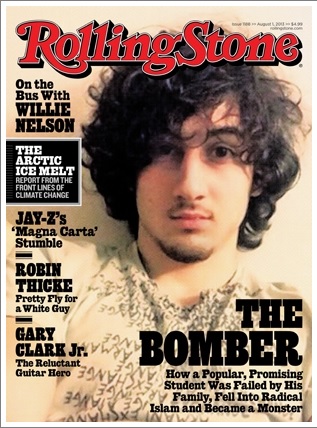
The new edition of Rolling Stone magazine is out and its cover is truly reprehensible. It has a full image of Boston Bomber Jahar Tsarnaev, looking more like a rock star than a terrorist. In fact, Tsarnaev looks good on the cover! It’s a glamour shot of him. Here it is:

Rolling Stone Cover

Boston Bomber Jahar Tsarnaev.

After a shooting in Portland, Oregon last year and right before the tragedy in Newtown, Forbes Joseph Grenny penned an excellent post (which I expanded on here) about the coverage of mass shootings and how the press must do better. Here’s the important part:

But my horror was twofold. The first misery came as I heard the names and numbers of victims and thought about the pain they and their families will endure for the rest of their lives. The second dose came as I held my breath, hoping and praying the media wouldn’t amplify the violence.

But they did.

They did exactly what they needed to do to influence the next perpetrator to lock and load.

  1. They named the shooter.
  2. They described his characteristics.
  3. They detailed the crime.
  4. They numbered the victims.
  5. They ranked him against other “successful” attackers.

Public shootings are a contagion. And the media are consistent accomplices in most every one of them.

The Boston Bombing is a bit different than a mass shooting. The Tsarnaev brothers weren’t motivated by fame or trying to “outnumber” past killers. Terrorist attacks of that sort aren’t fueled by that. In this case, the brothers were motivated by extremist Islamic beliefs and a deep hatred for America.

But, nevertheless, Rolling Stone‘s cover still glamorizes the attack. Future potential terrorists won’t see it as further incentive to attack our country (as noted above, that’s not what incentivize them), but other madmen may. Future potential mass murderers may see the cover and think that they could one day find themselves on there as well. What kind of message is that for Rolling Stone to send?

The story has a number of interesting details about Jahar and his brother’s decent into radical Islam. It’s worth reading and provides an invaluable look into their lives. But there is no reason for Rolling Stone to put Jahar on the cover whatsoever, especially not a glamour shot of him. The less we do to spotlight terrorists and mass shooters while still investigating stories, the better. With its recent cover, Rolling Stone failed mightily.