S.E. Cupp’s Absurd Argument

I rarely have time to watch TV during the day, but over break, I caught a bit of MSNBC’s The Cycle yesterday. At the end, conservative host S.E. Cupp gave her take on the current gun control argument in America. It’s online as well. Here’s the most infuriating part:

If you truly believe that guns are the problem, then the only intellectually honest argument is to eliminate them all. Focusing only on assault weapons is a cop-out. In 2010, a mere 2.8% of homicides were committed with an assault weapon, while 42.6% were committed with handguns. And during the 10-year federal ban on assault weapons, numerous mass shootings–including Columbine–still took place. Making it harder to obtain a gun is (sorry about the wording) half-assed. Adam Lanza apparently stole his guns from his mother, who legally purchased and owned them. Gun control advocates should want her guns, and all legal guns, banned, too.

“Gun free” zones don’t cut it either. Because would-be murderers like Cho Seung-Hui, Lanza, and Major Nidal Hassan, don’t respect those artificial boundaries. But aside from the constitutional impossibility of eliminating all guns, prohibition hasn’t proven to be useful in eliminating, well, much of anything, including illicit drugs and, yes, illegal weapons. There are mass shootings even in countries with the strictest of gun laws. And someone intent on killing a lot of people doesn’t need a gun to do it. So if we know that banning certain guns won’t stop gun violence, that gun-free zones don’t protect the people inside them, and that eliminating all guns is impossible and ineffective, then what workable solutions are gun control advocates actually bringing to the table when they say they want to have a “real conversation?”

She then goes on to focus on mental health care for a bit. But hearing that part made my blood boil.

First off, it’s not intellectually dishonest to argue for stricter gun control policies without trying to eliminate them all gun. It’s a remarkably idiotic remark from Cupp (normally I refrain from name-calling, but Cupp’s argument is just too insulting). Her argument basically boils down to “If stricter gun regulations won’t eliminate all shootings, why even bother?”

No gun control advocate is arguing that guns are the only cause of mass shootings. Nor are they arguing that gun control measures will eliminate all gun violence. The goal is to reduce shootings while protecting second amendment rights. And Cupp asks for some workable solutions. Well here you go:

  • A ban on high-capacity magazines accomplishes that goal.
  • Stricter background checks and closing the “gun show” loophole accomplishes that goal.
  • An assault-weapons ban accomplishes that goal.
  • Better access to mental health care accomplishes that goal.

In addition, there are gun-control advocates who want to eliminate all guns (I’m not one of them). But they understand that the elimination of all guns is, as Cupp says, a “constitutional impossibility.” So, instead, they propose realistic policies. What is intellectually dishonest about advocating for a practical, realistic policy to reduce gun violence, even if it’s not your preferred policy?

And just because a policy wouldn’t stop certain past mass shootings is not a reason for not adopting that policy. That argument is what’s really a cop-out.
Switching to Chained-CPI and How Politicians Spin it

I’m getting a bit annoyed at the liberal blogosphere about how they’re spinning the proposal to use chained-CPI for Social Security. Here’s Ezra Klein:

The way we measure inflation right now really does mismeasure inflation. Chained-CPI really is a bit more accurate. But that’s not why we’re considering moving to chained-CPI. If all we wanted to do was correct the technical problem, we could make the correction and then compensate the losers.

But no one ever considers that. The only reason we’re considering moving to chained-CPI because it saves money, and it saves money by cutting Social Security benefits and raising taxes, and it’s a much more regressive approach to cutting Social Security benefits and raising taxes than some of the other options on the table.

The question worth asking, then, is if we want to cut Social Security benefits, why are we talking about chained-CPI, rather than some other approach to cutting benefits that’s perhaps more equitable? The answer is that chained-CPI’s role in correcting inflation measurement error is helpful in distracting people from its role in cutting Social Security benefits. Politicians who are unwilling or unable to offer a persuasive political or policy rationale for cutting Social Security benefits are instead hiding behind a technocratic rationale. We’re not “cutting benefits,” we’re “correcting our inflation measure.”

Emphasis mine. I sympathize with Ezra’s annoyance here. Switching to chained-CPI is being billed as a “technical fix.” If we wanted to implement such a technical fix, we don’t need it to be part of a grand bargain. Social Security benefits should increase with inflation. If we’re using the wrong measure of inflation, then we need to fix that. The reason Republicans are so set on fixing it now is because their ultimate goal is to cut benefits, not to correct the inflation measure. Thus, Ezra’s right when he says:

We’re not “cutting benefits,” we’re “correcting our inflation measure.”

However, Ezra makes the exact same error in the bolded section above. Continue reading “Switching to Chained-CPI and How Politicians Spin it”

Are Senators Warner and Manchin “Shameless + Untrustworthy?”

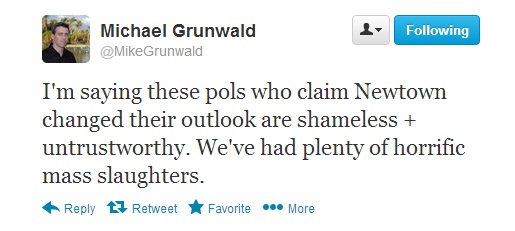
Here’s a tweet from Time Magazine writer Michael Grunwald:

grunwaldI tweeted with Mr. Grunwald briefly about this and I don’t quite agree. He’s referring to the separate remarks by Senator Mark Warner (D-VA) and Senator Joe Manchin (D-WV) stating that they’ve changed their opinions on gun control and now want stronger regulation.

Grunwald tweeted: “I’m suggesting they’re not really switching their opinion, and people shouldn’t get their hopes up” and “But in our business we don’t have to pretend awful opportunists aren’t awful opportunists. Aurora was shattering too.”

The question comes down to whether you believe Warner and Manchin changed their opinions for political purposes or really had a change of heart. Certainly, none of us knows for sure, but it’s unfair to rule out a change of heart.

Grunwald believes that Virginia Tech, Aurora and every other mass shooting would have been enough to change their minds. The fact that Warner and Manchin are doing so after Friday’s tragic events and now that there is desire for greater gun control demonstrates not a change of hearts, but a politically-motivated decision.

Maybe that’s so, but I’m not so sure.

The reason is: this time is different. It’s sad, but it’s true. The shooting at Newtown has hit people across the country harder than the ones in Aurora and in Oak Creek. Part of it is the sheer number of tragedies this year – there have been 13 shootings with multiple fatalities just in 2012. But it’s more than that.

It’s different from Aurora, Oak Creek and others. This was a targeted attack on the most innocent people in our country in one of the most innocent locations. If an elementary school in a safe town is not safe, nowhere is. That’s not to say that shootings in a movie theater or a temple should not cause widespread outrage and provoke demands for more gun control. But the shooting at Sandy Hood caused an even greater emotional response for the precise reason that it targeted little kids.

That’s what sets Newtown apart from all of the other tragic shootings.

It’s why the petition for the Obama Administration to address gun control has received a record number of signatures. It’s why people everywhere are shaken and demanding new legislation. It may just be why Senators Manchin and Warner have changed their minds.

If it turns out that they are doing so just to gain political points, then Grunwald is right, that is shameless, untrustworthy and revolting. That would be a new low for American politics and I sincerely hope it is not the case. Until I see evidence proving that, I’m willing to give them the benefit of the doubt