When You’re in Office, Govern

Chris Cilliza wrote a post yesterday warning Democrats to be careful about changing the filibuster rules as Senate Majority Leader Harry Reid is considering for nominations to cabinet and agency positions. He says that if Democrats change the rules now just for those positions, expect Republicans to take it a step further if they take control of the chamber in 2014:

But, politics works on the slippery slope principle. That means that if Democrats cross the line to change a rule to benefit them when they are in the majority, it sets a precedent for rule-changing that is not limited to filibusters on agency and cabinet nominees in future Senates — including those controlled by Republicans.

This may entirely be true, but I still think Harry Reid should go nuclear. Why? Because if the GOP takes control of the upper chamber in the midterm elections, they may change the rules anyway. Republicans have been clamoring for years about the oppressive regime of Barack Obama. If they keep the House and take the Senate next year, but Senate Democrats begin filibustering every piece of legislation, do you think they are just going to accept defeat as Democrats have? I’m very skeptical of that. The Tea Party base will rally in a hurry and demand that Republicans fix the filibuster. After all, Democratic obstruction in the Senate would just become an extension of the authoritarian stranglehold Obama has on the legislative process. Whether or not Reid decides to change the rules now, he should at least work under the expectation that Republicans are going to strongly consider changing the rules in the future anyways.

But there’s also a more simple reason to change the rules: when you’re in office, govern. I think it was Michael Grunwald who tweeted this a ways back (I can’t find it now), but it’s stuck with me. It’s why I think Democrats should (and have) compromised on immigration reform. When you have the presidency, use it. When you have the Senate, use it. President Obama has inexplicably been historically slow at nominating judges. That fault lies entirely on him (and Senator Leahy). The confirmation process has been just as slow. But there are other positions (NLRB spots, CFPB head Richard Cordray) that Republicans have filibustered simply because they don’t like the agencies. Sorry, that’s not how government works. If you don’t like an agency, pass legislation to amend it or abolish it. Don’t filibuster the heads of those departments to prevent them from operating. That’s just as illegal as President Obama’s regulatory end-around on the employer mandate.

The President took a chance in “recess” appointing his NLRB nominations and Cordray, but one court has already ruled that Obama overstepped his authority with the NLRB appointments and others will follow. That puts all of the agencies’ current actions in jeopardy. It’s long past time the GOP gave them an up or down vote. If the President cannot fill simple vacancies like these, then government cannot function. Republicans will just refuse to confirm the leaders of any agency they dislike. That’s not how government works and the Reid must finally stand up and say, “Enough is enough. Give us a vote or get out of our way. You can do what you when you’re in power and see what happens, but right now we have control.”

The NLRB and CFPB deserve to operate with the full-extent of their powers.

President Obama and Harry Reid should listen to Grunwald: When you’re in office, govern.

Let’s Have a National Referenda on Key Issues

Gallup is out with a poll today on political reform. Here are the results:
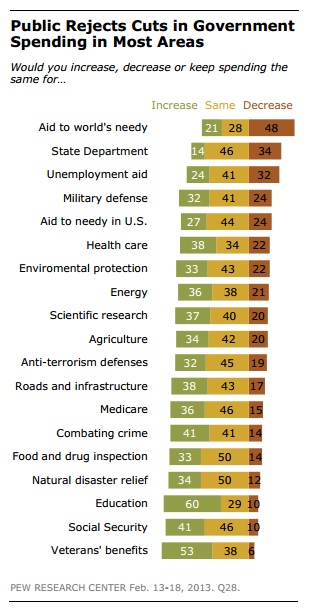
national referendaObviously, a national referenda isn’t going to happen. But if we did, it would clearly show that the vision most Americans have for their government is not realistic.Public Rejects Cuts

For instance, a Pew poll in February found that 70% of Americans, including 65% of Democrats, wanted the President and Congress to act on deficit-cutting legislation this year. But another Pew poll released just a day (PDF) later found that Americans don’t want to cut any individual programs except foreign aid (to the right).

Of course, it’s not that surprising that no one wants to cut any of those programs. They all sound very useful. But how are we going to reduce the deficit – as voters say they want – if we don’t cut anything. Well, how about we raise taxes? I’m very confident in saying that if we put tax increases up for a national referenda, it would lose badly.

Here we get to an impasse. Voters don’t want to cut individual programs, don’t want higher taxes but want to reduce the deficit. Those three things together are not possible. In the mean time, voters get angry when spending cuts pass (they don’t like the sequester), hate higher taxes (remember how hard it was to raise taxes on the richest Americans?) and are demanding cuts to the budget deficit. One party demands spending cuts, the other wants higher taxes and both clamor about the budget deficit. This all stems from a fundamental misunderstanding of the capabilities of the US government.

Maybe a national referenda is just what we need – at least then Americans would have a better understand of what its government can and cannot do.

Yes, Barnes & Noble is in Trouble

Wonkblog’s Lydia DePillis pushed back against Matt Yglesias that Barnes & Nobles is in a failing business. She cites a couple of reasons that the industry’s decline is not inevitable. Here’s a quick summary:

1. Barnes & Noble retail posted a tidy $374 million profit for FY2013 (not last quarter as DePillis writes, but still strong). That’s a rise of 16% compared to 2012.

2. The company runs around 700 college bookstores across the country.

3. Publishers dislike Amazon and may offer B&N discounted prices to fight the online giant.

Let’s pick these apart a bit.

First, about the profit. B&N retail had a solid performance in 2013, but those figures mask the structural problems the company faces. Over the past two years, the firm has closed 30 stores and opened just one new one. At the same time, retail sales have been falling. A couple of things to bear in mind here. Books are a leisure item that people easily cut back on when times are tough. Thus, it’s no surprise to see sales dropping after the recent recession. But the combination of the recent recovery and the closure of B&N’s main competitor (Borders) should have given its revenue a boost. Instead, sales dropped 6% last year. That $374 million profit is not a result of growing revenue, but of closing stores and cutting costs. That’s great for a company, of course, but it masks the realities of the bookstore retail business. Readers are still turning to e-books and Amazon over the regional bookstore. At some point, B&N is only going to be able to cut costs so much. This can be seen in the company’s fourth quarter profit of $51 million, a 24% drop from 2012.

In Barnes & Noble’s college bookstores, there’s more hope for the company, but still major issues. These stores are a lucrative business. Students have to buy textbooks for class and publishers jack up the prices, leaving everyone with a nice profit and students with holes in their wallets. Reading a textbook is unlike reading a normal book. Students take notes, active read and solve problems in the margins. It’s very helpful to have a physical copy of the book and not a digital one. This means that revenues for these stores may stay strong. That’s what we see in the company’s recent filings, where sales from college bookstores rose slightly to $1.643 billion (although that’s still below the FY2011 level). Overall, the firm’s college stores had profits of $111 million, slightly below 2012 levels but that was mostly due to digital investments the company made. The firm has increased its digital textbook footprint and is offering textbook rentals as well. Sounds like a solid business, right? Well, maybe not.

The problem is that the landscape for college bookstores is changing as well. It just hasn’t shown up in the numbers yet. More and more students are turning to online textbook stores or are starting to rent books instead. The National Association of College Stores recently released a report that noted that the college textbook market is basically unchanged since 2006 even while college enrollment has increased nearly 25%. The graph below shows the story:

2013_Enrollment_graph

The monopoly power that textbook stores once had over students is rapidly disappearing. Local bookstores and online retailers have seen the opportunity to undercut school stores and offer students a lower price for the same books. Students, many of whom are on scholarship and are less attentive to textbook prices, are realizing that they can save a lot of money by shopping off-campus.  So while the firm posted increased revenue in 2013, don’t expect that to continue. B&N itself expects bookstores sales to decline slightly next year.

As for DePillis’s last point, I don’t know much about it. She offers it as a hypothetical and maybe she’s right. But if the company is relying on publisher’s hatred of Amazon to survive, that’s not a sustainable business model.

This doesn’t mean that the retail bookstore industry is entirely dead. Local stores can certainly survive and prosper as the big retail giants fade away. As DePillis notes, the community franchise model is certainly a possibility for Barnes & Noble. Selling off the failing Nook business, taking the company private, reducing store size and offering a local bookstore with a national supply chain could be a very profitable business. But the end of giant retail bookstores is rapidly approaching. If Barnes & Noble doesn’t want to follow Borders into bankruptcy, it better act fast.