Glass-Steagall Returns

Anyone who has studied the financial crisis knows that Glass-Steagall wouldn’t have prevented it. Glass-Steagall was the law that required commercial banks and investment banks to be separate businesses. Basically, investment banks couldn’t gamble with commercial bank deposits. In 1998, Bill Clinton signed the repeal of the law and investment banks began merging with their commercial counterparts.

Except the banks that failed during the financial crisis weren’t combo investment and commercial banks. Lehman Brothers and Bear Stearns were both investment banks. AIG was an insurance company. Countrywide and Washington Mutual were just commercial banks. Undoubtedly, having Glass-Steagall in place would have lessened the damage of the crisis slightly, but it wouldn’t have come close to prevent it.

Now, Senators Elizabeth Warren (D-MA) and John McCain (R-AZ) are out with a bipartisan bill that would reinstate the law. Kevin Drum isn’t impressed:

I’m in favor of smaller banks, and I suppose that splitting up the big universal banks would accomplish that. But either Congress is willing to split up the big banks or it isn’t. If it’s not, then McCain-Warren bill won’t pass. It it is, there are far better ways of doing it.

For my money, I wouldn’t bother at this point. I’d simply mandate higher capital requirements for everyone, and much higher capital requirements for the biggest banks on a sliding scale. That would automatically put pressure on banks to stay smaller, and it would make them safer regardless of their size. It’s a better, simpler way to go.

I think Drum is missing an important point here: reinstating Glass-Steagall has greater name recognition than any other bills. Americans hated the bank bailouts. They still dislike the banks and a number of Congressmen still are concerned with Too Big To Fail. There actually is motivation from both sides to enact a law that would restrict the size of major banks. No legislation is close to passing and bank lobbyists will flood with the capital with both money and threats if anything appears close to passing. But if Congress is going to find a way to pass something, Glass-Steagall is its best shot. That’s for two reasons:

There is public support for reinstituting Glass-Steagall.

There is public support for reinstituting Glass-Steagall.

1. People have heard of Glass-Steagall. They may not know much about it, but lots of people have vaguely heard the name. They may remember that banks were overjoyed went it was repealed in the late 1990s. They may remember some analysts (wrongly) arguing that Glass-Steagall could have prevented the crisis. It’s not a large mass of people, but it’s a larger group of people than will have heard of any other potential law. Senators Sherrod Brown (D-OH) and David Vitter (R-LA) have also authored a bill designed to combat TBTF – mostly by ramping up capital requirements (as Drum wants). But which potential bill do you think will have greater name recognition? Which would people support more?

2. Intuitively, Glass-Steagall makes sense. Explaining capital requirement is not easy as Matt Yglesias noted earlier this week. But telling banks that they can’t gamble with the money you deposited? Well, that just seems like a no brainer. Congressmen will find it much easier to explain to their constituents the reinstitution of Glass-Steagall than a new law. Banks are going to be up in arms no matter what. A straightforward, simple explanation to voters would help both Democrats and Republicans find the political cover to go against the big banks. Glass-Steagall offers that.

Now, Glass-Steagall isn’t the best way to break up the banks. And it shouldn’t be looked at as a fix to the financial crisis – as noted above, the repeal of Glass-Steagall did not cause the crisis. But it’s the bill with the greatest chance of passing Congress that reduces bank risk and makes the financial system safer. That’s worth doing.

So, I disagree with Drum. I don’t think it is as simple as “either Congress is willing to split up the big banks or it isn’t.” For any two obscure, complicated bills, that would be the case. But Glass-Steagall has two things going for it that others don’t and we would be foolish to throw away those advantages for a slightly better, but ultimately doomed bill.

When You’re in Office, Govern

Chris Cilliza wrote a post yesterday warning Democrats to be careful about changing the filibuster rules as Senate Majority Leader Harry Reid is considering for nominations to cabinet and agency positions. He says that if Democrats change the rules now just for those positions, expect Republicans to take it a step further if they take control of the chamber in 2014:

But, politics works on the slippery slope principle. That means that if Democrats cross the line to change a rule to benefit them when they are in the majority, it sets a precedent for rule-changing that is not limited to filibusters on agency and cabinet nominees in future Senates — including those controlled by Republicans.

This may entirely be true, but I still think Harry Reid should go nuclear. Why? Because if the GOP takes control of the upper chamber in the midterm elections, they may change the rules anyway. Republicans have been clamoring for years about the oppressive regime of Barack Obama. If they keep the House and take the Senate next year, but Senate Democrats begin filibustering every piece of legislation, do you think they are just going to accept defeat as Democrats have? I’m very skeptical of that. The Tea Party base will rally in a hurry and demand that Republicans fix the filibuster. After all, Democratic obstruction in the Senate would just become an extension of the authoritarian stranglehold Obama has on the legislative process. Whether or not Reid decides to change the rules now, he should at least work under the expectation that Republicans are going to strongly consider changing the rules in the future anyways.

But there’s also a more simple reason to change the rules: when you’re in office, govern. I think it was Michael Grunwald who tweeted this a ways back (I can’t find it now), but it’s stuck with me. It’s why I think Democrats should (and have) compromised on immigration reform. When you have the presidency, use it. When you have the Senate, use it. President Obama has inexplicably been historically slow at nominating judges. That fault lies entirely on him (and Senator Leahy). The confirmation process has been just as slow. But there are other positions (NLRB spots, CFPB head Richard Cordray) that Republicans have filibustered simply because they don’t like the agencies. Sorry, that’s not how government works. If you don’t like an agency, pass legislation to amend it or abolish it. Don’t filibuster the heads of those departments to prevent them from operating. That’s just as illegal as President Obama’s regulatory end-around on the employer mandate.

The President took a chance in “recess” appointing his NLRB nominations and Cordray, but one court has already ruled that Obama overstepped his authority with the NLRB appointments and others will follow. That puts all of the agencies’ current actions in jeopardy. It’s long past time the GOP gave them an up or down vote. If the President cannot fill simple vacancies like these, then government cannot function. Republicans will just refuse to confirm the leaders of any agency they dislike. That’s not how government works and the Reid must finally stand up and say, “Enough is enough. Give us a vote or get out of our way. You can do what you when you’re in power and see what happens, but right now we have control.”

The NLRB and CFPB deserve to operate with the full-extent of their powers.

President Obama and Harry Reid should listen to Grunwald: When you’re in office, govern.

Let’s Have a National Referenda on Key Issues

Gallup is out with a poll today on political reform. Here are the results:
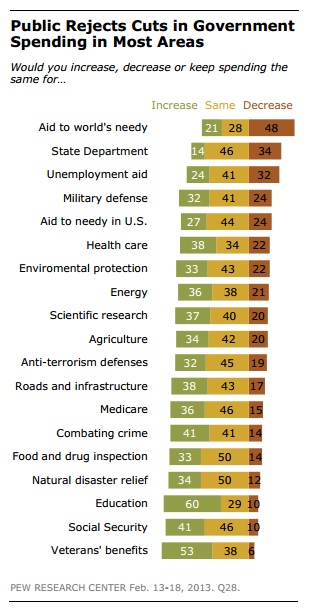
national referendaObviously, a national referenda isn’t going to happen. But if we did, it would clearly show that the vision most Americans have for their government is not realistic.Public Rejects Cuts

For instance, a Pew poll in February found that 70% of Americans, including 65% of Democrats, wanted the President and Congress to act on deficit-cutting legislation this year. But another Pew poll released just a day (PDF) later found that Americans don’t want to cut any individual programs except foreign aid (to the right).

Of course, it’s not that surprising that no one wants to cut any of those programs. They all sound very useful. But how are we going to reduce the deficit – as voters say they want – if we don’t cut anything. Well, how about we raise taxes? I’m very confident in saying that if we put tax increases up for a national referenda, it would lose badly.

Here we get to an impasse. Voters don’t want to cut individual programs, don’t want higher taxes but want to reduce the deficit. Those three things together are not possible. In the mean time, voters get angry when spending cuts pass (they don’t like the sequester), hate higher taxes (remember how hard it was to raise taxes on the richest Americans?) and are demanding cuts to the budget deficit. One party demands spending cuts, the other wants higher taxes and both clamor about the budget deficit. This all stems from a fundamental misunderstanding of the capabilities of the US government.

Maybe a national referenda is just what we need – at least then Americans would have a better understand of what its government can and cannot do.