Question for Felix Salmon on Charitable Giving

Reuter‘s Felix Salmon wrote a blog post a few days ago on charitable giving and how the internet allows random acts of kindness. However, at one point Salmon asserts something and makes the rare error of not citing or linking to supporting evidence for his assertion:

The fact is that almost none of us have some kind of annual giving budget, from which we draw when we send money to someone like Karen Klein. Instead, we give as and when we’re moved to do so. Once you start giving money away, you’re more likely to give money away in the future; Stevenson’s implication, by contrast, is that giving money in one place makes you less likely to give money somewhere else. Which is completely wrong.

The first part of that paragraph I believe, but is it really true that once you start giving money, you’re more likely to give more in the future? When is “the future” exactly? For instance, if i give to a charity in April, am I then more likely to give in June? Or not until next year when I’ve earned more money (or in my case, hope to have earned more money)? I wish Salmon had linked to a study or any academic literature that shows this.

Also, at the extreme, giving money in one place DOES make you less likely to give to another. If you give your last $20 to one charity, there’s nothing left for you to give to another. Of course, that’s the extreme, but there has to be some point where an individual giving money to once charity makes them less likely to give elsewhere. That point may vary with each individual, but it does exist and Salmon seems to act here like it doesn’t.

Nevertheless, I agree with Salmon that the advent of the internet has changed how people give and charities must react to these changing times. Will this lead to a rise in charitable giving? I hesitantly say yes, but I’m not sure. Will it lead to less giving to charities and more to individual people? I’m very unsure about that, but it will be interesting to see how it plays out.

GOP Chooses Big Business Over Free Markets

I don’t link to other articles and blog posts on here enough. I’m trying to do it more. So here’s a piece by Ezra Klein on former Republican Study Committee staffer Derek Khanna and his support for more relaxed intellectual property laws, starting with allowing consumers to legally unlock their cell phones and to create a backup of legally purchased DVDs. In November, Khanna wrote a memo for the RSC on how to reform copyright law. It was filled with great ideas and received widespread praise across the blogosphere. Unfortunately, Republican congressmen immediately faced significant pushback from Big Business, which is very happy with the current restrictive copyright regime. The RSC pulled the memo after a few hours and informed Khanna a few weeks later that he would not be retained at the start of the new Congress. Big Business had won.

Here’s Klein:

There’s a difference between being the party of free markets and the party of existing businesses. Excessively tough copyright law is good for big businesses with large legal departments but bad for new businesses that can’t afford a lawyer. And while Khanna, like many young conservative thinkers, believes in free markets, the Republican Party is heavily funded by big businesses.

If Republicans really were for free markets, they would openly embrace Khanna’s reforms, such as stricter term limits on copyright, expanded fair use and reduced statutory damages. These policy ideas push government policy towards free markets and less regulation. As Khanna writes at the end of his memo, “[c]urrent copyright law does not merely distort some markets – rather it destroys entire markets.”

By ignoring and refuting Khanna’s ideas, Republicans are confirming what many Americans already believe: the GOP is the party of the rich and Big Business. Republicans cannot claim to be in favor of free markets and small government when they oppose such sensible reforms that would reduce government overreach in intellectual property law. It’s hypocritical to claim otherwise. At the same time, this is the perfect opportunity for Republicans to improve their image. Supporting copyright reform would prove to Americans that they are still the party of free markets.

Alas, there have been no sign that the GOP will embrace Khanna’s ideas. As for the young Republican, he’s pushing ahead promoting intellectual property reform and just earned White House support for allowing consumers to unlock their cell phones. That’s a big victory for Khanna, but there is lots more work to be done. Unfortunately, it doesn’t look like he’ll have Republican support in his pursuit of freer markets.

Why Republicans Should Care Even More About the Sequester

The sequester officially hits on Friday and at this point, there’s no chance of avoiding it. If Congress and the President agree on a deal, when that deal is struck will determine how much damage the sequester ultimately causes.

The White House and Republicans have spent the last week not trying to avoid the cuts, but trying to lay the blame at the other’s feet. The GOP has ardently pushed the line that President Obama came up with the idea for the sequester and thus is responsible for it. The Administration has tried to scare the public and Congress into a deal by demonstrating how bad the cuts will be (cuts to teachers, airline delays, etc.). Yesterday, they released a state-by-state breakdown of how the cuts will effect different departments and programs in every state. The Washington Post has a nice interactive graphic of it here.Sequester state by state

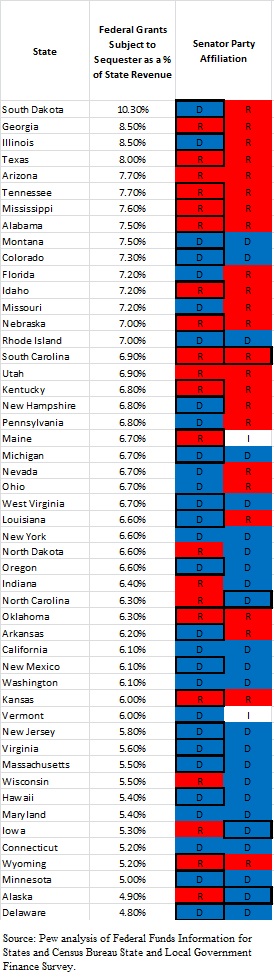
As I read Wonkblog today, I came across a post detailing the states who receive the most in federal aid as a percentage of state revenues and thus are most exposed to sequester cuts. This wasn’t using White House data, though. It’s from a Pew Center of the States study from last December. That got me thinking: the senators of states more exposed to the sequester should have an even greater incentive to push for a deal to avert it. So, I went through Pew’s data and combined it with the partisan identity of the senators in each state. The result is to the right.

The states most exposed to the cuts are undeniably states with Republican Senators. Of the 20 states most exposed, 28 of the 40 senators in them are Republicans. In the 20 states least exposed, just 11 of the 40 senators are Republicans (28 are Democratic with one Independent). This isn’t a surprise though: Republican states receive a large share of federal funds and thus steep cuts to those dollars will hurt those red states the most. Given that, Republicans should have even greater incentive to cut a deal.

Now, let’s say that Republicans are worried enough about the deficit that they can swallow the cuts, even if they predominantly impact Republican states. What about the political prospects of senators in those states? The public is going to be upset with these steep funding cuts as polling shows that no one actually wants to cut anything outside of foreign aid. Senators in states who face deep budget cuts from the sequester are going to face a disgruntled constituency. Those up for reelection in 2014 will be at the greatest risk of voters giving them a one-way ticket out of Washington.

Thus, I went through and outlined each senate seat up for election in 2014 in bold. Here, neither Democrats or Republicans are in particularly good shape. In 2014, 36% (10/28) of Republican Senators in the 20 most exposed states are up for reelection while just 27% (3/11) of Republicans seats are up for grabs in the 20 least exposed states. The is true for Democrats as well. Of Democratic Senators in the most exposed states, half (6/12) are up for reelection, but in the least exposed states, just 39% (11/28) of Democratic seats are up.

What does this all mean?

While both Republican and Democratic senators are going to find themselves with a lot of angry constituents post-sequester, Republican senators are going to face even greater wrath. This should give them a further incentive to make a deal. Nevertheless, they have refused to consider any additional revenue thus far and without relaxing that demand, no deal is going to be struck. At this point, it looks like the GOP would rather accept the cuts and deal with angry constituents instead of cutting a deal with more revenue in it.

As for those up for reelection in 2014, they have significantly more incentive to make a deal as well, but this doesn’t seem to be having much of an effect on their decision-making either. Republican senators up for reelection in 2014 whose states will be deeply affected by the cuts still won’t agree to additional revenues and Democratic senators are not going to accept that, even if they are up for reelection in 2014 and reside in a state severely impacted by the sequester as well.

In the end, which states are most exposed to the sequester and how it affects different senators’ reelection prospects doesn’t seem to be impacting the negotiations at all. That’s not particularly surprising to me, but in 18 months, we may see some senators who wished that they’d advocated for a compromise harder.