Good for Balthazar for Getting Rid of its Bathroom Attendants

Henry Blodget caused a bit of a stir last week when he penned a diatribe against the bathroom attendants at the New York restaurant, Balthazar. Here’s a sample of it:

I always forget that Balthazar makes a guy stand in the tiny bathroom all day, so whenever I open the Balthazar bathroom door after breakfast, I am hit by the same series of unpleasant emotions: Annoyance, guilt, pity, uncomfortable invasion of personal space, and then… extortion.

I go through this internal dialogue and series of emotions every time I enter the Balthazar bathroom. And it makes me hate Balthazar and never want to come back. And then, over time, I forget the Balthazar bathroom experience, and remember only the dining room and meal. And then, eventually, I go back.

But this is a terrible practice — this “bathroom attendant” thing.

It is never helpful.

It is never anything other than uncomfortable and degrading.

It is never a “service” that I look forward to or enjoy.

So I am hereby appealing not just to the bosses at Balthazar, but to restaurateurs and hoteliers all over the world, to eliminate it.

Lo and behold, Balthazar took his advice. Owner Keith McNally announced today that he will be relieving the bathroom attendants of their duties over the next few weeks. In the end, he said, he agreed with Blodget so the bathroom attendants will be no more.

In finding this out, Blodget reacted on Twitter with remorse and wished that McNally had hired them as waiters instead. But this doesn’t make any sense. If McNally agrees with Blodget and does not see a purpose for the attendants, then he should get rid of them. If he has an opening on his wait staff, then he should fill it. But hiring extra waiters for the sake of hiring isn’t a good business strategy.

It’s certainly sad that those workers have lost their jobs, but our economy works best when companies take advice from their customers and make changes to their businesses accordingly. Capitalism dictates that companies have the ability to fire workers it deems expendable and workers can leave jobs for better ones. McNally made that decision. He should not feel compelled to continue employing them just because he eliminated their positions.

There is a larger point here as well. We’re into President Obama’s second term and the economy is still barely recovering. These firings wouldn’t be as painful if the workers knew they had a high chance of finding a new job in the near future. Unfortunately, our government (read: Republicans) has done everything in its power to lower those odds. Sequestration is a moronic policy that is significantly reducing growth. The government shutdown harmed the economy and fiscal brinksmanship does so well. Bipartisan agreement to let the payroll tax cut expire is holding back the economy too. These are just the ways Congress is actively harming the economy. It should be actively helping it by passing infrastructure bills and immigration reform. The Balthazar bathroom attendants would have a much greater chance of finding a new job if Congress wasn’t actively trying to stop them from doing so.

It’s a sad state of affairs that eliminating pointless jobs will cause such an uproar. These positions simply unnerved customers and guilt-tripped them into tipping. They should be eliminated, but the workers should also be able to find new employment in positions that use their skills better (anyone can turn on a faucet and hand out paper towels) and provide a greater benefit to society. The abomination here isn’t McNally eliminating those jobs or Blodget’s post that led him to do so. It’s the government’s inability to help Americans get back on their feet and recover from the Great Recession. Direct your anger there.

Mike Lee Is The Tea Party’s Resident Wonk

Mike Lee speaks at Heritage.

Mike Lee speaks at Heritage.

Last week, Sen. Mike Lee (R-Utah) delivered an address at the Heritage Foundation focused on the future of the Republican Party, on both political and policy grounds. What many people don’t realize is, he might just be that future.

Lee has played second fiddle to Sen. Ted Cruz (R-Texas) for much of his first term in Congress, but that is changing. Many political commentators have noted that disagreements within the Republican Party focus more on tactics than on policy. No one represents this divide better than Lee.

His tax plan is the most serious piece of Republican legislation that anyone in the party has proposed since Obama took office. He does away with the conservative dream of a flat tax and instead opts for a two bracket system, a 15% rate for individuals making less than $87,850 (double for married couples) and 35% for those making more. The focal point of the plan is a new $2,500 tax credit for every child a family has. Most importantly, the credit applies to both income and payroll taxes so that low-income families who don’t itemize can take advantage of it as well. Lee would also cap the mortgage interest deduction, create a new charitable deduction that’s available to all tax filers and gets rid of the deduction for state and local taxes. The plan aims to collect revenues equal to about 18-20% of GDP.

Wonks and political analysts all over the internet praised Lee’s proposal. but it has received limited attention on the national stage. Instead, Lee is most well-known for the government shutdown, of which he was a fierce supporter. The futile strategy has sent Lee’s approval rating plummeting, with many Utahns insisting that the senator become more willing to compromise. But Lee’s tax plan is a compromise. He doesn’t insist on absurdly low revenues or a huge tax cut for the rich. It’s unclear how progressive (or regressive) the plan is, but it’s a legitimate opening proposal. That’s exactly what Utahns want.

This is what makes Lee’s decision to become Ted Cruz’s sidekick all the more intriguing. Lee could become the face of a new, serious, policy oriented wing of the Republican Party, taking cues from conservative reformists such as Ross Douthat, Reihan Salam and others. Why become a wacko bird and build a reputation as a non-serious thinker? Few people outside of Utah and Washington know of Mike Lee and those who do don’t think of him as a wonk, but that’s exactly what he is.

At Heritage, Lee spoke in platitudes about the future of the Republican Party. More policy proposals will come in future speeches, but he did touch on a couple of other topics that are legitimate conservative ideas as well. He proposed reducing the gas tax over time, putting states in charge of the nation’s highways and mentioned that states could fund it with congestion pricing. In education, Lee wants to give states the right to determine accreditation for student aid. However, the main focus of the speech was pushing the party to adopt a new policy agenda:

By the time we reach November 2016, we will be as far away – chronologically speaking – from Reagan’s election as Reagan’s election was from D-Day. Yet, as the decades pass and a new generation of Americans faces a new generation of problems, the party establishment clings to its 1970s era agenda like a security blanket. The result is that to many Americans today, especially the underprivileged and middle class or those who have come of age or immigrated since Reagan left office, the Republican Party may not seem to have much of a relevant reform message at all. This is the reason the GOP can seem out of touch and it’s also the reason we find ourselves in such internal disarray. The gaping hole in the middle of the Republican Party today – the one that separates the grassroots from the establishment leaders – is precisely the size and shape of a new, unifying, conservative reform agenda. For years we’ve tried to bridge that goal with tactics and personalities and spin, but it doesn’t work. To revive and reunify our movement, we must fill the void with new and innovative policy ideas. Today, as it was a generation ago, the establishment will not produce that agenda and so once again, conservatives must. We must.

Lee’s new policy agenda should not stop at infrastructure and student aid though. He should continue his focus on smaller government by reforming our intellectual property laws so that they are fit for the modern world. This is an untapped area where conservatives can propose solutions that will restrict the size of government and have them gain mass appeal. Lee should jump on that opportunity. He should also implore states to reduce housing and occupational licensing restrictions, both of which will lead to increased economic growth. Farm subsidies and corporate welfare are also areas that he should attack.

However, proposing these ideas to a favorable crowd of D.C. insiders is not enough. To have any effect, Lee must make an impact on the Republican Party on a national scale. That’s his next challenge. How does he transition his image from one of reckless sidekick to thoughtful reformer? Doing so is not easy. But liberals should not take the difficulty of that as reason to ignore the young senator. Through his antics, Lee has earned the valuable support of the Tea Party. If he is able to earn national attention for his ideas, he’ll possess the dual credentials as radical Tea Partier and serious conservative policy wonk. That role was once misleadingly filled by Rep. Paul Ryan (R-Wisc.), who somehow managed to gain credibility as a serious thinker while proposing a budget so extreme that House Republicans couldn’t even pass the policies this summer. After Ryan’s defeat on the Romney ticket last year, that office is empty. Lee now has the opportunity to fill it.

Of Course, the Tea Party Has a More Favorable View of the GOP

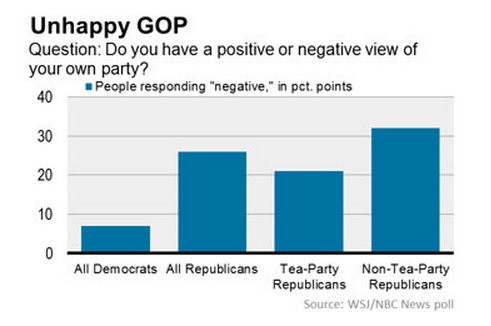
A WSJ/NBC News poll today is out with what is at first a surprising result. They find that when people are asked whether they have a positive or negative view of their own party, Thirty-two percent of non-Tea Party Republicans respond in the negative while only 21% of Tea Party Republicans do so:

Intra-party pollGiven how much the Tea Party rails against the Republican Party and the establishment, it seems contradictory that more non-Tea Partiers actually have a negative opinion of the party as a whole. Except, this view doesn’t take into account what the party is actually doing. The fact of the matter is that the Tea Party controls the House GOP right now, which, as the only part of the party that controls a branch of Congress, then has the ability to dictate its agenda. Thus, the government shutdown, no immigration reform and a strict adherence to no new revenues. These are all policies that grew out of the Tea Party movement and the Republican Party has now adopted. Of course, the Tea Party has more favorable views of the Republican Party than non-Tea Pariers do! The Tea Party is in control.

This can be seen clearly in the same WSJ/NBC News poll when it asks about compromising on a budget deal. Here are the results:

Compromise Tea PartyNon-Tea Partiers want to make a budget deal by an overwhelming amount while the Tea Party wants the party to stick to its position by an even greater amount. Overall, the party is split. Guess what? The Tea Party wins. We certainly aren’t getting a big budget deal. At most it will be a small compromise and even that is unlikely. Polling for immigration reform shows a similar split where the Tea Party is against a path to citizenship while the rest of the party is open to it. There too, the Tea Party’s preferences have become the Republican Party line.

This perfectly represents why non-Tea Partiers give the party such a negative view as a whole. They are the ones who have been cut out and ignored, not the Tea Party. If anything, it’s surprising that nearly a fifth of Tea Partiers have a negative view of the GOP. After all, the Republican Party is following the Tea Party’s strategy to a tee.