Delaying the Individual Mandate Isn’t A Real Possibility

One thing that Republicans have been clamoring about recently is for a one-year delay in the individual mandate in response to the Administration’s (unlawful) decision to delay the employer mandate a year. This morning, National Journal and Public Notice hosted an event at the Newseum titled “Fiscal Fallout: What is ‘Responsible’ in Today’s Fiscal Reality” with keynote addresses from Sen. Orrin Hatch (R-UT) and Center on Budget and Policy Priorities’s Robert Greenstein as well as a panel discussion on our fiscal situation. Near the end of the panel,  Bill Hoagland, the Senior Vice President at the Bipartisan Policy Center, discussed the possibility of delaying the individual mandate for a year:

You can’t defund Obamacare on a continuing resolution because 90% of Obamacare is entitlements so it doesn’t make any sense, but I do think Bob [CBPP’s Robert Greenstein] passed over one small thing. He mentioned that a delay would increase the number of uninsured by 11 million. Yet he did not mention that the CBO’s cost estimate on that was that it would save $35 billion too. I’m not here to propose a delay, but for the average person listening to this debate outside, [they may say,] ‘Wait a minute. You delayed the employer mandate. Why can’t we delay the individual mandate?” And I worked with some insurance companies also so I know that the argument will be that this will drive up premiums immediately. Quite frankly, premiums have been set here for the exchanges starting in a few weeks and the companies don’t know what the experience is going to be anyway. So I don’t find a delay necessarily to be bad. In fact, I would almost think the Administration would want a delay to get the exchanges ready [while] other provisions of the law remain in effect – no [rejecting people with] pre-existing conditions, [allowing young people to stay on their parents’ insurance] up until age 26. So I think one of the outcomes here will be that you hear more about a delay. And I’m not proposing it. I’m just suggesting you’ll hear more about a delay.

First of all, under no circumstance is the Obama Administration going to delay the individual mandate for a year. They’ve fought off challenge after challenge for the law to get to this point and they believe (as I do) that once it officially begins, it will be here to stay. Based on their desperate, stubborn refusal of House Republicans to fund the government unless the Administration agrees to defund the law, they seem to agree as well.

Second, just delaying the individual mandate would be a disaster. Hoagland says he understands the counter argument to such a delay, but he doesn’t seem to. The problem is that if you delay the individual mandate, but still require insurance companies to cover everyone with pre-existing conditions then the death spiral ensues. Only unhealthy people sign up for the law while healthy people forego insurance. Without the offset of those healthy people paying into the system, these insurers must raise premiums to cover the unhealthy ones. Hoagland notes this, but uses a bit of hand-waving to say that insurance prices are locked in and thus insurers won’t be able to raise premiums. Well if that’s the case, then insurance companies will go bankrupt. The companies came up with insurance premiums assuming that young, healthy individuals would purchase insurance. Their business model falls apart if those individuals aren’t required to sign up, but the firms are not allowed to revises their premiums.

Thus, if Hoagland wants to delay the individual mandate (which he never says he wants to do – he’s just suggesting it’s going to come up), then we must delay the pre-existing condition requirement as well. This would effectively delay the entire law and give Republicans another year to figure out how to repeal and undermine it. They can even try to delay it until the midterm elections where they will hope to win back the Senate and repeal it altogether (of course, the President would veto such a bill).

So, contrary to Hoagland’s suggestion, this isn’t something you’re going to hear more about. It would be an epic disaster policy-wise and the Administration isn’t going to consider it. Obamacare is the law of the land and that’s not changing.

Boehner Can’t Betray The Tea Party

Salon’s Brian Beutler is out with an article this morning advising House Speaker John Boehner to give up waging repeated fights over the government budget and debt ceiling and instead agree to fund both for a lengthy period of a time. These fights do nothing, but divide the Republican party and hurt its imagine nationally. So, Beutler’s logical advice to the Speaker is to no longer pass stopgap fixes and get them off his plate until at least the midterm elections.

This makes a lot of sense on political grounds for the Republican party. The GOP wouldn’t have to revisit every few months whether they’re going to bankrupt the government or allow it to default, both political losers for the party. As for the country, these nasty fights unnecessarily hold back the economy and crowd out other important Congressional legislation such as immigration and tax reform.

The problem with Beutler’s strategy is that it would probably cost Boehner his speakership. Beutler says that if Boehner is worried about this, he could make a deal with House Minority Leader Nancy Pelosi that Democrats will support him if he’s challenged by his conservative base.

Speaker Boehner has no good options.

Speaker Boehner has no good options.

But this doesn’t actually accomplish much for the Speaker. He keeps his title while losing all of his power.

If the Speaker faces a rebellion from within his ranks and turns to Pelosi for help, it effectively makes her de-facto Speaker. As we’ve seen repeatedly, Tea Party Republicans aren’t going to sit idly by while the Speaker betrays their most deeply held interests: cutting government spending and defunding Obamacare. In reality, the House doesn’t have a chance of accomplishing either of those, but House Republicans don’t live in reality. They will see Boehner’s betrayal not as a practical solution to improve the image of the party, but as a validation of their not-to-secret belief that the Speaker is a RINO. And they won’t accept that.

Whoever rises up to challenge Boehner for his speakership – whether it be the Majority Leader, Eric Cantor, or someone well outside Republican leadership such as Justin Amash – will have the support from Tea Party groups around the country and many members of the Republican caucus. If Democrats come to Boehner’s aid and save his speakership, the Tea Party will not simply give up the fight. The Tea Party doesn’t give up fights, even ones they’ve lost repeatedly (see, Obamacare). They will continue to fight against everything Boehner does, if just to send a message to future speakers that the Tea Party is not to be messed with.

If Boehner hopes to accomplish anything else in this Congress, it will require large Democratic support and it will be up to Pelosi to provide that support. Anything Boehner wants to pass, he’ll have to run by the Minority Leader to see if she can whip the votes for it. That gives Pelosi all the power. That’s great for Democrats, but horrible for Republicans and even worse for Boehner. He’ll have no power in Congress and a Republican base that will never forgive him. That’s not a strategy the Speaker should pursue.

Richmond Officially Approves Eminent Domain Plan

Sigh.

Last night, Richmond, California’s city council approved the plan to use eminent domain to help underwater borrowers by a vote of 4-3. The plan is pure fraud. Mortgage Resolution Partners (MRP), an advisory firm, rounded up investors to supply capital to Richmond so that it could purchase the mortgages of underwater borrowers in the area. The city would then right down the value of the loan so that the borrowers could refinance at a lower rate. However, MRP wasn’t just helping out the city. It was looking to make a profit. And how was it doing that? By paying investors well below fair market value for the loans.

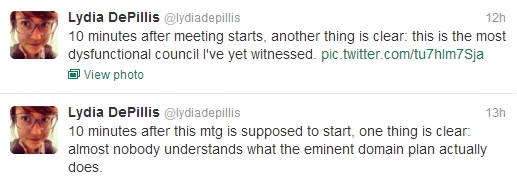
I’ve said repeatedly that I have no idea how Richmond fell for this plan. These two tweets from Wonkblog’s Lydia DePillis, who was at the meeting, may explain it a bit:
.

Eminent Domain Tweet.
A dysfunctional city council that doesn’t understand what they’re voting on is about the best explanation I’ve heard for why the city is implementing MRP’s plan. Still, I was hoping someone would talk some sense into the council members and explain to them why this is such a bad idea. Unfortunately, that hasn’t happened.