Conservative Hatred for the Social Cost of Carbon is Infuriating

Conservative reporter Matt Lewis of the Daily Caller was on Fox News this weekend denouncing the Obama Administration’s decision to increase the social cost of carbon (SCC) and also wrote a short post this morning titled, “4 reasons you should be outraged by Obama’s new microwave regs.” Lewis is a thoughtful conservative voice, but he’s overreacting here.

Let’s start with his first reason: this was a unilateral decision by the Obama administration. Well, yes it was. But this isn’t a new law. It’s a measure used in the cost-benefit analysis of regulations. In the microwave rule that Lewis is so furious with, the Energy Department (DOE) also made assumptions about annual energy use, the product cost, product lifetime and forecasted efficiencies. When it’s making rules that estimate costs and benefits for decades, the DOE has to make assumptions. There’s no way around it. Congress is not going to pass a bill for every assumption in every regulation. That would be the end of regulation. Lewis doesn’t like this assumption so he complains that the action was unilateral, but that’s how the DOE (and all federal regulators) operates.

That gets us to reasons number two and three: “it was hidden” and “the price is arbitrary.” Lewis calls the social price of carbon a “guesstimate” and that regulators have lots of autonomy in their decision-making, but this is unfair too. Calling the price a “guesstimate” makes it seem like it came out of thin air. But that’s not true whatsoever. The Department released a 21-page document explaining its reasoning for the change in the social cost of carbon. The first page of it lists 11 different agencies that were involved in the process and the report goes on to cite a number of academic studies. Lewis is right that the social cost of carbon is tough to calculate, but what should we do instead? Just ignore the costs and pretend they don’t exist? That’s a terrible idea. Instead, we should try to calculate them as best we can, using both public and private resources. That’s what the Office of Management and Budget (OMB) did and that’s the number that the DOE used for its microwave regulation.

In addition, if you dig into the final rule, there is a part devoted entirely to explaining the old social cost of carbon and the new one. There is also a paragraph that warns about the uncertainty of the estimate:

It is important to recognize that a number of key uncertainties remain, and that current SCC estimates should be treated as provisional and revisable since they will evolve with improved scientific and economic understanding. The interagency group also recognizes that the existing models are imperfect and incomplete. The National Research Council report mentioned above points out that there is tension between the goal of producing quantified estimates of the economic damages from an incremental ton of carbon and the limits of existing efforts to model these effects. There are a number of concerns and problems that should be addressed by the research community, including research programs housed in many of the Federal agencies participating in the interagency process to estimate the SCC.

Does that sound like an agency trying to cover up a guesstimate? The Obama Administration didn’t announce the change in the SCC with a big press conference or a media blitz, because It’s a change in an assumption used in the cost-benefit analysis of complicated regulations. That’s not to say that Administration didn’t try to downplay it. It is a big (justified) change and the Administration announced it on a Friday afternoon in late May. It was a classic news dump. But they also didn’t try to hide it. In the very brief (five paragraph) press release on it, a full paragraph is devoted to the new estimate. That’s not an attempt to hide a massive regulatory change from the American people.

I actually agree with Lewis’s final reason: “it’s a big deal.” I’m going to quote him at full here:

This could impact the cost of almost everything you consume (including, yes, the cost of microwaves). What is more, the new regulations will impact the projected cost of building and maintaining power plants — and the Keystone XL Pipeline project. (When calculating a cost-benefit analysis, these new regulations will increase the (supposed) cost, making it less likely that new energy projects will be green lit.)

Lewis is exactly right. The SCC has big implications for a number of other projects. Lewis is complaining that this update has far-reaching effects, but that’s exactly why it’s so valuable that we revise it. This isn’t a reason to oppose the regulation. On the contrary, it’s a reason to praise the DOE and other agencies for updating their assumptions. Lewis and other conservatives may dislike the idea of the SCC and oppose any update to it that raises it’s price, but it’s a vital consideration in regulatory policy and should be a pillar of conservative policy. After all, taking into account the SCC is internalizing a negative externality that the market doesn’t take into account. It’s a step closer to a free-market system. Shouldn’t conservative embrace that?
Does Welfare Reduce Work Participation?

Michael Tanner and Charles Hughes of the libertarian Cato Institute published a report (PDF) this week evaluating the total amount of welfare benefits that individuals can collect on a state-by-state basis. What they found was pretty alarming:

The current welfare system provides such a high level of benefits that it acts as a disincentive for work. Welfare currently pays more than a minimum-wage job in 35 states, even after accounting for the Earned Income Tax Credit, and in 13 states it pays more than $15 per hour. If Congress and state legislatures are serious about reducing welfare dependence and rewarding work, they should consider strengthening welfare work requirements, removing exemptions, and narrowing the definition of work. Moreover, states should consider ways to shrink the gap between the value of welfare and work by reducing current benefit levels and tightening eligibility requirements.

That’s quite a finding, but it doesn’t really hold up under scrutiny as Josh Barro explains. But that’s not what I want to talk about. I want to assume that those findings are correct and look at their outcome on work. Tanner and Hughes include a table in their report that lists every state and the percent of adults receiving Temporary Assistance for Needy Families (TANF) benefits who are in work activities. Work activities does not necessarily mean employed; it also includes job search activities as well. So, to see if welfare disincentives people to work, we can look at which states have the highest work participation and compare that to the welfare packages they offer, right? After all, if states with substantial welfare packages also have low work participation rates, that’s a sign that welfare may act as a disincentive.

But looking at the benefit levels themselves isn’t helpful. What matters more is the purchasing power of those packages. That’s what people really care about. Five hundred dollars in SNAP (food stamps) benefits will buy you a lot more in Fargo, North Dakota than in New York City and that impacts people’s desire to work. I couldn’t find a measurement of the differences in cost-of-living in different states – possibly because it varies so much within states themselves – but Tanner and Hughes actually provide a metric that can be used as a proxy for cost-of-living: median salary. In fact, they present welfare benefits as a percent of the median salary for each state. Median salary is not a perfect proxy, but it is still a pretty good measure of the cost-of-living in each state.

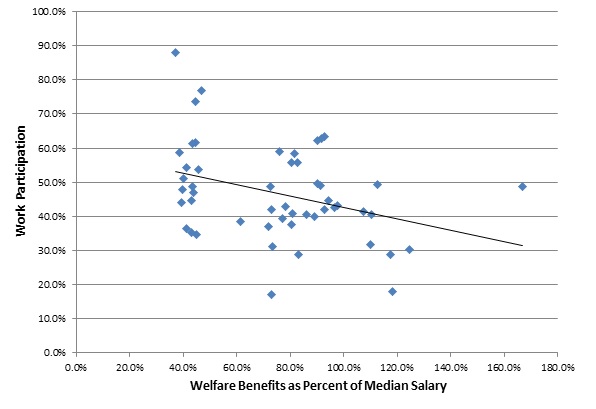
Now, comparing the welfare benefits as a percent of the median salary to the work participation rate in each state can give us a better idea of the incentive effects of welfare. So, that’s what I did. Here’s a graph of the results with a best fit linear line attached:

Welfares EffectsThere’s certainly a negative correlation between welfare purchasing power and work participation, but it’s not that strong. In particular Idaho’s work participation rate of 87.9% along with its small welfare purchasing power (36.9% of median salary) is impressive. But this analysis isn’t quite right. You may be looking at the welfare benefits as a percent of median salary and are shocked to see so many percentage over 100 percent. That’s because just about no one actually qualifies for all eight of the welfare programs that the Cato Institute includes. As Barro points out in his article, most people on welfare receive SNAP and Medicaid benefits and nothing else.

However, Tanner and Hughes predicted this rebuttal and calculated the maximum amount a person can receive from just SNAP, TANF and Medicaid benefits. They were also nice enough to include a table of those benefits as a percent of median salary in each state. I then compared those numbers to work participation and look what I found:

Welfare Effects2The correlation is positive now! State’s with greater welfare purchasing power have higher work participation rates. The correlation is even less than in the previous graph so it’s not particularly meaningful. In addition, correlation does not equal causation. This could be a complete coincidence. But it should at least make you pause whenever you hear conservative claims that welfare causes people to forego their job search and mooch off other taxpayers. The evidence on it is very unclear.

Yet Another Reason Janet Yellen Should Be Fed Chair

This one comes from former CFTC chairperson Sheila Bair, who participated in a panel today on restoring economic growth in America. Asked afterwards about Janet Yellen’s gender playing a role in the nominating process, she responded:

Janet Yellen can stand on her own. The fact that she’s a women should be irrelevant to this. I think her gender has been working against her. Some people have been saying that if she gets it, it’s just because she’s a woman. That’s nonsense. Of all the candidates I’ve heard about, I view her as the most qualified.

Absolutely. It should be icing on the cake for President Obama that the most qualified candidate would also be a groundbreaking choice.

Bair then brought up another aspect of Yellen’s candidacy that I haven’t seen written anywhere before: her lengthy time in public service.

[Her appointment] would make an important statement about public service. Revolving door is an accepted practice in Washington. I don’t fault people who do it. But there have been a number of high-level appointments where you’ve had people going in and out of Wall Street. Janet’s not one of those people. Most of her recent career has been in public service or in academia. Some people say, ‘Well, she doesn’t have Wall Street experience.’ I view that as a positive. She hasn’t done the revolving door. She’s got a good public image. That would be another thing that argues in her favor. Others who do come from Wall Street or have come back and forth from there  will reinforce the public’s cynicism that I worry about. But she does not have that. It would be a good tribute to those who do spend most of their time in public service.

Yellen is the best candidate for the job. Period. But this is yet another reason to select her. The Obama economic circle is littered with people with recent ties to the financial industry. That’s not a knock on them – as Bair pointed out, it’s common practice in Washington. But the Fed is going to make a lot of major regulatory decisions in the next couple of years. Wouldn’t it be nice if the Fed Chair wasn’t buddy-buddy with a bunch of bankers interested in watering down those rules?

Bair also correctly emphasizes that nominating Yellen would signal to career public servants that their loyalty to their jobs will not harm their chances of being promoted in the future. I think the counterfactual is even more convincing though. Imagine if Obama selects Summers and one of the reasons for doing so is because of his private sector experience. Now, government officials have incentives to leave their jobs to gain such experience. After all, Obama just demonstrated that not having it will reduce their chances of promotion. The revolving door isn’t necessarily a bad thing, as Matt Yglesias pointed out. But it presents the opportunity for rent-seeking and quid-pro-quo agreements that hinder federal agencies. Selecting Yellen sends a signal to government officials that private sector experience – using the revolving door – is not necessary.

Overall, it’s not a big enough reason to choose Yellen over Summers. Most public workers aren’t going to suddenly decide they desperately need private sector experience if Summers is chosen. But it is yet another advantage that Yellen has. At this point, it shouldn’t be a difficult decision for the President: Yellen is the best choice. We’ll find out soon enough.