Former economic adviser to Mitt Romney, Greg Mankiw published an essay (PDF) recently titled “Defending the One Percent.” In it, he argues that growing economic inequality in and of itself is not a bad thing. He writes that the Left has three main arguments in favor of higher taxation for the rich and attempts to refute each one.
First, he argues that liberals believe the current tax system is regressive. Um, not sure where Mankiw got this one: I don’t know of any liberals who believe this. As he points out, the top 20% of homeowners paid significantly more in taxes than the middle fifth and massively more than the bottom quintile. Those are facts – our current tax system is progressive. But that doesn’t mean it’s progressive enough. As for why liberals don’t believe it’s progressive enough, let’s move to his second and third arguments.
Next, Mankiw suggests that liberals do not believe that compensation for the rich accurately represents “their contributions to society.” He also notes that the rich earning their income through rent-seeking behavior is inequitable and inefficient:
The key issue is the extent to which the high incomes of the top 1 percent reflect high productivity rather than some market imperfection. This question is one of positive economics, but unfortunately not one that is easily answered. My own reading of the evidence is that most of the very wealthy get that way by making substantial economic contributions, not by gaming the system or taking advantage of some market failure or the political process.
Finally, he argues that liberals believe the rich should pay a greater share in taxes, because they benefit from the social, legal, and physical infrastructure more than others. Mankiw does not refute that belief, but argues that the rich already pay enough. His main reasoning is that government expenditures have gone more and more towards transfer payments than towards infrastructure over the past few decades. Given all that, the rich have to be paying more than their fair share:
As I pointed out earlier, the average person in the top 1 percent pays more than a quarter of income in federal taxes, and about a third if state and local taxes are included. Why isn’t that enough to compensate for the value of government infrastructure?
How much value the rich receive from government infrastructure is not an easy question and I don’t have a simple answer. But Mankiw completely dismisses it, assuming instead that the rich must be paying too much. Maybe they are. Maybe they aren’t. But he offers zero evidence here to backup his complaint.
However, I want to return to the second argument as Mankiw ends his essay by offering his “just desserts” philosophy of income distribution:
According to this view, people should receive compensation congruent with their contributions. If the economy were described by a classical competitive equilibrium without any externalities or public goods, then every individual would learn the value of his or her own marginal product, and there would be no need for government to alter the resulting income distribution. The role of government arises as the economy departs from this classical benchmark. Pigovian taxes and subsidies are necessary to correct externalities, and progressive income taxes can be justified to finance public goods based on the benefits principle. Transfer payments to the poor have a role as well, because fighting poverty can be viewed as a public good.
In large part, I agree with this framework (with the glaring exception of us having a moral obligation to provide basic living conditions and equal opportunity for all Americans). People should be paid based on their contributions to society, but those contributions are not always priced into the economy. Are teachers salaries in line with what they add to society? What about stay-at-home moms? Of course not! The free market doesn’t take into account many of the ways that people contribute to society. Thus, I agree that we should aim for perfectly competitive markets with the government correcting externalities and fixing any other market failure. But we also need to take into account non-capitalistic ways people add to society.*
Here’s where Mankiw and I differ: He believes our current system lives up to this philosophy. I don’t.
This disagreement results from the difficulties in ascertaining how much an individual contributes to society. Estimating those numbers is very challenging. In October 2011, the CBO released a report on changes in after-tax household income between 1979 and 2007 (PDF). Here’s the most important finding:
The share of after-tax household income for the 1 percent of the population with the highest income more than doubled, climbing from nearly 8 percent in 1979 to 17 percent in 2007.
That stat also takes into account government transfers. If we assume that Mankiw is correct and our current system accurately represents individual’s contributions to society, that means that during that period, the top one percent became more than twice as valuable to society while the bottom eighty percent all became less valuable. Does that sound like a legitimate depiction of how our society has changed over the past 30 years? The top 1% contribute twice as much as they did in 1979?
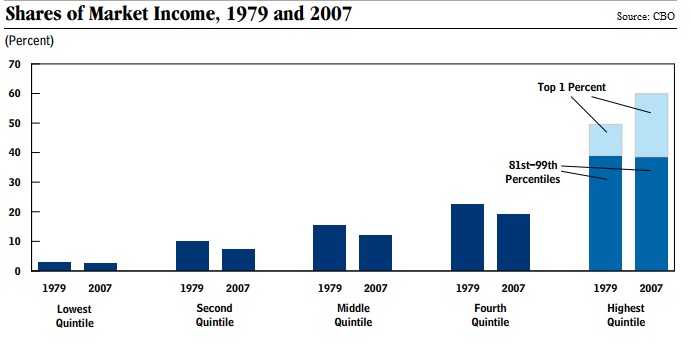
However, just because that isn’t true doesn’t mean that the income levels of the top 1% are too high. It’s possible that in 1979, the top 1% were paid only half as much as they contributed to society. Thus, even if their contributions hadn’t changed over those three decades, their growth in after-tax income led to a more accurate representation of each quintile’s value to society. That’s certainly a possibility, though I don’t believe that’s the case either.
On a more fundamental level, do you believe that the top 1% equal 17% of the value of our economy and thus deserve 17% of the after-tax, post-transfer income? Do the top 20% contribute 53% of value to society? I find that extraordinarily hard to believe. Based on his conclusion, Mankiw doesn’t. Unfortunately, deciding who is right is not so simple. There’s no easy way to estimate how much each quintile is worth. That’s a main reason that Mankiw’s essay lacks specific numbers – those numbers are hard to come by. But I have trouble believing that most Americans look at that distribution of after-tax income (to say nothing of wealth) and believe it’s an accurate representation of value-added to society. I certainly don’t.
*I edited this paragraph up to make it more clear that I advocate for people earning what they contribute to society in all forms, not just economic ones.

 Danny Vinik