St. Petersburg and Housing Regulations

While I’m no longer in Russia (on to France), I wanted to write a quick post about St. Petersburg’s building height regulations. It was one of the things I noticed immediately after landing in the city. Buildings are never more than 10 stories in height. Meanwhile, according to the Russian real estate magazine “Bulleten Nedvizhimosti,” the average cost of housing per square meter in the secondary market is 94,721 rubles (I would advise translating the magazine into English). According to the Federal State Statistic Service, Russian’s federal stat agency, the average cost of housing per square meter in the secondary market in all of Russia is 56,370 rubles (PDF). St. Petersburg is significantly more expensive than the national average.

In terms of population density, St. Petersburg ranks 599 out of 875 urban areas with a population greater than 500,000 in the world (PDF). It ranks 22nd out of 60 Russian cities in terms of population density. The reason? Building height restrictions. The Construction Codex of 1844 states that no building can be higher than the Winter Palace, which is just 23.5 meters tall. Over the past few decades, repeated attempts to construct high rises have failed due to opposition from the city’s citizens. Last August, city hall approved the construction of a 463 meter skyscraper, but activists have already pushed back and are urging their local politicians to retract the approval.

The height restriction limits the available housing supply in the city, driving up prices and rents. Higher rents means that businesses must charge more for their products and services in order to cover their costs. The height restriction thus drives up the cost of living throughout the entire city. Having just been there for a few days, I can attest to the high prices (though I’m sure part of that was tourist traps).

Protesters argue that allowing taller buildings will ruin the city’s skyline and historic landscape. To some extent, St. Petersburg is a beautiful city because it’s not a maze of 500-meter buildings. But that doesn’t mean that the 23.5 meter limit is acceptable either. The city should raise the cap on building heights – maybe to 75 meters, maybe to 100. This would keep the city’s skyline in tact  while drastically increasing the housing supply and lowering prices. Housing costs will not be as affordable as they could be if St. Petersburg removed the cap altogether, but the extra costs are what the city’s citizens pay to retain the beautiful views.

Frequently in the U.S., stupid city policies act in the same manner. Policymakers don’t even seem to understand the connection between height restrictions and high prices (Go read Matt Yglesias for more). They never propose loosening housing regulations as a way to fix the problem. At least in St. Petersburg, the city seems aware that the 169-year-old code drives up prices and have approved the building of skyscrapers in recent years. In this case, the opponents of taller buildings – mostly citizens of the city itself – are the ones preventing the implementation of sensible policies. Hopefully, city hall will not cave in to pressure yet again and St. Petersburg will be home to its first skyscraper.
CPI Is A Technical Fix, Let’s Keep It That Way

President Obama unveiled his budget yesterday and liberal groups have responded angrily to the inclusion of Chained-CPI in the proposal. A quick recap: currently Social Security benefits increase each year to keep pace with inflation according to the Consumer Price Index (CPI). The current calculation for inflation does not take into account that when the price of one product increases, people will switch to a lower-priced substitute instead of paying the higher price. The classic example is that when the price of beef rises, people buy more chicken and less meat, so the actual increase in the cost-of-living is not equal to the rise in the price of meat. Chained-CPI takes this into account. Since Chained-CPI is a low measure of inflation, Social Security benefits will grow at a slower rate. Thus, liberals argue that Chained-CPI is a benefit cut.

However, both CPI and chained-CPI estimate inflation for the average person. But Social Security beneficiaries are not average people. Most of them are elderly and much of their consumption comes in the form of health care and housing. Since health care and housing prices have risen faster than the rest of economy, the cost-of-living for seniors has increased at a quicker rate as well. That means that CPI and Chained-CPI both actually underestimate inflation for Social Security beneficiaries. Their benefits should actually rise quicker than inflation.

Nevertheless, much of the discussion right now centers on the fact that Chained-CPI is a benefit cut. The Washington Post‘s Dylan Matthews outlines everything I’ve said above and more, but finishes his piece by saying:

But ultimately, the question of which you prefer likely has more to do with whether you think Social Security benefits need to be pared back to ensure the program’s long-run solvency, or whether you think the elderly need, if anything, a benefit bump. Those are policy questions, not technical ones, and all the debate in the world about chained CPIs and CPI-Es relative methodological merits won’t resolve them.

Slate’s Matt Yglesias has a slightly better take:

As a technical matter, the best way to express this would be to start with the most accurate possible measurement of the price level (I might prefer the PCE deflator) and then inflate it by a fixed amount. But using a measurement of the price level that slightly overstates inflation works too.

If we want to have real benefits increases slowly each year for beneficiaries, then let’s use Yglesias’s technical fix. But, let’s start by getting the level of inflation right. CPI is not correct. Chained-CPI is also not correct. The closest measure right now may be CPI-E, but it’s still experimental and not ready for use.

In the end, I’m with Kevin Drum: let’s budget a small bit of money to research and develop a precise measure of inflation and then implement it. After that, we can start talking about inflating it by a fixed amount (as Yglesias advocates) or pairing benefits back altogether (as many Republicans advocate). First, though, let’s get it right.

The Graph That Made (Almost) Everyone Hate Deficits

Kevin Drum penned a post last night about why people hate deficits so much. He runs through a few options, but settles on the following:

Liberals have done an abysmal job of explaining why deficits are good during periods of high unemployment, so ordinary citizens have no reason to think deficits are anything other than bad.

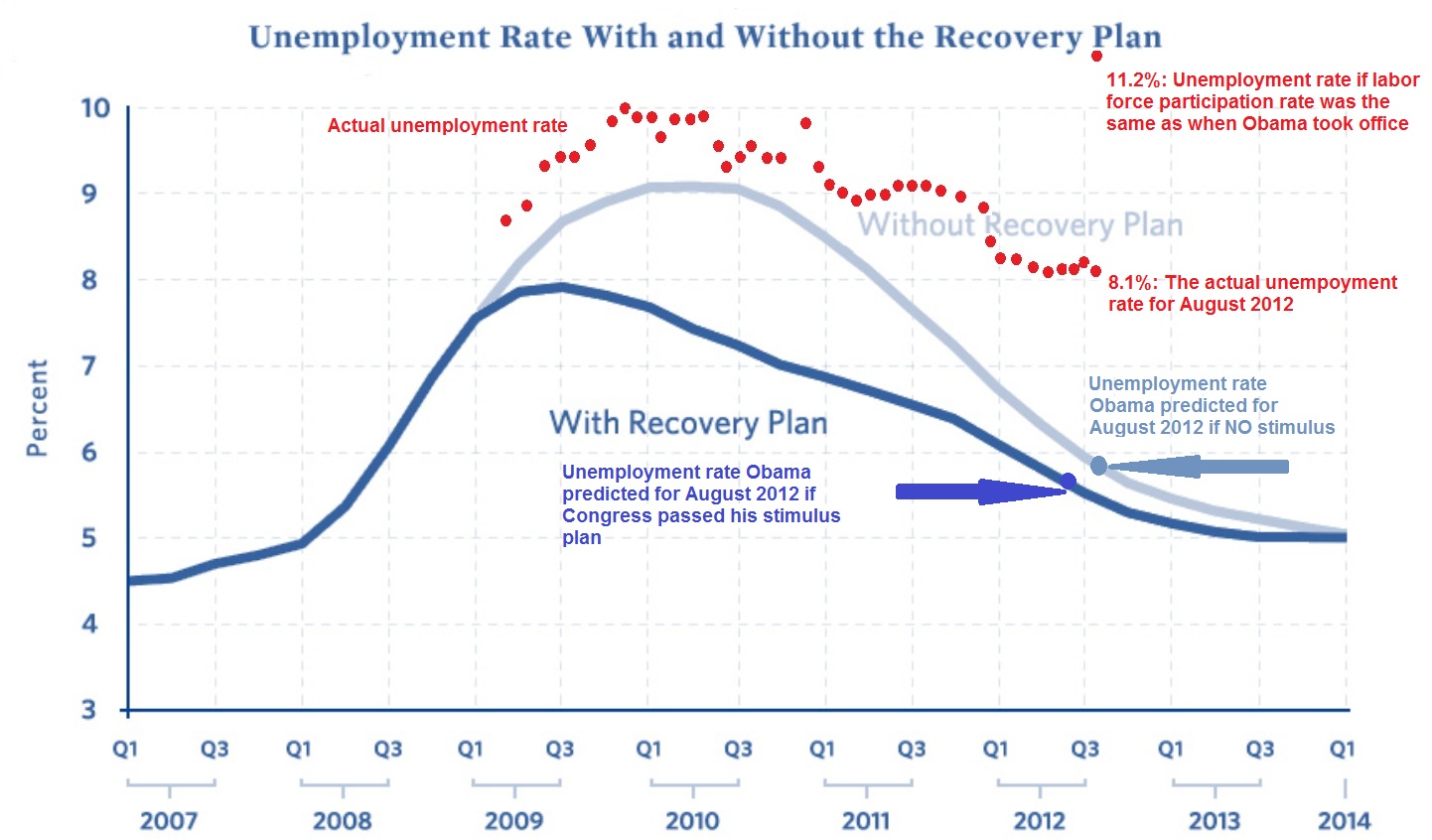
I think this all hearkens back to the graph from Obama Administration economists Jared Bernstein and Christina Romer in January 2009 showing the expected unemployment rate with and without the stimulus. American Enterprise Institute’s James Pethokoukis has updated the graph with the actual unemployment rate (this is his update from September of last year):RomerBernsteinAugust1

It’s tough to prove that deficit spending in times of high unemployment works when the stimulus seems to have failed so badly. Of course, Bernstein and Romer’s graph was so far off because the economy was much weaker than anyone realized at the time, not because the stimulus failed (it didn’t). But, try telling that to your average person. For most people, that graph is confirmation that deficit spending does not work. That’s a very deep hole for liberals to start in.