Presidential Leadership is a Myth

Ezra Klein writes in Wonkbook today about why gun control measures with mass support (90% of Americans support background checks) can’t pass through Congress:

If public opinion remains this uninformed despite overwhelming media coverage of the issue, the president’s aggressive use of the bully pulpit, and the focusing power of a national tragedy, then that suggests public opinion can’t effectively be leveraged even in extremely favorable circumstances. These results don’t explain the fluke status of gun control. They explain why majority support is a reliably weak predictor of congressional action.

As Klein goes on to say, much of the Washington press still operates as if Obama has not used the bully pulpit enough. You often hear this in the form of him not showing enough  “leadership.” But this is just a flawed way of looking at how D.C. works. The President has given more than a dozen, heartfelt speeches since Newtown on gun control. He’s put in calls to Congress and sent Vice President Biden to the hill to lobby for stricter gun control measures. What else can he do? What power does the bully pulpit have when in the face of a national tragedy and an overwhelming majority demanding action, the President can give speech after speech with nothing to show for it? The answer is none. Presidential leadership is just code for blaming each party equally, when only one is to blame.


Income Inequality vs. Wealth Inequality

In today’s edition of The Chronicle, the student newspaper here at Duke (Disclaimer: I wrote for the sports section during my freshman and sophomore years), freshman Jonathan Zhao wrote an op-ed pushing back against a viral YouTube video depicting the massive wealth inequality in the United States. Here’s Zhao’s key point:

[T]he video makes the case that the rich have become disproportionately wealthier over time. Again, so what? This is simply an example of Pareto’s principle that a small minority generates the majority of production. As such, they receive the majority of the wealth created. The key point to understand is that both the rich and the poor have become wealthier over time. According to data from the U.S. Census Bureau, from 1967 to 2009 the real mean household income of the top quintile increased by 71 percent. Over the same period, the real mean household income in the bottom quintile increased by 25 percent.

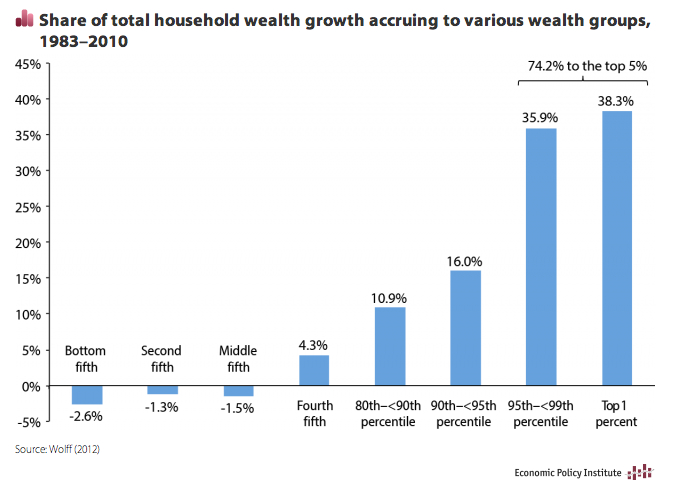
Zhao has already made an error here: mean household income is very different than wealth. Income is what a household earns in a given year, but wealth is the cumulative value of all assets that the household owns (houses, investments, savings, etc.). Those are very different things, but Zhao equates changes in mean household income and changes in wealth. Luckily, the Economic Policy Institute graphed the changes in wealth for different income groups from 1983-2010:
Wealth Inequality

As you can see, over the past few decades, the top five percent of households have seen massive rises in their wealth while the lowest 60 percent have actually seen their wealth decrease. Zhao is wrong: both the rich and poor have not become wealthier over time, only the rich have.

The freshman continues on to correctly point out that the video implies “that CEOs do not deserve to be paid what they’re paid. Zhao’s right: CEO pay does not represent the work effort of the CEO, but instead measure the CEO’s value to the company. Some CEOs may be worth 380 workers. Others may not be. The comparison is not meaningful. The video uses it to emphasize that wealth inequality has risen in recent years. If that rise had coincided with increased wealth for everyone, than Zhao could be right that it is just the price of the country growing richer (see more from Ezra Klein on why it still would be an issue). Nevertheless, the fact of the matter is that the poorest have lost wealth over the past 30 years and the rich have seen huge gains. The “rising tide” lifted a few boats way in the air while drowning everyone else.

On a separate note, it’s disappointing to read through the comments on the article and see very few people engaging Zhao’s argument. These are complex, important topics and the difference between wealth and income is especially vital. Most people in the comments simply attack Zhao morally without responding to his article whatsoever. The Duke Community can do better.

Scott Sumner on Fiscal Stimulus

Yesterday, Scott Sumner penned a post arguing against liberals’ blind acceptance that the stimulus worked. He presents a counter factual arguing that if Congress hadn’t passed the stimulus, that the Fed would have stepped up and done more to offset the crisis. He argues that under that scenario, the economy would be in better shape now thanks to the Fed. At the very least, he says, liberals cannot claim that the stimulus worked without acknowledging his counter factual.

Fair enough. I’m with Matt Yglesisas here – economists agree that the stimulus worked, but are split on whether the benefits outweighed the costs. I’m not entirely sure how to evaluate Sumner’s counter factual. Is there any way to judge this? Are we forever left to wonder if the stimulus was the most effective policy or if, absent it, the economy would be in better shape due to the Fed? I wish there was an answer and I hesitate to offer one. I’m just a senior in college soon to have a degree in economics – nothing like Sumner or all the other economists who are unable to answer this question. Sumner’s theory is very interesting though and I’d love to hear a response from Paul Krugman, who has argued for quite a while that the stimulus succeeded.

One other point – at the end of his post, Sumner writes, “PS.  Remember those Keynesians telling us that higher payroll taxes would slow retail sales in Q1?  Looks like they might want to revise their models” and then quotes an article about how retails were way up in February. I’m going to offer a counter factual here: maybe retail sales would have been higher without the rise in payroll taxes and thus the higher payroll taxes did slow retail sails! I have no data or evidence for this – just as Sumner has no evidence that the Fed would’ve have done more and our current economy would be better if there was no stimulus. But both arguments are certainly plausible and worth exploring. Nevertheless, Sumner spends the majority of his post berating liberal economists who don’t consider Sumner’s counter factual only to make the exact same mistake himself. Nevertheless, a fascinating post and worth a read.