DeMarco’s One Correct Point

Liberals have been jumping on Federal Housing Finance Agency (FHFA) leader Ed DeMarco for not allowing principal reduction for mortgages held by Fannie Mae and Freddie Mac. Such a policy would bring many homeowners above water and allow them to refinance at lower interest rates and afford their mortgages. Here’s Krugman:

In any case, however, deciding whether debt relief is a good policy for the nation as a whole is not DeMarco’s job. His job — as long as he keeps it, which I hope is a very short period of time — is to run his agency. If the Secretary of the Treasury, acting on behalf of the president, believes that it is in the national interest to spend some taxpayer funds on debt relief, in a way that actually improves the FHFA’s budget position, the agency’s director has no business deciding on his own that he prefers not to act.

I don’t know what DeMarco’s specific legal mandate is. But there is simply no way that it makes sense for an agency director to use his position to block implementation of the president’s economic policy, not because it would hurt his agency’s operations, but simply because he disagrees with that policy.

That’s 100% correct and it’s terrible that DeMarco is overstepping his bounds. However, DeMarco also made one good point:

Perhaps the greatest risk of the Enterprises’ allowing principal forgiveness is one with far more significant long-term consequences for mortgage credit availability. Fundamentally, principal forgiveness rewrites a contract in a way that other loan modification programs do not. Forgiving debt owed pursuant to a lawful, valid contract risks creating a longer-term view by investors that the mortgage contract is less secure than ever before. Longer-term, this view could lead to higher mortgage rates, a constriction in mortgage credit lending or both, outcomes that would be inconsistent with FHFA’s mandate to promote stability and liquidity in mortgage markets and access to mortgage credit.

I’ve talked about this before in using eminent domain for principal reduction. It’s a real issue that many economic bloggers are overlooking. Here’s Felix Salmon’s response: Continue reading “DeMarco’s One Correct Point”

Graph of the Day: Obama’s Tax Plan vs. Romney’s Tax Plan

Courtesy of Naomi Robbins via Ezra Klein at Wonkblog, here’s how individuals at different income levels would fare under Obama and Romney’s tax plans. It’s not pretty:


Imagine if Americans saw this and believed it, would Romney even have a chance? Alas, that’s a pipe dream. Even those who do see it will believe the numbers were just manipulated and there’s no way Romney could have a tax plan like that. But those numbers come from the non-partisan Tax Policy Center and are not manipulated. Romney’s tax plan really is a massive tax cut for the rich.

Is Obamacare the Biggest Tax Increase in History? No

Nope. Not at all. Kevin Drum debunks this one:

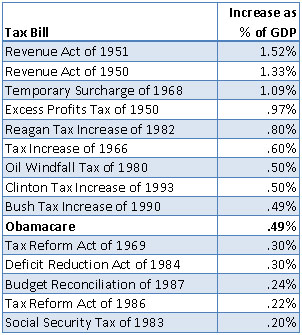
“There have been 15 tax increases of significant size since 1950, and Jerry Tempalski, a tax analyst in the Treasury Department, has estimated the size of all of them as a percentage of GDP.  Tempalski hasn’t estimated the eventual size of ACA, but PolitiFact took a crack at it using the same methodology, and they figure that ACA amounts to a tax increase of 0.49% of GDP seven years from now. That places it tenth on the list.”

And he supplies the table to the right as well.

Since the mandate is now defined as a tax, Obamacare does raise (optional) taxes. The President can no longer say otherwise. Politifact has dug up the transcript of an interview Obama did with ABC’s George Stephanopoulous and it’s good stuff:

Stephanopoulos: Under this mandate, the government is forcing people to spend money, fining you if you don’t. How is that not a tax?

Obama: Well, hold on a second, George. Here — here’s what’s happening. You and I are both paying $900, on average — our families — in higher premiums because of uncompensated care. Now what I’ve said is that if you can’t afford health insurance, you certainly shouldn’t be punished for that. That’s just piling on. If, on the other hand, we’re giving tax credits, we’ve set up an exchange, you are now part of a big pool, we’ve driven down the costs, we’ve done everything we can and you actually can afford health insurance, but you’ve just decided, you know what, I want to take my chances. And then you get hit by a bus and you and I have to pay for the emergency room care, that’s…

Stephanopoulos: That may be, but it’s still a tax increase.

Obama: No. That’s not true, George. The — for us to say that you’ve got to take a responsibility to get health insurance is absolutely not a tax increase. What it’s saying is, is that we’re not going to have other people carrying your burdens for you anymore than the fact that right now everybody in America, just about, has to get auto insurance. Nobody considers that a tax increase. People say to themselves, that is a fair way to make sure that if you hit my car, that I’m not covering all the costs.

Obama is right about everything here except declaring it not a tax increase. It is a tax increase, but it is a tax increase to correct a market failure. The President points the market failure out, but does not acknowledge that the way to correct it is through the tax. When Obama says “take a responsibility,” he means that individuals can either buy insurance or face a tax increase (which, in reality, is just the withholding of potential tax refunds). The reason for the tax seems to have been lost in the discussion of the Supreme Court’s ruling this past week, but it’s important to remember why it’s there. Without it, only unhealthy individuals would sign up for insurance and insurance companies, who can no longer discriminate based on pre-existing conditions, would get sucked into the “death spiral.”

By the way, check out what tax increase is fifth on the list: Reagan’s tax in 1982.