Medicare Payment for End of Life Care

Representative Earl Blumenauer (D-OR) has reintroduced his bill that would allow Medicare to pay doctors for having talks with their patients about their preferred end of life care. It has bipartisan support in the House and a similar bill is being drafted in the Senate by Mark Warner (D-VA) and Johnny Isakson (R-GA).

From Politico:

The heart of the Blumenauer bill is simple: Doctors and patients should talk about aging and about how a disease is likely to progress so that the patient can make clear and informed choices, and the doctor can understand and respect them. Those conversations can and should take time.

Doctors are paid well for doing procedures, Blumenauer said. They should also be paid for the time they talk to a patient about something this important. The bill calls for Medicare to reimburse the physician for one such conversation with the patient every five years, more frequently if the patient’s health deteriorates.

Every time Blumenauer brings up the bill, conservatives immediately start screaming “death panels” and rally opposition against it. But this is just silly.

There’s no good reason Medicare shouldn’t pay doctors to have these talks with patients. As people near the end of their lives, they should understand what they’re going through, different options they have and ensure that their wishes are respected. That’s the role of a medical professional and Medicare should be reimbursing them for it.

This reminds me of another agency that Republicans have been screaming “death panels” about – the Independent Payment Advisory Board (IPAB). IPAB is a 15-member board that analyzes Medicare reimbursement rates and finds ways to cut spending while not reducing quality of care or eligibility. The American Medical Association notes the many restrictions the agency has in its cost-cutting mission:

The IPAB is prohibited from submitting proposals that would ration care, increase revenues, change benefits, modify eligibility, increase Medicare beneficiary cost sharing (including Parts A and B premiums), or change the beneficiary premium percentage or low-income subsidies under Part D.

Nevertheless, Republicans have been screaming that it will ration care and throw grandma off a cliff. That’s not what the board does. It’s not about rationing care and explicitly cannot do so. The same is true with Blumenauer’s bill. It’s not about Medicare telling doctor’s to convince patient’s to forego expensive surgeries or prevent them from receiving desired treatments. It’s about abiding by their wishes and making them as comfortable as possible at the end of their lives. There shouldn’t be any opposition to that.
California Does NOT Fudge the Math on Obamacare

Over the past few days, fans of the Affordable Care Act have been celebrating the news that the expected premiums for California’s health care plans have come in well below expectations. Sarah Kliff summarized the story nicely on Wonkblog. Just a bit ago, former policy director for Mitt Romney, Lanhee Chen, wrote an article for Bloomberg View arguing that California did not compare plans correctly and that premiums would actually increase. Here’s Chen:

Covered California, the state-run health insurance exchange, yesterday heralded a conclusion that individual health insurance premiums in 2014 may be less than they are today. Covered California predicted that rates for individuals in 2014 will range from 2 percent above to 29 percent below average small employer premiums this year.

Does anything about that sound strange to you? It should. The only way Covered California’s experts arrive at their conclusion is to compare apples to oranges — that is, comparing next year’s individual premiums to this year’s small employer premiums.

I hadn’t seen any push back on the California numbers so this immediately intrigued me. Chen goes on to offer what he deems a direct comparison of California health care plans:

So, let’s make an actual apples-to-apples comparison for the hypothetical 25-year-old male living in San Francisco and making more than $46,000 a year. Today, he can buy a PPO plan from a major insurer with a $5,000 deductible, 30 percent coinsurance, a $10 co-pay for generic prescription drugs, and a $7,000 out-of-pocket maximum for $177 a month.

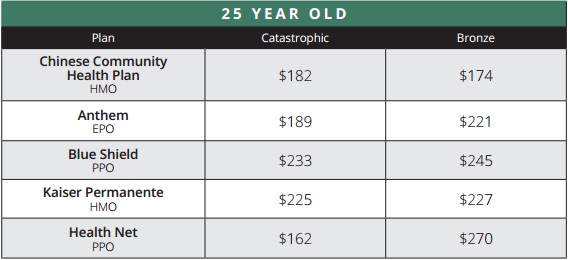
According to Covered California, a “Bronze” plan from the exchange with nearly the same benefits, including a slightly lower out-of-pocket maximum of $6,350, will cost him between $245 and $270 a month. That’s anywhere from 38 percent to 53 percent more than he’ll have to pay this year for comparable coverage! Sounds a lot different than the possible 29 percent “decrease” touted by Covered California in their faulty comparison.

I wanted to find out where those numbers came from so I dug into the Covered California report (PDF). Here’s the important table from page 39 of the report:

Covered California

The three most expensive plans range from $245 to $270 but Chinese Community Health Plan and Anthem both offer cheaper plans! That $174 plan is actually $3 per month cheaper than the current plan that Chen outlines. Am I missing something here or did Chen just deliberately choose the more expensive plans as examples to prove his point? If he did, it’s just blatant dishonesty. Otherwise, I’m not really sure why he excluded Chinese Community Health Plan and Anthem. I’m not an expert on health policy and certainly not one on the San Francisco area, but this seems pretty straightforward to me.

Seconding Steve Randy Waldman

I’m not sure there will be much new in this post, but I wanted to reiterate Steve Randy Waldman’s blog post regarding our massive healthcare costs. Waldman’s post, titled “Shame,” responds to Steven Brill’s long article on healthcare costs. Brill’s piece, while long, is very good, though I agree with Matt Yglesisas: the policy solutions he outlines don’t address the main problem.

But, I’m a bigger fan of Waldman’s response, which is pure disgust that we allow hospitals to rip off the most-needy in our society when an unfortunate health incident strikes:

The burden of citizenship is to share in, and hold people to account for, the injustices experienced by our neighbors. Alice was fucking ripped off to the tune of any semblance of economic and financial security she might ever have had at the very moment that her husband was dying of cancer. This is beyond awful. This is mortal sin in any religion worth the name. This is pure evil.

Our problem is not a matter of shitty policy arrangements. We have plenty of those. Whatever. Policy is a third-order pile of bullshit. Our problem is that it is a sick excuse for a society when this sort of ass-rape is relegated by custom and practice into the sphere of the “private”, the sort of bureaucratic struggle one quietly hires professionals to deal with and hides as much as possible from friends and coworkers.

There’s a bit more in his post (it’s not very long) and it’s definitely worth a read. Those hit by a health disaster are, in many cases, massively unlucky. Some may not have eaten healthily or exercised enough and thus have some responsibility for their poor health. But many unhealthy people don’t have huge heart attacks. They’re incredibly lucky and those that do get sick are unlucky. As for those people do live a healthy life and still get sick, they are incredibly unlucky.

So what do we do when all of these unlucky people go to the hospital and get treated? We throw a massive bill at them that wipes out their life savings and can leave debt hanging over their family for years. What type of society are we that allows this to happen? I’m just repeating Waldman here, but it’s worth repeating.

In a midterm for class a week ago, part of an essay I wrote implied that people are inherently selfish and care only about their own ends. It’s been an assumption economists have made for decades and I never really stopped to question it. My professor commented:

[T]he theory that all human beings are selfish is one of those bizarre dogmas that economists and political scientists are finally starting to abandon.  There’s just no evidence for it, and all the evidence from behavioral game theory is quite opposed to it.  People have a deep sense of fairness, and will take a personal loss to uphold fairness norms.

I’m not sure of the exact evidence he’s referring to it, but I certainly believe it. When I read Waldman’s post, that’s what I thought of. Human beings really aren’t inherently selfish, except it seems in the health care market. Hospitals, doctors, big pharma and every other part of the industry capture huge profits at the expense of the unlucky. And the rest of us? We mostly sit around and watch it happen. We call it a free market and blame unhealthy lifestyles instead of the cash-sucking industry itself. We empathize, but do nothing, caring more about our own time and life. Where’s the fairness here? Is that the type of society we want to be? I certainly don’t think so. It’s about time the rest of us, the lucky ones, start showing our unselfishness and stand up to the healthcare industry.