Rand Paul: Health Care is Not a Right

Katrina Trinko has a nice piece at National Review on Rand Paul continuing to offer pro-bono healthcare work when he returns home to Kentucky. Trinko reports right from the operating room, where Paul is literally giving people back their vision through cataracts surgery. But, it’s what Paul said in a speech at the University of Louisville that is most interesting:

“There’s a philosophic debate which often gets me in trouble, you know, on whether health care’s a right or not,” Paul, in a red tie, white button-down shirt, and khakis, tells the students from the stage. “I think we as physicians have an obligation. As Christians, we have an obligation. . . . I really believe that, and it’s a deep-held belief,” he says of helping others.

“But I don’t think you have a right to my labor,” he continues. “You don’t have a right to anyone else’s labor. Food’s pretty important, do you have a right to the labor of the farmer?”

Paul then asks, rhetorically, if students have a right to food and water. “As humans, yeah, we do have an obligation to give people water, to give people food, to give people health care,” Paul muses. “But it’s not a right because once you conscript people and say, ‘Oh, it’s a right,’ then really you’re in charge, it’s servitude, you’re in charge of me and I’m supposed to do whatever you tell me to do. . . . It really shouldn’t be seen that way.”

There’s a nuisance nuance here that Paul misses. If I want to purchase food or water, I know I can do so at an affordable, reasonable rate. I may not have the money to do so, but I know that if I do make a bit of money, I’ll have the ability to feed and hydrate myself. Health care is not the same. If I have a pre-existing condition, health care providers may not offer me any coverage whatsoever, or may only offer plans that are way too expensive to be deemed reasonably affordable.

If Paul wants to make those markets more similar to each other, then he must require insurance companies to cover those with pre-existing conditions. That way everyone has the ability to purchase insurance. But if that happens, then the old and sick buy coverage while the young and healthy forego it. This creates a bad risk pool and leads to higher premiums, causing more young, healthy people to drop out of the market. Thus, the death spiral ensues. How do you stop that? By requiring or convincing young, healthy people to purchase health care. That’s what the Affordable Care Act does using both carrots (subsidies) and a stick (individual mandate). Paul’s comparison of health care to food and water demonstrates the need for greater regulation in the insurance market.

Paul’s answer to health care reform has always been that there needs to be greater competition in the industry. But greater competition isn’t going to help those with pre-existing conditions. If insurers don’t want to cover them, they aren’t going to cover them up – barring a requirement from the government that they do. That’s the type of requirement that makes the healthcare market more similar to the market for food or water. It’s also the type of requirement that Paul vehemently opposes. Nevertheless, that inherent contradiction doesn’t seem to bother the young senator as his speech at Louisville shows.
Does Welfare Reduce Work Participation?

Michael Tanner and Charles Hughes of the libertarian Cato Institute published a report (PDF) this week evaluating the total amount of welfare benefits that individuals can collect on a state-by-state basis. What they found was pretty alarming:

The current welfare system provides such a high level of benefits that it acts as a disincentive for work. Welfare currently pays more than a minimum-wage job in 35 states, even after accounting for the Earned Income Tax Credit, and in 13 states it pays more than $15 per hour. If Congress and state legislatures are serious about reducing welfare dependence and rewarding work, they should consider strengthening welfare work requirements, removing exemptions, and narrowing the definition of work. Moreover, states should consider ways to shrink the gap between the value of welfare and work by reducing current benefit levels and tightening eligibility requirements.

That’s quite a finding, but it doesn’t really hold up under scrutiny as Josh Barro explains. But that’s not what I want to talk about. I want to assume that those findings are correct and look at their outcome on work. Tanner and Hughes include a table in their report that lists every state and the percent of adults receiving Temporary Assistance for Needy Families (TANF) benefits who are in work activities. Work activities does not necessarily mean employed; it also includes job search activities as well. So, to see if welfare disincentives people to work, we can look at which states have the highest work participation and compare that to the welfare packages they offer, right? After all, if states with substantial welfare packages also have low work participation rates, that’s a sign that welfare may act as a disincentive.

But looking at the benefit levels themselves isn’t helpful. What matters more is the purchasing power of those packages. That’s what people really care about. Five hundred dollars in SNAP (food stamps) benefits will buy you a lot more in Fargo, North Dakota than in New York City and that impacts people’s desire to work. I couldn’t find a measurement of the differences in cost-of-living in different states – possibly because it varies so much within states themselves – but Tanner and Hughes actually provide a metric that can be used as a proxy for cost-of-living: median salary. In fact, they present welfare benefits as a percent of the median salary for each state. Median salary is not a perfect proxy, but it is still a pretty good measure of the cost-of-living in each state.

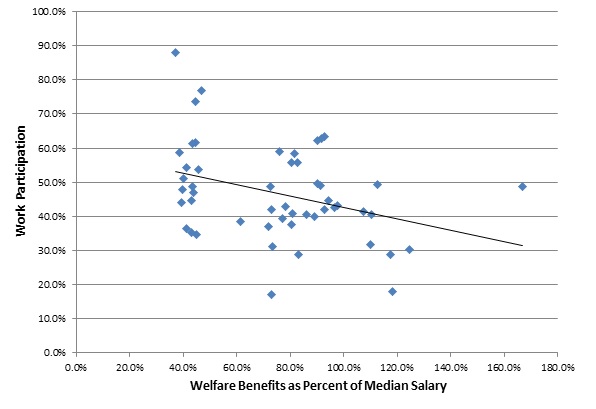
Now, comparing the welfare benefits as a percent of the median salary to the work participation rate in each state can give us a better idea of the incentive effects of welfare. So, that’s what I did. Here’s a graph of the results with a best fit linear line attached:

Welfares EffectsThere’s certainly a negative correlation between welfare purchasing power and work participation, but it’s not that strong. In particular Idaho’s work participation rate of 87.9% along with its small welfare purchasing power (36.9% of median salary) is impressive. But this analysis isn’t quite right. You may be looking at the welfare benefits as a percent of median salary and are shocked to see so many percentage over 100 percent. That’s because just about no one actually qualifies for all eight of the welfare programs that the Cato Institute includes. As Barro points out in his article, most people on welfare receive SNAP and Medicaid benefits and nothing else.

However, Tanner and Hughes predicted this rebuttal and calculated the maximum amount a person can receive from just SNAP, TANF and Medicaid benefits. They were also nice enough to include a table of those benefits as a percent of median salary in each state. I then compared those numbers to work participation and look what I found:

Welfare Effects2The correlation is positive now! State’s with greater welfare purchasing power have higher work participation rates. The correlation is even less than in the previous graph so it’s not particularly meaningful. In addition, correlation does not equal causation. This could be a complete coincidence. But it should at least make you pause whenever you hear conservative claims that welfare causes people to forego their job search and mooch off other taxpayers. The evidence on it is very unclear.

A Panel Discussion: The Coming Asian Arms Race?

This morning, the Atlantic Council’s Brent Scowcroft Center of International Security hosted a discussion on the increased military budgets of Asian states and how the United States must react in this ever-more connected world. Barry Pavel, the Director of the Center, moderated the panel, which included Ely Ratner, Randall Schriver and Kurt Amend. Ratner, the Deputy Director of the Asia-Pacific Security Program at the Center for a New American Security, opened the discussion by warning about the limitations of looking exclusively at the defense budgets of Asian countries.

“Defense spending on its own tells us little about the regional security direction in Asia,” he said. “Diplomatic and political context is absolutely vital.” He added that it’s important to take into account the increasing connectivity of security issues in Asian states.

Schriver, the President of the Project 2049 Institute and a long-time promoter of US-Taiwan relations, stressed the importance of continued U.S. support to Taiwan, whose defense spending has decreased since 2007, in the face of continued military buildup by China. He called proposals to reduce arms sales with Taiwan “naive,” arguing that the sales act as a necessary deterrent to China and also have facilitated breakthroughs in the China-Taiwan relationship in the past. Like Ratner, Schriver emphasized that the context of China’s buildup in the face of Taiwanese disarmament is a vital consideration in planning U.S. policy in the region.

Yet, Schriver expressed skepticism that the Obama Administration is showing the same enthusiasm and committment for the rebalance of resources to the Asia-Pacific as it did in Obama’s first term.

“I’m hard-pressed to know who is the go-to position in Asia right now,” he said. It’s the first time in 20 years that Schriver said he couldn’t name a director or deputy in the U.S. government focused on Asia.

Ratner shared Schriver’s concerns.

The USS Freedom departed for the Asia-Pacific in the spring.

The USS Freedom departed for the Asia-Pacific in the spring.

“Going forward, it needs to be clear that high level officials in the State and Defense Departments are interested in the ASEAN (Association of Southeast Asian Nations) region,” he said. He agreed with Schriver that there was no need or potential for forming a multilateral alliance in the area, noting that it would be unfair and harmful to Asian nations to force them to choose between a regional security alliance with the United States and their economic dependence with China.

One concern that many officials have is that U.S. committment to supporting their allies in the ASEAN region will lead those countries to become more provocative towards China. Ratner said those worries were overblown and that the U.S.’s increased presence in the region has not led to increased hostility with China. For those reasons, it’s vital that the U.S. continue to show similar levels of support to its Asian allies.

“The more secure that countries in the region feel standing up to China, the more stable the region will be,” he said. “Weakness, not strength, invites instability.”

Instead, Schriver stressed the need for the United States to develop security mechanisms that the U.S. has confidence in.

“We need to have an infrastructure of confidence building measures that actually work in the case of a crisis or an accident,” he said.

The potential for a miscalculation that causes an international incident was a theme throughout the discussion. All three panelists agreed that such an accident was one of the biggest threats to regional stability. In particular, Ratner feared the potential of a maritime accident while Schriver lamented the risk of increased corruption within the Chinese military.

Nevertheless, the panelists agreed that the increased interconnectedness between Asian nations had just as much potential to end in diplomatic agreement as it does in military conflict. Ratner stressed this fact repeatedly, emphasizing that military cooperation on defense issues and space weaponization could increase stability in the region. In either case, the U.S. must stay committed to its allies and not let other international hot spots distract it from the region, Schriver said. “The variable that is mot important and where there is the most uncertainty is the United States.”

President Obama shouldn’t forget that.