There was a bit of a dust-up between liberal bloggers and the fact checking site PolitiFact yesterday over House Majority Leader Eric Cantor’s (R-VA) comment this weekend that the government should be “focused on trying to deal with the ultimate problem, which is this growing deficit.” The deficit isn’t growing. It’s shrinking at a rapid pace, but PolitiFact rated the statement as “half-true.” So, what gives? How can the deficit be shrinking and Cantor’s statement be half-true? Let’s take a look:
Steve Benen, one of the first bloggers to jump on PolitiFact today, wrote about Cantor’s comments the day before. In fact, he quoted the following exchange in his post:
CANTOR: Here is the problem. What we need to have happen is leadership on the part of this president and White House to come to the table finally and say, we’re going to fix the underlying problem that’s driving our deficit. We know that is the entitlement programs and unfunded liability that they are leaving on this generation and the next.
WALLACE: So, are you’re saying you are willing to get — you’re willing, if you could get a compromise on entitlements, then you would give up on the sequestration?
CANTOR: What we have said in the House as Republicans, leadership and members alike, is that we want to fix the real problem. The real problem is entitlements. We’ve also said sequester is not the best way to go about spending reductions. It was, as you know, a default mechanism because Congress couldn’t do the job it was supposed to a couple of years ago. We’ve always said that. But, in fact —
WALLACE: You’re willing to give up on sequestration?
CANTOR: But, in fact, Chris, we’ve always said, president, come join us.
The full interview is here. That exchange is right before Cantor made his false “growing deficit” comment. But clearly, Cantor isn’t talking about the current debt. He’s talking about the long-term deficit. Entitlements are driving our long-term deficit while our current deficit is the result of two wars, the Bush tax cuts, and increased spending on the safety net during the recession. That’s the context of Cantor’s comment and if you are going to grade its truthfulness, you have to take that into account.
That’s what PolitiFact did. They realized that Cantor’s remark was 100% false, but in the context of what he was talking about, Cantor is right. The ultimate problem with the deficit is entitlement spending. Cantor misspoke and that’s why his statement isn’t correct. But it also can’t be called a “Pants on Fire” lie. PolitiFact responded to the criticisms today and pointed all of this out.
Kevin Drum explained this as well and noted that this is the problem with fact-checking in general. When most people think about fact-checking, they want the specific comment checked for accuracy. But this isn’t really fair. How can you analyze something without including the context? Cantor’s comment taken out-of-context is flatly wrong. In context, it makes much more sense and is more Cantor mis-speaking than anything else.
What’s most frustrating about this is that as soon as Benen posted his critique of PolitiFact, it spread around the blogosphere quickly. Paul Krugman, Ed Kilgore, Greg Sargent and Brian Beutler all criticized the fact-checking. All of those are well-respected journalists whose work I read daily. But they chose to look at Cantor’s quote out of context (except for Sargent, who put it in context of the debt ceiling when it actually referred to the problems driving the long-term deficit). Kilgore relied upon Benen’s analysis while Sargent quoted Krugman’s. It’s easy to jump on PolitiFact and make fun of Cantor for his remark, but it just creates more partisan bickering and further harms PolitiFact’s reputation. That’s not helpful for anyone.
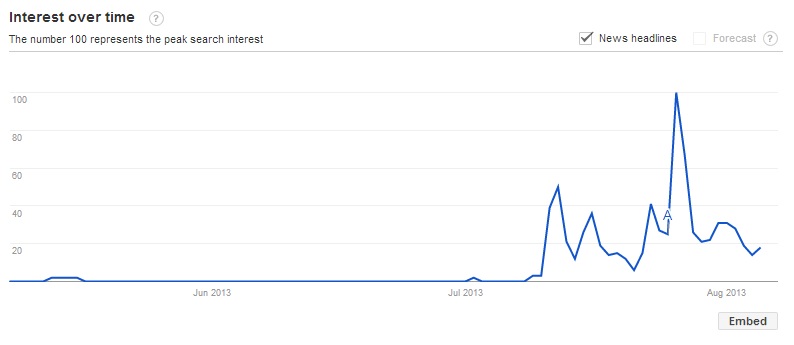 This is a Google Trends search of newspaper headlines over the past 90 days. The first allegation against Filner came on July 11th and the story picked up steam towards the end of the month, but the last couple of weeks have seen a drop in coverage. Maybe this new revelation will cause a firestorm of news stories that force Filner out of office. I hope so. Because this is beyond unacceptable for an elected official, particularly for the Mayor of a major US city. Enough of this: Filner needs to resign. Immediately.
 Danny Vinik