A Terrorist Attack from a Plane is More Likely than One from a Bus

Matt Yglesias has a good post up on his blog arguing that intelligence agencies should be required to perform cost-benefit analyses of potential security policies before implementing them. Josh Barro wrote a similar column yesterday. Within Yglesias’s post, he notes that buses have no security yet terrorists do not routinely blow them up:

As I’m going to be boarding a flight to Brussels soon, I’ve just had the opportunity to reaquaint myself with the banal aspects of the post-9/11 national security state—liquids out of your bags, full-body scans, etc. The purpose, as ever, is security. After all, if airplanes were no more secure than city buses then we’d see terrorists blowing up airplanes about as often as they blow up city buses.

At any rate, that’s my view. Approximately zero lives per year are saved by airport security measures. Some amount of economic cost is directly inflicted, and then there’s a secondary cost as people substitute dangerous driving for safe flying.

While I wholeheartedly agree that the Department of Transportation should be required to estimate the costs and benefits of new security policies, I don’t agree with the above analogy. Certain security measures may not be worth their costs, but if we reduced airport security to the levels seen on buses, would-be terrorists would have strong incentives to carry out an attack.

First, an airplane can be used as a weapon in a way a bus can’t. If a terrorist were to hijack a bus and attempt to drive it into a major building, there are a number of ways that law enforcement can stop the attack from succeeding. In many situations, police will find out quickly about such an incident and can respond in kind. They can set-up blockades, shut down parts of the city and track the vehicle easily. On an airplane though, law enforcement have few methods to respond. They cannot simply shoot the plane down and sacrifice the Americans on it. There is no way to set up a blockade.

Second, bus riders can text or phone friends to alert the authorities if the attack is not clear. In the air however, passengers cannot easily communicate with friends and family on the ground. Notifying the authorities of the attack is much more difficult from the sky than from the ground.

Third, a terrorist attack from a plane has the potential to be much more deadly than one on a bus.  At the very least, there are more people on a plane than on a bus. But terrorists can also inflict significantly more damage crashing a plane into a tall building or a secure location than they can running a bus into a similar target. Planes can crash into locations that cars and buses cannot even travel to (for example, the White House). This makes a hijacked plane much more dangerous than a hijacked bus.

Fourth, an attack from the sky is more emotionally damaging than one from the ground. We are unfortunately becoming more used to mass shootings and other threats on the ground. Part of the reason that 9/11 scared Americans so much was that it was the first time that we were attacked from the sky. That’s part of what makes drones so scary for Middle Easterners. You can’t see them and don’t know that they’re there – but they can strike at any moment. Before 9/11, we didn’t think twice about such a threat. Afterwards, we are now all alert and aware that we are not immune. A bus bombing would terrify us, but we can see a bus coming from a distance and can attempt to avoid it if it’s heading right at you. If you are so scarred from such an event, you can avoid buses for the rest of your life. You can’t avoid a plane striking your home or office out of nowhere. You don’t see it coming until it’s too late and there’s no way to fully protect yourself. That fear sticks with you for the rest of your life.

For all those reasons, terrorists have greater incentives to hijack a plane than a bus. That’s why Yglesias’s analogy doesn’t work. Now, there are some TSA policies that almost certainly have costs greater than their benefits (banning pocket knives) and Yglesias is right that we need agencies to conduct cost-benefit analyses more often. With specific estimates of the costs and benefits of a proposed policy, politicians will have more confidence in supporting less security. After all, no politician wants to risk advocating for reduced security and then face voters if a terrorist attack does happen. This biases the entire system towards excessive security. At least with a cost-benefit analysis, Congressmen will have specific statistics to show their constituents for why they voted for such a policy. If that alone can reduce the bias in the system, it’s worth a shot.
St. Petersburg and Housing Regulations

While I’m no longer in Russia (on to France), I wanted to write a quick post about St. Petersburg’s building height regulations. It was one of the things I noticed immediately after landing in the city. Buildings are never more than 10 stories in height. Meanwhile, according to the Russian real estate magazine “Bulleten Nedvizhimosti,” the average cost of housing per square meter in the secondary market is 94,721 rubles (I would advise translating the magazine into English). According to the Federal State Statistic Service, Russian’s federal stat agency, the average cost of housing per square meter in the secondary market in all of Russia is 56,370 rubles (PDF). St. Petersburg is significantly more expensive than the national average.

In terms of population density, St. Petersburg ranks 599 out of 875 urban areas with a population greater than 500,000 in the world (PDF). It ranks 22nd out of 60 Russian cities in terms of population density. The reason? Building height restrictions. The Construction Codex of 1844 states that no building can be higher than the Winter Palace, which is just 23.5 meters tall. Over the past few decades, repeated attempts to construct high rises have failed due to opposition from the city’s citizens. Last August, city hall approved the construction of a 463 meter skyscraper, but activists have already pushed back and are urging their local politicians to retract the approval.

The height restriction limits the available housing supply in the city, driving up prices and rents. Higher rents means that businesses must charge more for their products and services in order to cover their costs. The height restriction thus drives up the cost of living throughout the entire city. Having just been there for a few days, I can attest to the high prices (though I’m sure part of that was tourist traps).

Protesters argue that allowing taller buildings will ruin the city’s skyline and historic landscape. To some extent, St. Petersburg is a beautiful city because it’s not a maze of 500-meter buildings. But that doesn’t mean that the 23.5 meter limit is acceptable either. The city should raise the cap on building heights – maybe to 75 meters, maybe to 100. This would keep the city’s skyline in tact  while drastically increasing the housing supply and lowering prices. Housing costs will not be as affordable as they could be if St. Petersburg removed the cap altogether, but the extra costs are what the city’s citizens pay to retain the beautiful views.

Frequently in the U.S., stupid city policies act in the same manner. Policymakers don’t even seem to understand the connection between height restrictions and high prices (Go read Matt Yglesias for more). They never propose loosening housing regulations as a way to fix the problem. At least in St. Petersburg, the city seems aware that the 169-year-old code drives up prices and have approved the building of skyscrapers in recent years. In this case, the opponents of taller buildings – mostly citizens of the city itself – are the ones preventing the implementation of sensible policies. Hopefully, city hall will not cave in to pressure yet again and St. Petersburg will be home to its first skyscraper.

California Does NOT Fudge the Math on Obamacare

Over the past few days, fans of the Affordable Care Act have been celebrating the news that the expected premiums for California’s health care plans have come in well below expectations. Sarah Kliff summarized the story nicely on Wonkblog. Just a bit ago, former policy director for Mitt Romney, Lanhee Chen, wrote an article for Bloomberg View arguing that California did not compare plans correctly and that premiums would actually increase. Here’s Chen:

Covered California, the state-run health insurance exchange, yesterday heralded a conclusion that individual health insurance premiums in 2014 may be less than they are today. Covered California predicted that rates for individuals in 2014 will range from 2 percent above to 29 percent below average small employer premiums this year.

Does anything about that sound strange to you? It should. The only way Covered California’s experts arrive at their conclusion is to compare apples to oranges — that is, comparing next year’s individual premiums to this year’s small employer premiums.

I hadn’t seen any push back on the California numbers so this immediately intrigued me. Chen goes on to offer what he deems a direct comparison of California health care plans:

So, let’s make an actual apples-to-apples comparison for the hypothetical 25-year-old male living in San Francisco and making more than $46,000 a year. Today, he can buy a PPO plan from a major insurer with a $5,000 deductible, 30 percent coinsurance, a $10 co-pay for generic prescription drugs, and a $7,000 out-of-pocket maximum for $177 a month.

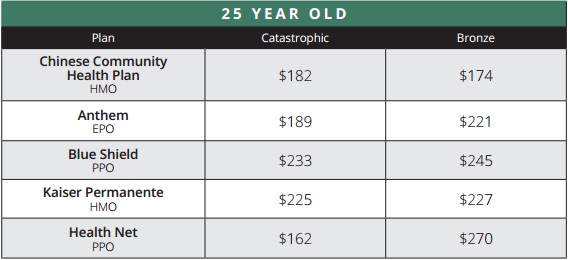
According to Covered California, a “Bronze” plan from the exchange with nearly the same benefits, including a slightly lower out-of-pocket maximum of $6,350, will cost him between $245 and $270 a month. That’s anywhere from 38 percent to 53 percent more than he’ll have to pay this year for comparable coverage! Sounds a lot different than the possible 29 percent “decrease” touted by Covered California in their faulty comparison.

I wanted to find out where those numbers came from so I dug into the Covered California report (PDF). Here’s the important table from page 39 of the report:

Covered California

The three most expensive plans range from $245 to $270 but Chinese Community Health Plan and Anthem both offer cheaper plans! That $174 plan is actually $3 per month cheaper than the current plan that Chen outlines. Am I missing something here or did Chen just deliberately choose the more expensive plans as examples to prove his point? If he did, it’s just blatant dishonesty. Otherwise, I’m not really sure why he excluded Chinese Community Health Plan and Anthem. I’m not an expert on health policy and certainly not one on the San Francisco area, but this seems pretty straightforward to me.