The Debt Ceiling is Terrifying

I recently finished reading Robert Draper’s book, Do Not Ask What Good We Do, on the 112th Congress, focusing on the House of Representatives. Here’s a quick excerpt from a meeting with Joe Biden and Eric Cantor during the 2011 debt ceiling fight:

“Well, we’re giving you the vote on the debt ceiling,” said Cantor. “You may not think it’s a big deal. But you’ve got to understand, I’ve got a lot of guys who think that not raising the debt ceiling wouldn’t be such a bad thing – that in fact it’s just what we need.”

The Democrats weren’t sure what to say

Cantor added, somewhat abashedly: “We’re working hard to educate our guys.”

Here’s another passage about the debt ceiling:

Still, the disconnect between what Boehner himself had termed fiscal “Armageddon” and the bullheadedness of the tea partiers unnerved members like Jo Ann Emerson. She sidled up to one of the freshman one day and said, “I need you to explain why you don’t think there’s anything wrong with us defaulting on the debt. I can’t have this conversation with my constituents because I’ll yell at them and they’ll yell at me. So you tell me.”

The freshman’s reply bewildered Emerson. “We’ve spent way too much money,” he told her. “If this is price we pay, so be it.”

Emerson wanted to reply: You asshole! Do you really not understand what could happen?

Some House Republicans are entirely satisfied with defaulting on our debts. Now in January, the 113th Congress begins which is a bit more liberal than the previous one. But that leaves Boehner, presuming he keeps his Speakership, with three basic options:

1. Bring up a vote to raise the debt ceiling no-strings-attached. This would earn near unanimous support from Democrats and the Speaker could lose almost all of his party and still have the bill pass. It would also provoke massive blowback from the Right and jeopardize his power in the party.

2. Bring up a vote to raise the debt ceiling with very conservative strings-attached. This would earn very little support from Democrats and the Speaker would have to ensure that every Republican voted in favor of the bill. To that, it would have to be a very conservative bill. That means it will be DOA in the Senate. Boehner would, however, solidify his Speakership.

3. Bring up a vote to raise the debt ceiling with moderate strings-attached. This could earn moderate support from Democrats and the Speaker could lose some of his party and still have the bill pass. The bill would also likely pass the Senate. However, this would also provoke massive blowback from the Right.

The President has taken the stance that he will not negotiate over the debt ceiling. Obama does not want to create a precedent for the minority party to use the debt ceiling as a hostage to enact concessions from the majority. I believe he will stick by this.

That’s going to make this very scary though. It means that either Boehner choose Option 1 above and risks his Speakership or puts together a bill (possibly with the help of Nancy Pelosi or Harry Reid) that raises the debt-ceiling with moderate strings-attached. He’ll risk huge criticism from his base and still have to keep much of his caucus in line while working with Pelosi and Reid. At the same time, the President will refuse to even take his calls.

Otherwise, we default.

It helps that Boehner will likely keep his Speakership when the House votes on January 3rd. But he still has to whip votes for any bill and that’s very difficult to do with the current makeup of House Republicans, as seen by the failure of his Plan B. And this time, there’s no cheap tricks such as a Super Committee and Sequester to get a deal. It’s a very scary proposition.

 

Extend the Payroll Tax Cut!

Fiscal Cliff

Does Boehner have to accept a compromise?

Yesterday, I wrote a post arguing that liberals are overestimating the President’s leverage on the fiscal cliff. There were a couple of reasons for this, but the biggest one was that the Republicans were now apparently willing to raise taxes on people earning more than a $1,000,000. Turns out, that’s not true.

House Speaker John Boehner was unable to convince his caucus to pass such a bill. It’s clear now: Tea Party Republicans are never going to vote for a tax increase, even if such a vote would actually avoid raising taxes on the majority of Americans. It’s not going to happen.

President Obama does not have to worry about convincing Americans that Republicans are holding the middle class tax cuts hostage. It’s painfully obvious without him saying so. If we go over the fiscal cliff, the Republicans will be blamed.

In addition, if Boehner wants to avoid going over the cliff, he’s going to need support from lots of House Democrats and that means compromising with Obama.

Either way, Obama now has all the leverage in the negotiations and I’m hoping he uses it.

However, unlike other Democrats, I’m not looking for the President to walk back from his most recent offer. As Ezra Klein wrote earlier today, that’s not entirely an option. It will look bad for Democrats and risk hurting the economy. Instead, the President should demand the inclusion of an extension to the payroll tax cuts.

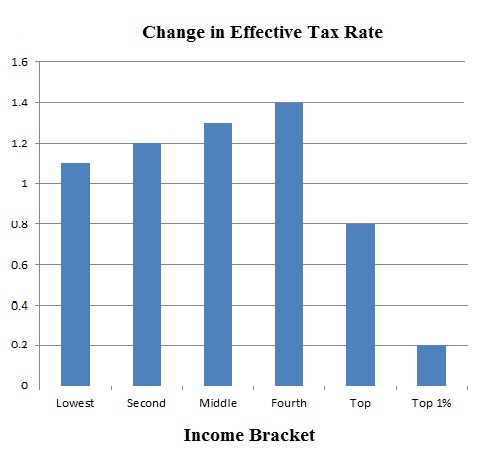
The economy is still barely recovering and extending the payroll tax cuts will prevent an unnecessary and untimely increase on middle class taxes. According to the Tax Policy Center, it would raise taxes mostly on the bottom 80 percent of households:Pay Roll Tax Cut Expiration

Extending the payroll tax cut will help out these families the most. Now that Obama has the full leverage on the fiscal cliff and isn’t at risk to lose it, it’s time he uses it to help out the middle class. This is the way to do it. (Image via)

Liberals Overestimate Obama’s Leverage on the Fiscal Cliff

The Fiscal Cliff is still unresolved.

The Fiscal Cliff is still unresolved.

Over the past couple of days, the White House has taken a lot of heat from liberals for agreeing to using chained-CPI in Social Security. Different writers have lashed out at such a deal and argued that the President is back to “negotiating with himself.” Many of these liberals see going over the fiscal cliff as better than the deal Obama is currently offering. They believe that going over the cliff will give Obama more leverage in the negotiations and allow him to extract a better deal from Republicans. However, I’m very skeptical of this for three reasons:

First, the President is in such a great position now because Republicans really don’t want the Bush tax cuts to expire for anyone. The President wants to extend the tax cuts as well, just not for those making $250,000 a year or more (his most recent offer upped this amount to $400,000). In his counteroffer, House speaker John Boehner agreed to raise rates on those making more than a $1,000,000.

But the rates on everyone automatically rise on January 1st (though its effects don’t occur for a few months). This where the President’s leverage comes from. He would sign a bill extending the tax cuts for the middle class, but Republicans won’t because they want to extend rates for the upper class (and small businesses) as well. That’s why the President can say:

It’s unacceptable for some Republicans in Congress to hold middle class tax cuts hostage simply because they refuse to let tax rates go up on the wealthiest Americans

The polling has largely backed up the President, with the American people blaming Republicans for not compromising.

The thing that many liberals have overlooked is that this can change quickly. Boehner’s offer to raise rates on those making over a $1,000,000 may not be much substantively, but it represents a big shift in the Republican party. For years now, the Republicans have adamantly refused to raise taxes. Period. End of question.

Now, the Speaker is finally offering to let taxes rise on the wealthiest Americans. The American people may see this as a major compromise for Republicans and believe that the President is now holding the middle tax cuts hostage. I haven’t seen any polling since Boehner submitted this offer to the President,  but I’d be very interested in it. If we go over the fiscal cliff, it’s possible that Obama could receive much of the blame. That would certainly put him in a much worse bargaining position. Continue reading “Liberals Overestimate Obama’s Leverage on the Fiscal Cliff”