California Does NOT Fudge the Math on Obamacare

Over the past few days, fans of the Affordable Care Act have been celebrating the news that the expected premiums for California’s health care plans have come in well below expectations. Sarah Kliff summarized the story nicely on Wonkblog. Just a bit ago, former policy director for Mitt Romney, Lanhee Chen, wrote an article for Bloomberg View arguing that California did not compare plans correctly and that premiums would actually increase. Here’s Chen:

Covered California, the state-run health insurance exchange, yesterday heralded a conclusion that individual health insurance premiums in 2014 may be less than they are today. Covered California predicted that rates for individuals in 2014 will range from 2 percent above to 29 percent below average small employer premiums this year.

Does anything about that sound strange to you? It should. The only way Covered California’s experts arrive at their conclusion is to compare apples to oranges — that is, comparing next year’s individual premiums to this year’s small employer premiums.

I hadn’t seen any push back on the California numbers so this immediately intrigued me. Chen goes on to offer what he deems a direct comparison of California health care plans:

So, let’s make an actual apples-to-apples comparison for the hypothetical 25-year-old male living in San Francisco and making more than $46,000 a year. Today, he can buy a PPO plan from a major insurer with a $5,000 deductible, 30 percent coinsurance, a $10 co-pay for generic prescription drugs, and a $7,000 out-of-pocket maximum for $177 a month.

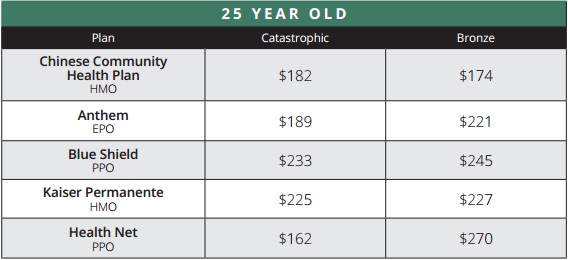
According to Covered California, a “Bronze” plan from the exchange with nearly the same benefits, including a slightly lower out-of-pocket maximum of $6,350, will cost him between $245 and $270 a month. That’s anywhere from 38 percent to 53 percent more than he’ll have to pay this year for comparable coverage! Sounds a lot different than the possible 29 percent “decrease” touted by Covered California in their faulty comparison.

I wanted to find out where those numbers came from so I dug into the Covered California report (PDF). Here’s the important table from page 39 of the report:
Covered California

The three most expensive plans range from $245 to $270 but Chinese Community Health Plan and Anthem both offer cheaper plans! That $174 plan is actually $3 per month cheaper than the current plan that Chen outlines. Am I missing something here or did Chen just deliberately choose the more expensive plans as examples to prove his point? If he did, it’s just blatant dishonesty. Otherwise, I’m not really sure why he excluded Chinese Community Health Plan and Anthem. I’m not an expert on health policy and certainly not one on the San Francisco area, but this seems pretty straightforward to me.

Liberals Should Use the Term “Obamacare”

President Obama signs the Affordable Care Act into law

For a while, liberals stayed away from the term, but as the public as grown more and more accustomed to it, they have changed tactics.

I’m with Kevin Drum. I’ve never really had a problem with the term. I’ve never really seen what the problem is.  And I somewhat agree with Drum when he writes “if ACA eventually becomes popular, then Obamacare will be a positive term. If it fails, then it will fade away. It’s that simple.”

I don’t think it’d fade away if the law fails. Conservatives will forever use it to remind the public that the Democrats tried and failed to reform health care. But I think there’s a better reason for liberals to use the term “Obamacare.” If (and when, in my opinion) the law succeeds and popularity for it soars, Obama and the Democrats deserve credit it.

And Democrats will receive a great share of that credit, but Republicans are not going to just let the Dems bask in the glory of the law without trying to gain some of that credit themselves. They may claim that the success of the law is because of the state-run exchanges, not the federal government. They may claim it’s a result of governors actually accepting the new Medicaid expansion. No matter what though, they are going to try to spin it more in their favor, no matter how hard that may be.

And under that scenario, “Obamacare” would certainly disappear from the conservative lexicon. But it shouldn’t disappear from the public’s lexicon. After all, conservatives have used the word to attack Obama for the past 3+ years. Why should it disappear right when the law becomes successful?

In all likelihood, it wouldn’t. It’s likely too ingrained in the public image of the law to simply vanish just because it’s no longer a conservative talking point. But Democrats have proven inept at messaging the law and it’s not impossible for that to happen.

But Democrats and Obama deserve credit for the law if it succeeds. They cannot allow Republican messaging to diminish the fact that the Democrat plan worked. So how do we prevent that from happening? By calling it “Obamacare” now. Make sure the name is even more embedded in the public discourse. Make sure Democrats are used to using the term. Support the law and build a positive message around the term. And don’t back away from it if (and when) it succeeds. That’s how you ensure that Obama and Democrats get credit.

It starts by accepting the term now and I’m glad to see Democrats (finally) doing that. (Image Via)

Democrat Support for Obamacare Jumps

A lot of political reporters have commented on the Kaiser Family Foundation poll released today with numbers in the aftermath of the Supreme Court upholding the Affordable Care Act. Overall, Americans seem to want the opponents of the law to move on and support for the law has moved slightly in the Democrats’ favor, though it really has not changed much.

There was one graph that immediately jumped out at me though:


Democrats who have a very favorable opinion of the bill has skyrocketed from before the health care decision until afterwards, up from 31 percent to 47%. In fact, Democrats have never had a more favorable opinion of the bill. What does this mean? Probably nothing, the economy will be the main focus come November and health care won’t have an affect, but it has to be nice for Obama to finally see some appreciation from Democrats for his health care bill.

The poll also finds that the decision makes Democrats 18 percent more likely to vote and Republicans 31 percent. I would imagine that the rise in Democrats who have a very favorable opinion of the law would make them more likely to vote, but conservative hatred of the law is a stronger driver of votes than liberal approval of it. I will be highly surprised if it actually matters in the presidential election, but interesting nonetheless (especially on a slow news day).