Liberals Overestimate Obama’s Leverage on the Fiscal Cliff

The Fiscal Cliff is still unresolved.

The Fiscal Cliff is still unresolved.

Over the past couple of days, the White House has taken a lot of heat from liberals for agreeing to using chained-CPI in Social Security. Different writers have lashed out at such a deal and argued that the President is back to “negotiating with himself.” Many of these liberals see going over the fiscal cliff as better than the deal Obama is currently offering. They believe that going over the cliff will give Obama more leverage in the negotiations and allow him to extract a better deal from Republicans. However, I’m very skeptical of this for three reasons:

First, the President is in such a great position now because Republicans really don’t want the Bush tax cuts to expire for anyone. The President wants to extend the tax cuts as well, just not for those making $250,000 a year or more (his most recent offer upped this amount to $400,000). In his counteroffer, House speaker John Boehner agreed to raise rates on those making more than a $1,000,000.

But the rates on everyone automatically rise on January 1st (though its effects don’t occur for a few months). This where the President’s leverage comes from. He would sign a bill extending the tax cuts for the middle class, but Republicans won’t because they want to extend rates for the upper class (and small businesses) as well. That’s why the President can say:

It’s unacceptable for some Republicans in Congress to hold middle class tax cuts hostage simply because they refuse to let tax rates go up on the wealthiest Americans

The polling has largely backed up the President, with the American people blaming Republicans for not compromising.

The thing that many liberals have overlooked is that this can change quickly. Boehner’s offer to raise rates on those making over a $1,000,000 may not be much substantively, but it represents a big shift in the Republican party. For years now, the Republicans have adamantly refused to raise taxes. Period. End of question.

Now, the Speaker is finally offering to let taxes rise on the wealthiest Americans. The American people may see this as a major compromise for Republicans and believe that the President is now holding the middle tax cuts hostage. I haven’t seen any polling since Boehner submitted this offer to the President,  but I’d be very interested in it. If we go over the fiscal cliff, it’s possible that Obama could receive much of the blame. That would certainly put him in a much worse bargaining position. Continue reading “Liberals Overestimate Obama’s Leverage on the Fiscal Cliff”

Debate Reaction

The final debate came and went last night and if you follow me on my twitter, you saw absolutely nothing from me on it. Why? A couple of reasons:

First off, I had the luxury of watching with my class of students with none other than Karl Rove. He debated Howard Dean earlier during the day at Duke and stuck around to watch the debate with us. Of course, we were all focused on the actual debate but it was still very cool to be sitting just a few feet away from him during it.

But, plenty of my classmates were on Twitter during it and Rove was as well. I chose to stay off because I wanted to judge it without the nonsense of Twitter. I thought last night was particularly partisan. The first debate Romney clearly won in a landslide. Obama won the second by a little. But throughout last night’s debate and afterwards, any Democrat or left-leaning journalist I follow seemed to think Obama dominated and any Republican or right-leaning journalist thought Romney dominated. It was split decisively along party lines. It was quickly clear to me that I wasn’t going to get much from reading Twitter and I certainly wasn’t going to add anything to the discussion as well. So I stayed away and I’m glad I did so. It actually felt kind of nice to watch the debate away from social media (mostly – I snuck a peek every once in a while).

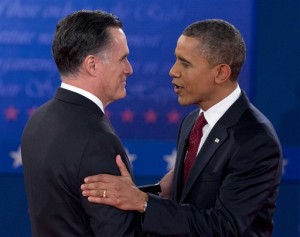
President Obama and Mitt Romney during their third and final presidential debate.

As for my thoughts on the debate, I thought it was a dead draw. Obama responded well on Israel/Iran while Romney seemed to do better on China (something that infuriates me – more on that later). I thought the rest of the issues were about even. The polling after the debate seemed to show a Obama victory, but remember my way of judging the debates: the winner is the person who convinces voters to vote for him.

Here are the snap polls:

CNN

Who won the debate? Obama 48%, Romney 40%

Who are you more likely to vote for? Unchanged 50%, Romney 25%, Obama 24%

Public Policy Polling

Who won the debate? Obama 53%, Romney 42%

Are you more or less likely to vote for President Obama?

More likely 37%
Less likely 31%
Unchanged 30%

Are you more or less likely to vote for Governor Romney?

More likely 38%
Less likely 35%
Unchanged 26%

CBS News

Who won the debate? Obama 53%, Romney 23%, Tie 24%

Once again, CBS annoys me and doesn’t have any more info on their polls (or if they do, someone please point it out to me). As for the CNN and PPP poll, clearly it was about a draw. The PPP poll actually shows Romney with an advantage among independents. Thirty-two percent of independents said they were more likely to vote for Obama after the debate while 47% said they were less likely. In contrast, 47% of independents said they were more likely to vote for Romney afterwards with 35% saying they were less likely.

Some numbers point towards Obama, some towards Romney and my gut reaction was a tie. Thus, I’m going to call it a tie until I see further polling. We (and by we, I mean Nate Silver) will have plenty of polls to sort through during the next two weeks. (Image via)

“Who Won” the Debate

President Obama and Mitt Romney squared off in their second presidential debate Tuesday.

Before I jump into the snap polls from after the debate, it’s worth remembering what it means to “win” a debate. It means that voters come away afterwards more likely to vote for you than your opponent. In the end, that’s the winner of the debate.

For instance, Public Policy Polling conducted an instant poll after the debate last night in Colorado and found that 48% of voters declared Obama the winner while 44% of them gave it to Governor Romney. So a slight win for Obama right? Wrong. You can read it that way but that’s not very useful. The same poll found that 37% of voters were more likely to voter for Obama after the debate and  36% more likely to vote for Romney. That’s a tie.

Now, I expect this debate to offset some of the ground Romney gained in the first debate. If that’s the case, then Obama did win. But based off individual polls, if voters are equally as likely to vote for Obama and Romney after last night’s debate as they were before it, then the debate is a draw.

As for the CNN poll that found a 46% to 39% advantage for President Obama, it also is a bit misleading. The poll also found “[o]ne-quarter of debate-watchers said the event made them more likely to vote for Obama, and an equal amount said it made them more likely to vote for Romney. Half said it would have no effect on their vote.” Once again, a draw.

I haven’t been able to find more details on the CBS poll that gave Obama a 37%-30% victory.

The main point is that it doesn’t matter who voters say won. It matters who they are more likely to vote for after the debate. The initial (and likely very noisy) polls indicate that Obama and Romney tied last night. I actually don’t think this is the case – I do think the President won and it will show up marginally in the polls the next few days. Just keep this in mind as you read more polls on “who won” last night. (Image via)