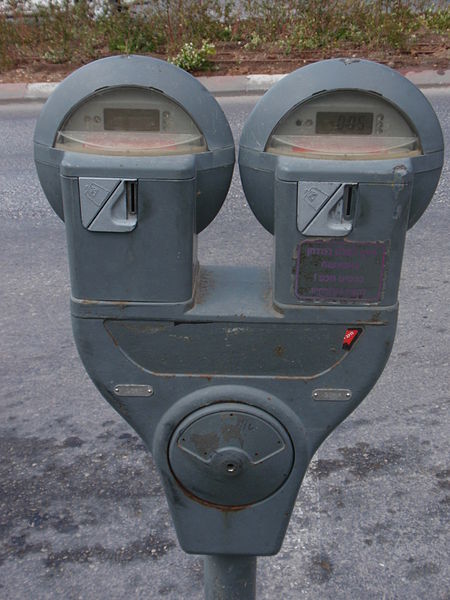
Taibbi Still Wrong About NYC Parking Meters

New York City will lease out its parking meters.

Matt Taibbi wrote a post on June 13 strongly arguing against New York City leasing its parking meters. The piece was titled “New York to Repeat Chicago’s Parking Meter Catastrophe.” Felix Salmon shot back at Taibbi and I added a bit more to Salmon’s post as well. Now, it’s back to Taibbi:

“The city might get $11 billion in the deal, but if that’s even a dime less than the real present value of these parking meters (to say nothing of the actual amount of revenue that will be collected over the life of this arrangement), then to me that’s bad and shortsighted public policy.”

First of all, Taibbi’s first post assumed that the real present value of the parking meters must be a lot higher than $11 billion. He assumes the same in this piece as well:

“If $11 billion can do a lot of good, then I’m sure $20 billion or $25 billion – or whatever the investors buying into this deal end up calculating the real value of those meters is, and it’s surely more than $11 billion, or they wouldn’t be doing the deal in the first place – would do a lot more good.”

We don’t even know the length of the contract yet and Taibbi is jumping to conclusions that the state must be valuing it wrong. I admit that that is probably the case. States have never proven great at valuing their assets and selling them off, but New York is also determined to avoid repeating Chicago’s mistake when the city sold off its parking meters for dramatically less than they are worth. Continue reading “Taibbi Still Wrong About NYC Parking Meters”

Executive Pay Grows Yet Again

David E. Simon, CEO Simon Property Group

The top CEOs around the country saw their median pay grow to $14.5 million last year, even as stockholders began demonstrating their displeasure. The Dodd-Frank bill requires companies to hold a vote regarding executive pay at least once every six years. Many companies did so last year and stockholders voiced their displeasure. For instance, 73.3 percent of shareholders of Simon Property Group voted against the pay of its top executive, David Simon. Here’s the issue, though. The vote is non-binding. Companies have to take into account the stockholders’ vote, but they do not need to listen to it. Thus, Simon received $137 million last year, though a large chunk of it was in a stock package.

In many ways, CEO pay has fallen into a downward spiral. Companies are not just competing with each other for a limited supply of top-level executives, but they are competing with each other to pay those top-level executives the most. Many companies have begun using CEO pay as a form of prestige. A small company paying an outlandish amount for its top-level executives views itself as a more influential and important company than one of a similar size who pays just an average amount for its executives.

Each year companies pay their CEOs more, increasing their pay much more than the average worker and higher than inflation. Then the following year, in order to keep up with other companies, they raise their top-executive pay even more. Each year, the raises the executives receive outpace the raises that ordinary workers receive, f they happen. This just further increases income inequality. Do all CEOs really deserve a raise each year that is twice as a great in percentage terms as the ordinary worker? What if the company loses money? Can anyone really believe that CEOs deserve a raise then? But it happens and the American public has been rightfully outraged about it for year. Unfortunately, while Dodd-Frank at least gave stockholders the ability to vote on the issue, it didn’t give them any actual power. Thus, top-level executives continue to see their pay rise while the rest of America grumbles to itself.

Image via

Devil is in the Details: NYC Parking Meters

I want to expand a slight bit on Felix Salmon’s post on New York City’s plan to lease out their parking meters. The basics of the story is that New York City is going to lease out it’s parking meters (around 90,000 of them) to a private company. A couple of writers have come out against the plan, citing the catastrophe in Chicago as evidence. But Salmon sums up best why this is actually the perfect time to privatize the meters:

The fact is that New York, like most cities, is bad at monetizing the value of its on-street parking. This deal gives the city the opportunity to change that, and at the same time to introduce technology which could reduce congestion substantially, while also raising billions of dollars for investment in the city’s future. It’s a win-win-win.

He also adds in that New York is facing a $3 billion deficit and faces very low-interest rates. The deal would bring in approximately $11 billion,  more than enough to cover the hole this year. With that money, New York will not have to lay off more government employees and cut social services. It can even do the opposite, use the money to fund infrastructure developments or hire more teachers. Such actions will spur demand and add money to an economy still facing a liquidity-trap. It’s the absolute perfect time to privatize the meters.

Except there is one detail that has not been revealed: the length of the deal. That is the most important point. Chicago’s 75-year deal is a disaster because it was both heavily under-priced and lasts for a very long time. Chicago is stuck.

But New York can learn from the Windy City’s mistakes. In a perfect world, the city would make a deal for just a few years, effectively a short-term loan to cover its current deficit. However, investors are not likely to be that interested in a short-term deal so I expect this to be for at least 25, very likely closer to 40, years. That’s what will be key. If it turns out to be 2o years, then it is a huge win for New York. If it’s for 100 years though, New York City has big issues. But until the contract is finalized and we see the exact terms of it, we can’t say either way whether it’s good or bad for the city.