McConnell is Ready for a Tea Party Battle

For a little while, it seemed as if Senate Minority Leader Mitch McConnell (R-Ky.) would swing to the right to match up with his right wing challenger, Matt Bevin. The past couple of weeks have shown otherwise. McConnell stepped forward and orchestrated the debt ceiling deal and has criticized the Tea Party’s tactics repeatedly.

Sam Youngman has the details of this burgeoning battle:

McConnell caused widespread whiplash last week when he unleashed a blistering attack on Bevin, his Republican primary challenger, just days after the Kentucky senator had signaled he was looking past Bevin to likely Democratic opponent Alison Lundergan Grimes.

Instead, several allies of McConnell and other Senate Republicans say the senator is now planning a two-front war: one against Grimes and the other against the fundraising groups that are supporting Bevin. McConnell’s real targets are the Senate Conservatives Fund, which announced its endorsement of Bevin on Oct. 18, Heritage Action for America, Madison Project, FreedomWorks and other outside groups.

If McConnell can crush Bevin, the thinking goes, he can expose a lack of ideological consistency in the outside groups, allowing him to separate Tea Party voters from Tea Party fundraising groups.

This is shaping up to be the key race in next year’s elections. Can McConnell antagonize the Tea Party and outside groups and defeat Bevin by running a more centrist campaign? If he does so, will those Tea Partiers support him against Grimes and provide the votes to defeat her? Neither question has a clear answer. McConnell has a very difficult year ahead of him.

I’ve argued that the Republican establishment’s best way to retake the party from the radicals in it is to quietly win elections. McConnell isn’t taking that advice. He wants to make a statement here that will reverberate far beyond Kentucky. It’s a high-risk, high-reward strategy. If the minority leader can hold his seat, it will signal to other moderate Republicans that they can take a harder line against the Tea Party and still win elections.

McConnell is also the perfect candidate to take this risk. He’s a part of the Republican leadership, which means Tea Party disdain for him is already pretty high. He can only alienate so many more Tea Partiers by attacking them, compared to a more junior member who could incite strong opposition by doing so. In addition, Kentucky is a solid red state, meaning that he could lose some of the right-wingers and still defeat Grimes in the general election.

But the risks here are also extremely high. Bevin and Grimes are both strong candidates and will not go away easily. Outside money is going to pour into Kentucky as the primary kicks into full gear. McConnell’s attorney already accused Bevin of committing a misdemeanor last week. This is going to be a heated primary and it could easily hurt his showing in the general. How nasty will this get? Hollywood stars are already lining up to donate to Grimes, with many in the Democratic party thinking that she could have a real shot to unseat the minority leader. McConnell’s determination to send a message to his party and use Bevin’s radicalness against him only plays into their hands.

This is a vital test of the Republican establishment’s ability to tame the Tea Party by attacking them head on. If McConnell can defeat Bevin and Grimes, it will be a rallying cry for moderates to take back control of their party. But if he falters, the opposite will be true. It will be a crystal clear indication that the Tea Party is still in power and will force moderates to continue bending to their every whim. It’s not an understatement to suggest that McConnell’s campaign is a battle for control of the Republican party.
Dumb Arguments Against Changing The Height Act

The D.C. Office of Planning recently sent a proposal to Rep. Darrell Issa (R-Calif.) to update the 1910 Height Act. The proposal called for a modification of the formula used to calculate maximum height restrictions in the L’Enfant area and also to release the city of all federal height restrictions in the rest of the District. The city would set its own limits based on its zoning process.

Iss has taken a keen stance on D.C. issues and asked for the proposal, along with one from the National Capital Planning Commission (NCPC), which presented a much more timid recommendation. While the fate of the 103-year-old law rests with Congress, D.C. residents have not been quiet about voicing their displeasure at the proposal. But the arguments against modifying the Height Act always seem to come up short.

The arguments in favor are pretty straightforward. The current housing restrictions severely limits the supply of residential and commercial space. That means higher rents for both residents and businesses, which are passed down to consumers through higher prices of goods. With more housing, rents would fall, prices would fall and more people would move into the city. This would not just provide a much larger customer base, but also a much larger tax base, giving the city more resources to spend on infrastructure and other programs. The arbitrary restrictions on the housing supply severely restrict economic growth. D.C.’s plan would start to change that.

Not everyone seems to get this though.

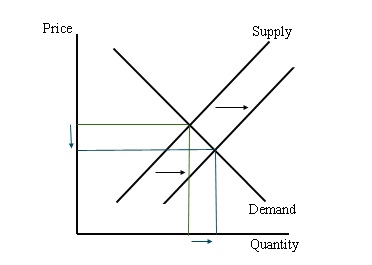
For instance, the President of the Capitol Hill Restoration Society, Janet Quigley, recently published a piece that argued it “could raise housing costs.” This is entirely wrong. Here’s a simple, Econ 101 demonstration of what happens when you increase the availability of housing:

supply shifts out


Notice how price falls? In the case of housing, that’s rents. The amount of housing demanded increases as well, but this is a shift along the demand curve. It’s a result of the lower housing costs as the market reaches a new equilibrium. In and of itself, relaxing housing restrictions will lead to lower, not higher, housing costs.

But the most ludicrous argument I’ve seen against modifying the Height Act comes from Chris Otten, the director of the District Dynamos, when he questioned whether the population growth forecasts laid out by Planning Director Harriet Tregoning were accurate. Much of the impetus for changing the law comes from the fact that D.C. estimates that its current housing stock cannot keep pace with the city’s expected population growth. Otten thinks he’s found a hole in that argument. Here’s Aaron Wiener at City Paper:

Chris Otten, director of the Ralph Nader-backed District Dynamos, questioned Tregoning’s population growth forecasts, saying they do not account for increased cancer rates from disasters like the Fukushima nuclear meltdown.

Wait. What?! Otten’s reason for doubting the growth forecasts is that more people may die of cancer thanks to potential nuclear meltdowns in the future. Of course, Otten could have come up with a hundred other potential future disasters that will restrict population growth. Why not the risk of a meteor shower? Or an alien attack? This line of argument is so absurd it goes to show how far opponents of changing the Height Act will go to stand in its way. Let’s hope Issa & Co. don’t give them a second thought.

The Disadvantage Liberals Face With Judging Obamacare

For the past couple of months, arguments surrounding the Affordable Care Act have centered on how the law will affect premiums for the majority of Americans. Then, something funny happened. The date when open enrollment started and people could first see what they would actually pay for health insurance came and went and all the talk of “rate shock” disappeared. It was replaced first by coverage of the government shutdown and then by the federal health exchange’s major problems. Almost a month later, we are finally starting to talk about the real effects of Obamacare.

Stories about rate shock abound and there hasn’t been time for a more comprehensive overview of how Obamacare is affecting premiums. What has happened though is that President Obama’s oft-repeated line that if you like your health care, you can keep it has proven to be an outright lie and supporters of the law have found themselves on the defensive.

For years, Obama assured Americans that his health care law wouldn’t force them to change insurance if they liked the coverage they had. It was an easy line to tell audiences, but it was clearly not going to be true. Obamacare requires insurance companies to cover 10 “essential health benefits” such as maternity and mental health care. Many plans didn’t cover those services before. The law also mandates that plans limit out-of-pocket expenses to $6,350. There was simply no way that insurance companies could comply with all the new requirements in the law and offer the same insurance plans. It was never a possibility, despite Obama’s repeated assurance that it was a certainty. The president was lying.

Conservatives have jumped on this lie to demonstrate that Obamacare isn’t working. President Obama promised you that you can keep your plan and now you can’t. That’s a fair criticism in and of itself, but it’s not an argument against the law. Just because some Americans can no longer keep their plans does not make the law a failure.

The same is true of conservative remarks about “rate shock.” This was the fundamental argument heading into October 1st. Would most Americans see higher premiums (after factoring the in the subsidies)? That answer is unclear, but liberals have nevertheless found themselves conceding that point while defending other aspects of it. Story after story have emphasized that Americans around the country are seeing higher premiums, not lower ones. Under that framework, it’s tough for the law’s supporters to argue that Americans are not facing “rate shock.” Instead, they’ve hard to argue that the complex nature of the law means higher premiums are not telling the entire story.

This is exactly right. The fact is that many Americans will witness “rate shock.” Their premiums are going to increase, but this isn’t a flaw or a failure of the law. It’s a feature. The law asks healthy, young people to pay more so that unhealthy, older ones have access to affordable coverage. It asks men to pay more so that women pay less. It asks the rich to pay more so that the poor pay less. It’s a law built on making the system fairer.

This doesn’t show up in “rate shock,” but it’s there. The problem is that during the past couple of months, conservatives have framed the success or failure of the law around the cost of premiums. Liberals bought into that framework and argued that premiums would be lower when you factored in the subsidies. That meant that the law would not be judged on the millions of people becoming eligible for Medicaid or Americans with pre-existing conditions finally having the opportunity to purchase affordable health insurance. It would be judged on “rate shock.”

The greater challenge here is that the media has an appetite for digging out and finding stories of people facing higher premiums. Never mind that many of these people are young, middle class Americans – the exact people who Obamacare asks to pay more. The framework ensures that the media treats this “rate shock” as a condemnation of the law.

Obamacare supporters always faced an uphill battle here. It’s easy to judge a law based on premiums. It’s much more difficult to judge it based on newly required services that insurers must cover, reduced discrimination, lower risk of financial catastrophe and the ability of Americans with pre-existing conditions to purchase coverage. This difficulty is not limited to liberals. Conservatives have argued that the law will greatly reduce consumer choices of doctors and hospitals. This doesn’t come up in the “rate shock” framework as well. But that framework is still overwhelmingly tilted in favor of the Republican argument.

Like Obama’s lie above, the existence of “rate shock” does not mean the law is a failure. It was bound to happen and the media was bound to hunt for instances of it and put them on a national stage. They were always much less likely to search out the 55-year old women with diabetes who finally can purchase health insurance. This has put liberals in the precarious situation of emphasizing the nuances about how “rate shock” is a necessity to ensure the many benefits of the law can take place.

The framework has put Obamacare supporters at an inherent disadvantage. In many ways, that disadvantage was unavoidable, but by buying into the use of “rate shock” as the benchmark for analyzing the law, they also brought it upon themselves. Now, they have to find a way to reshape the conversation so that the analysis of the law focuses not on premiums, but on the vastly fairer health insurance environment that will soon exist.