GOP Chooses Big Business Over Free Markets

I don’t link to other articles and blog posts on here enough. I’m trying to do it more. So here’s a piece by Ezra Klein on former Republican Study Committee staffer Derek Khanna and his support for more relaxed intellectual property laws, starting with allowing consumers to legally unlock their cell phones and to create a backup of legally purchased DVDs. In November, Khanna wrote a memo for the RSC on how to reform copyright law. It was filled with great ideas and received widespread praise across the blogosphere. Unfortunately, Republican congressmen immediately faced significant pushback from Big Business, which is very happy with the current restrictive copyright regime. The RSC pulled the memo after a few hours and informed Khanna a few weeks later that he would not be retained at the start of the new Congress. Big Business had won.

Here’s Klein:

There’s a difference between being the party of free markets and the party of existing businesses. Excessively tough copyright law is good for big businesses with large legal departments but bad for new businesses that can’t afford a lawyer. And while Khanna, like many young conservative thinkers, believes in free markets, the Republican Party is heavily funded by big businesses.

If Republicans really were for free markets, they would openly embrace Khanna’s reforms, such as stricter term limits on copyright, expanded fair use and reduced statutory damages. These policy ideas push government policy towards free markets and less regulation. As Khanna writes at the end of his memo, “[c]urrent copyright law does not merely distort some markets – rather it destroys entire markets.”

By ignoring and refuting Khanna’s ideas, Republicans are confirming what many Americans already believe: the GOP is the party of the rich and Big Business. Republicans cannot claim to be in favor of free markets and small government when they oppose such sensible reforms that would reduce government overreach in intellectual property law. It’s hypocritical to claim otherwise. At the same time, this is the perfect opportunity for Republicans to improve their image. Supporting copyright reform would prove to Americans that they are still the party of free markets.

Alas, there have been no sign that the GOP will embrace Khanna’s ideas. As for the young Republican, he’s pushing ahead promoting intellectual property reform and just earned White House support for allowing consumers to unlock their cell phones. That’s a big victory for Khanna, but there is lots more work to be done. Unfortunately, it doesn’t look like he’ll have Republican support in his pursuit of freer markets.
Last Game in Cameron

I’ve never posted about my time as a Cameron Crazie. I’ve been about as die-hard a fan as you can be over the past four years. I’ve never missed a home game while I’ve been on campus. I’ve been a top-10 tent for the Duke-UNC game every year. I’ve been front row, painted and cheering maniacally for almost every ACC game. Duke basketball has been one of the main focal points of my time here and tonight is my final game as a Cameron Crazie. Of course, I will always be one at heart, but my time in the student section is up. Time to pass the baton.

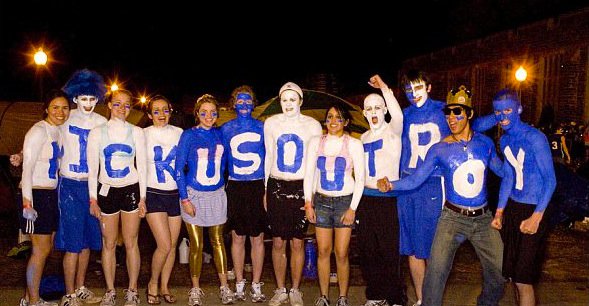
Maybe at some point I’ll reflect on my experience in the Cameron student section. It’s a lot more than cheers, jeers and a sea of blue and white. It’s an intricate process, complete with long schedule-making, rushed pregame painting and cold nights on the sidewalk. Of course, it is well worth it. There’s no better view in college basketball than the one I’ve had the past four years. Every second was worth it. Here’s a picture from right before the Duke-UNC game my freshman year. We spelled out “Kick Us Out Roy” after UNC coach Roy Williams had security remove a fan from a UNC home game after he yelled during a UNC free throw, something that happens everywhere all the time.

Kick Us Out Roy

I’m the awkward “I” in blue hair, second from the left.

It’s also fitting that my penultimate game was possibly the best one I’ve been to. Duke-UNC games have been incredible over the years, but this past weekend’s Duke-Miami showdown was as good as those. It was as loud a crowd as we’ve had in a long time and few players have had as special a night as Ryan Kelly. Add in beating a top-5 team and a close, well-played game and it made it an unbelievable night. I’m glad it was the penultimate. Tonight we play Virginia Tech (the last-placed team in the ACC) and hopefully will win easily. Hopefully Coach K can give big minutes to walk-on senior Todd Zafirovski and take senior stars Seth Curry, Ryan Kelly and Mason Plumlee off to a long standing ovations. They deserve it. If tonight’s game was against Miami or an equally tough opponent, we would be too caught up in the game to thank the seniors. Playing against Virginia Tech provides us that opportunity.

So tune in to ESPNU at 7 tonight and watch the seniors’ final game. I’ll be in the front row painted (weather-permitting, right now not looking good).

Does the Market Care About the Sequester?

The sequester officially takes effect tomorrow and there has been almost zero negotiations between the White House and Republican leaders over avoiding the cuts. Instead, both sides have spent most of their energy blaming the other side. The media has done an excellent job covering this aspect of the sequester, but it has ignored another major part of it: market reaction.

Remember, the sequester was enacted in the summer of 2011 when Republicans took the debt ceiling hostage and we almost defaulted on our debts. In the immediate aftermath of the deal, investors were happy that the U.S. Congress had avoided creating an artificial economic crisis. However, part of that optimism stemmed from the sequester. If the Super Committee failed (as it eventually did), then Congress would have to find a way to either replace the sequester or accept the sledge-hammer cuts. For a while now, a number of serious people on Wall Street have been calling for deficit reduction. I don’t agree with their analysis, but that’s what many people on Wall Street want.

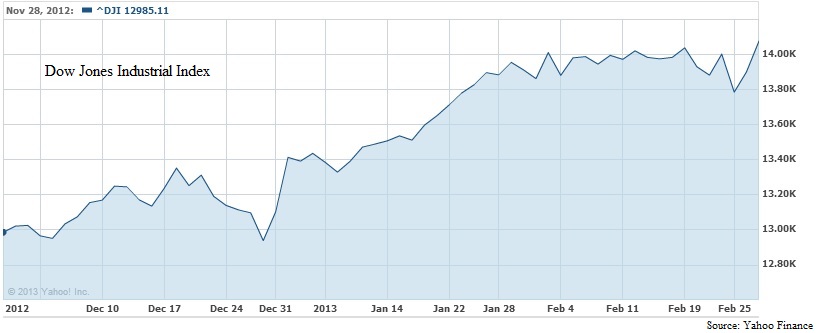
So, is it any surprise that as we get closer to the sequester taking effect, the market has soared? Here’s the Dow Jones over the past three months:

Dow 2.28Now, there’s a lot of other factors in there, such as the Fiscal Cliff deal and the recent mess in Italy. But look at the steep rise at the end. That’s in the last few days even as Italy cannot form a government and the Eurozone looks to be moving towards another crisis. At the same time, everyone in the U.S. wants to avoid the sequester, but we cannot agree to a deal so all these cuts that no one wants are going to be implemented tomorrow. Look at the market reaction over the past few days:

Dow 3 day
Does that look like the market is panicking about the sequester? Not at all. No one wants these cuts, our government is too dysfunctional to even negotiate over them and yet the Dow has almost reached a new high. Why?

One possible reason may be other factors. Fourth quarter GDP was revised upwards today and unemployment claims came in below expectations. But none of that explains the previous two days rising market. Of course, it is always tough to pin down a reason for why the market does what it does. No one knows for sure. But I’d hypothesize that the sequester hitting is actually reassuring markets.

The government is not just removing the sequester without replacing it. Although I would support such a bill, Wall Street would not. As I said above, Wall Street wants deficit reduction and the sequester cuts spending. It may not do so in a smart way, but it cuts it nonetheless and Wall Street is pleased that we are actually reducing the deficit.

It also shows that Congress can constrain future Congresses. This is always a tough thing for Congress to do. It can enact as many deficit reduction plans as it wants, but if future Congresses just repeal those spending cuts/tax increases, than any long-term plans that Congress legislates will be meaningless. Future Congresses will just undo them. But the sequester is demonstrating that future Congresses will not just ignore previous reduction plans. Part of this is a result of partisan gridlock, but if that’s what forces future Congresses to abide by the deficit reduction plans of the current Congress, so be it. That works just as well for the markets since that partisan gridlock doesn’t seem to be disappearing anytime soon.

Of course the impacts of the cuts, while unclear, will still hurt the economy and even if Wall Street is hoping the cuts take effect, it’s still bad policy. It also brings up a different question: if we were to just get rid of the sequester, would markets revolt? I’m not sure and it doesn’t look like we’ll ever find out. But it’s a question the media has ignored entirely and deserves more coverage.