Why Republicans Should Care Even More About the Sequester

The sequester officially hits on Friday and at this point, there’s no chance of avoiding it. If Congress and the President agree on a deal, when that deal is struck will determine how much damage the sequester ultimately causes.

The White House and Republicans have spent the last week not trying to avoid the cuts, but trying to lay the blame at the other’s feet. The GOP has ardently pushed the line that President Obama came up with the idea for the sequester and thus is responsible for it. The Administration has tried to scare the public and Congress into a deal by demonstrating how bad the cuts will be (cuts to teachers, airline delays, etc.). Yesterday, they released a state-by-state breakdown of how the cuts will effect different departments and programs in every state. The Washington Post has a nice interactive graphic of it here.Sequester state by state
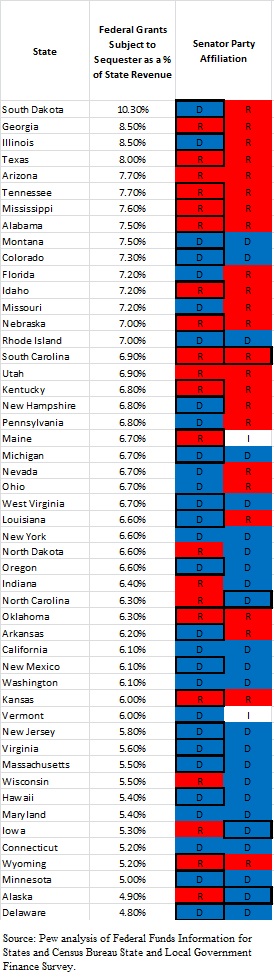
As I read Wonkblog today, I came across a post detailing the states who receive the most in federal aid as a percentage of state revenues and thus are most exposed to sequester cuts. This wasn’t using White House data, though. It’s from a Pew Center of the States study from last December. That got me thinking: the senators of states more exposed to the sequester should have an even greater incentive to push for a deal to avert it. So, I went through Pew’s data and combined it with the partisan identity of the senators in each state. The result is to the right.

The states most exposed to the cuts are undeniably states with Republican Senators. Of the 20 states most exposed, 28 of the 40 senators in them are Republicans. In the 20 states least exposed, just 11 of the 40 senators are Republicans (28 are Democratic with one Independent). This isn’t a surprise though: Republican states receive a large share of federal funds and thus steep cuts to those dollars will hurt those red states the most. Given that, Republicans should have even greater incentive to cut a deal.

Now, let’s say that Republicans are worried enough about the deficit that they can swallow the cuts, even if they predominantly impact Republican states. What about the political prospects of senators in those states? The public is going to be upset with these steep funding cuts as polling shows that no one actually wants to cut anything outside of foreign aid. Senators in states who face deep budget cuts from the sequester are going to face a disgruntled constituency. Those up for reelection in 2014 will be at the greatest risk of voters giving them a one-way ticket out of Washington.

Thus, I went through and outlined each senate seat up for election in 2014 in bold. Here, neither Democrats or Republicans are in particularly good shape. In 2014, 36% (10/28) of Republican Senators in the 20 most exposed states are up for reelection while just 27% (3/11) of Republicans seats are up for grabs in the 20 least exposed states. The is true for Democrats as well. Of Democratic Senators in the most exposed states, half (6/12) are up for reelection, but in the least exposed states, just 39% (11/28) of Democratic seats are up.

What does this all mean?

While both Republican and Democratic senators are going to find themselves with a lot of angry constituents post-sequester, Republican senators are going to face even greater wrath. This should give them a further incentive to make a deal. Nevertheless, they have refused to consider any additional revenue thus far and without relaxing that demand, no deal is going to be struck. At this point, it looks like the GOP would rather accept the cuts and deal with angry constituents instead of cutting a deal with more revenue in it.

As for those up for reelection in 2014, they have significantly more incentive to make a deal as well, but this doesn’t seem to be having much of an effect on their decision-making either. Republican senators up for reelection in 2014 whose states will be deeply affected by the cuts still won’t agree to additional revenues and Democratic senators are not going to accept that, even if they are up for reelection in 2014 and reside in a state severely impacted by the sequester as well.

In the end, which states are most exposed to the sequester and how it affects different senators’ reelection prospects doesn’t seem to be impacting the negotiations at all. That’s not particularly surprising to me, but in 18 months, we may see some senators who wished that they’d advocated for a compromise harder.

The Expiration of the Payroll Tax Cut is Killing Us

From the WSJ today:

Less take-home pay is causing 45.7% of consumers to curtail spending, according to a survey released on Thursday by the National Retail Federation, a trade group. A quarter of consumers are delaying big-ticket purchases, a third are reducing restaurant visits, and about a fifth of shoppers are spending less on groceries, it said.

U.S. retail sales in January rose at their smallest rate in three months, estimates the U.S. Commerce Department, a result said analysts of the effect the higher payroll tax was having on consumer spending.

The Fiscal Cliff debate was focused on the rising income taxes, but it should have been framed around the expiration of the payroll tax. For some reason, Democrats and Republicans both generally agreed that the payroll tax cut was due to expire. The President’s first proposal included a year-long extension of it, but after that, he dropped it. There just wasn’t any interest in renewing it.

Outside of the capital, it wasn’t much better. The mainstream media mostly ignored the issue. After all, it’s a lot more fun to cover a major battle over income tax rates than to cover bipartisan agreement on a rising payroll tax. But we reap what we sow and now both consumers and businesses are feeling the pain.

BTW, my previous posts pleading with Congress to extend the payroll tax cut had more on its expected effects: here and here.

Life Rant: The Importance of Competition

It’s been a busy few weeks with the Duke-UNC game, midterms and my job search, but I’m back and will be posting more over the next few weeks. First up: a rant I’ve been meaning to deliver.

I don’t’ think anyone really doubts the benefits of competition in markets these days, but sometimes life gives you very clear reminders of how important competition is. I’ve had two in just the past few days (these borderline on major whines so feel free to skim/not read):

1. I’m currently at school at Duke University in Durham, North Carolina and live in an apartment off-campus. The only option for internet and cable TV is Time Warner Cable. For those of you have used Time Warner, you probably know how incredibly frustrating every part of the company is. Now, the area around my apartment is under construction and it has disrupted various services while my roommates and I have lived there. For months now, the cable will go out numerous times a day. The TV screen will suddenly go blue and we will have to unplug various cords, jiggle the box or just wait it out. There isn’t any obvious cause for its failures and when we called Time Warner to come check it out, the tech didn’t even both coming and instead just informed us it was due to the construction and we could get a significant break on our payments. In addition, our internet has gone out at various times for hours at a time. It even went out in the middle of finals week for a full day. Now, you can call us just whiny college students, but we’re paying a decent amount of money for a service that fails a huge amount of the time. Is it that absurd to expect our internet and TV consistently?

frustrationSo, we called Time Warner to discuss that option. Let’s just say that Time Warner’s customer service was less than satisfactory. They sent us back and forth between different departments for an hour and finally offered us a $20 rebate, when we were looking for much, much more. Finally, we reached someone who offered us a month of free service, which was closer to what we were looking for. The manager politely told us that for a greater rebate, they’d have to send a service technician out to examine our setup again (they didn’t have much of a record of their tech’s first “visit”). We agreed and scheduled a meeting for the following day. Shockingly, no one arrived and we never heard from Time Warner. They’ll be getting another call this week.

If we could, we would dump Time Warner in a heartbeat and pick up a competitor. Unfortunately, no such competitor exists. I’d love to write a guest column in the Duke student newspaper recommending that anyone living off-campus bypass Time Warner and choose some other provider. I’d love to at least use that as a threat against Time Warner. Unfortunately, we can’t do that. Is there any clearer example of why competition matters? Time Warner can offer us sub-par internet, cable TV, maintenance and customer service, because we have no choice in the matter.* Continue reading “Life Rant: The Importance of Competition”