A Missed Opportunity

20120831-102703.jpg

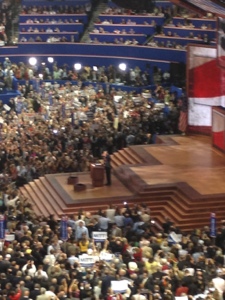
Romney speaks at the RNC.

The Republican National Convention wrapped up last night with Mitt Romney giving the keynote address and Clint Eastwood adding the…um entertainment. I was not able to attend the first night, but last night was certainly much more exciting and interesting than the previous evening.

The reason? The night wasn’t full of politicians. It was full of people who knew Romney personally. Ted & Pat Oparowsky spoke about the care and compassion Romney showed their family, and in particular, their son, who was diagnosed with cancer at just 14 years old. Next, Pam Finlayson gave a moving speech about her daughter, who was born three and a half months premature and died just over a year ago at the age of 26. She told the quiet crowd how Romney had frequently cared for her two-year-son while her daughter was in the hospital and when she was unable to prepare a Thanksgiving meal, the Romneys stepped right in and showed up at her door, meal in hand.

The crowd was silent during these great speeches and many were wiping tears off their cheeks after them.

A number of other individuals – from Romney’s days as a pastor, his time at Bain and his term as Massachusetts governor – gave a tremendous picture of Romney as a smart, caring man.

Then, just before the networks cut in, a video played throughout the arena about the Romney family and Mitt’s parents. It had numerous old family photos and videos from Mitt’s father, George Romney. It had interviews with the Mitt’s sons, about how they always used to cause trouble as a kid and they would never go to their dad to ask for money (always their mother).The video was nothing short of adorable.

Then prime time came and out walked Clint Eastwood to a huge ovation. Then Clint Eastwood spent the majority of his speech talking to a chair (with an invisible Obama in it of course). I don’t think it was disrespectful but it was incredibly strange. From inside the arena, it felt weird. When I re-watched in on TV later, it was even weirder. I really cannot figure this one out. Eastwood had no teleprompter or notes. He went on stage and said what he wanted to – and it showed.

The empty chair routine was certainly awkward. I’m not sure why anyone at the RNC approved of the idea (or let Eastwood sneak a chair onstage). But it was a huge missed opportunity. The Oparowsky’s story, Pam Finlayson’s moving speech or the video of Romney’s family would have been perfect to humanize Mitt and show a complete different side of him to a huge audience.

Instead, the world saw an 82-year-old Clint Eastwood talk to a chair. It was a huge mistake.

As for Romney’s speech itself, it was solid and effective. But it was not a game changer. It was policy-light, rhetoric-strong. His top lines of the night were certainly:

If you felt that excitement when you voted for Barack Obama, shouldn’t you feel that way now that he’s President Obama? You know there’s something wrong with the kind of job he’s done as president when the best feeling you had was the day you voted for him.

And:

I wish President Obama had succeeded because I want America to succeed.

Romney was mostly his strong, confident self for most of the speech. He grew a bit emotional when talking about his parents but quickly transitioned to his time as Governor.

Overall, Romney was exactly who we know him to be: a presidential-looking, confident man that just cannot seem to connect to the average person.

That’s what makes the inclusion of Eastwood and the exclusion of the humanizing videos and speeches about Mitt such a huge missed opportunity. Those stories could have helped him connect with the average voter more than any speech could. But the millions of viewers in prime time didn’t get to see them and that may go down as one of the biggest mistakes of this election.


Romney Campaign Finds Its Message

Paul Ryan speaks at the RNC.

The second night of the Republican National Convention was yesterday and I was lucky enough to be there (as I will be tonight). It was a slow starting night, but finished strong with speeches from former Secretary of State Condoleezza Rice, New Mexico governor Susana Martinez and of course Paul Ryan.

Republicans continued pounding the President for “you didn’t build that,” with nearly every speaker mentioning the line. It’s clearly playing a much more prominent role in the election than any political pundit predicted. It’s become the Romney campaign’s main message.

Now, the line is incredibly deceptive, if not an out-and-out lie. In fact, the Washington Post’s fact checker Glen Kessler awarded it Four Pinocchios just yesterday morning. But it’s not going away, not matter how much liberal bloggers scream and yell about it. And even worse for those annoyed bloggers, it has finally given the Romney campaign something to run on.

A theme I’ve noticed over the course of this election is that the Obama campaign has had a clear plan of attack against Romney, but the Romney campaign has not had one against Obama.

Obama began with Bain Capital, attempting to refute Romney’s claim that his business background makes him the optimal choice for the Oval Office. The campaign (somewhat dishonestly) called Romney an outsourcer and then transitioned to sharp attacks against the former Governor for not releasing more of his taxes. Finally, the campaign turned to the Ryan Budget, trying to paint Romney as a man whose main goal is to help the rich and cut the safety net.

The story flows from one theme to the other, building up evidence along the way. What did the Romney campaign have? A few gaffes that no one really cared about and an economy that, while still bad, has been slowly improving.

More than anything, it needed a message. It needed something that both confirmed conservative fears that Obama is a big government socialist and convinced independents that Obama’s ultimate goal is wealth equality. In “you didn’t build that,” Romney found his message.

The Romney campaign wants to convince voters that Obama is a socialist intent on using the government to control outcomes; that Obama believes government is the root of all success, that individuals are cogs in the government machine and do not determine their own success (or lack thereof).

Yes, Obama does not believe any of these things. But that doesn’t matter. What matters is what voters believe. If Romney can convince voters of this message, he can win.

For a while now, I haven’t actually thought the election would be particularly close but I’m becoming less convinced. Before the Romney campaign discovered this message, I just didn’t see a way for it to win (outside a European meltdown, major government scandal, etc.). But now I do. If the Obama campaign cannot refute the “you didn’t build that” message, it opens the doors for a Romney victory.

A Referendum on Campaigning

I’ve been away from the blog for a bit the past week, enjoying the end of my summer and I wanted to stay away from the Paul Ryan show. The blogosphere has covered him and the Ryan Budget profusely so I don’t have much to add. More and more I believe that his election is not going to be that close. Obama won’t win by as much as he did in 2008, but I just don’t see it being all that tight and Romney’s selection of Paul Ryan as his running mate has only strengthened my view. Why? Because Ryan is controversial, his budget isn’t popular and he’s just not as wonky as people think. Real Clear Politics’s excellent conservative blogger Sean Trende said as much in his article evaluating Romney’s choice.

But let’s assume for a second that Obama does win by a decent margin. Such a victory is important not just because it allows the President and Democrats four more years to implement their policies. It is also important because it sends two positive messages for futures campaigns:

1. Money doesn’t buy elections. Obama will get outspent handily in this election. There’s no doubt about that. But what if all the tens of millions of dollars that Sheldon Adelson puts in to Romney’s campaign becomes worthless? What about all the other big money donors? If Obama wins relatively easily, maybe next time, they will be more hesitant in opening their wallets. This matters less for the presidential election than for down ticket races. In the end, those down ticket races are where money matters. If we can remove some of the money from those races – where Republicans have a huge advantage in cash – it will be a big victory for the country. Right now, too many candidates just don’t have a chance because they just don’t have the resources. How many moderate Republicans has the Club for Growth taken out with their vast swaths of money? Well, maybe an Obama win can help reverse this trend. It certainly can’t hurt.

2. Vagueness doesn’t work either.  I feel bad for Romney. He has so little to run on now because the Republican party has lurched so far to the right. And to make up for that, Romney has been incredibly vague in all of his policies. In fact, they can barely be called policies. This cannot be the standard for presidential campaigns. Candidates need to lay out their platforms and allow the media and public to judge them. Right now, Romney isn’t allowing this happen. Ultimately, I don’t believe Romney really had much of a choice, but an Obama win would certainly ensure that future candidates cannot just skirt the issues. (More on this to come).

Many pundits have declared that Romney’s selection of Ryan will make this election “about the issues.” Yes and no. Yes, voters around the country will be able to read countless articles on Obama’s policies and the Ryan Budget. They will get a chance to vote on the issues. But for those of us who follow Washington closely, there isn’t really anything new. Both Obama’s policies and the Ryan Budget have been thoroughly dissected. Ultimately, there’s just not that much more policy-wise to add to the discussion. Now, the election is all about messaging those plans to the voters.

But this election is also a referendum on what works in campaigns. Does a huge money advantage ensure victory? What about vague policies? What about both of those in the midst of a weak economic recovery? The framework for future campaigns lies with the answers to these questions and it’s important that future campaigns aren’t run to maximize money and minimize serious policy proposals. For those reasons, an Obama victory offers more than just a victory on the issues (as would a Romney victory). It offers a victory on how to campaign. And since I believe Romney’s selection of Ryan will only increase the chances of the President winning a second term, I’m certainly happy with Romney’s choice.