Of Course, the Tea Party Has a More Favorable View of the GOP

A WSJ/NBC News poll today is out with what is at first a surprising result. They find that when people are asked whether they have a positive or negative view of their own party, Thirty-two percent of non-Tea Party Republicans respond in the negative while only 21% of Tea Party Republicans do so:
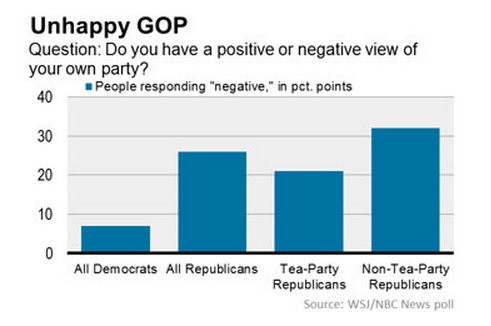
Intra-party pollGiven how much the Tea Party rails against the Republican Party and the establishment, it seems contradictory that more non-Tea Partiers actually have a negative opinion of the party as a whole. Except, this view doesn’t take into account what the party is actually doing. The fact of the matter is that the Tea Party controls the House GOP right now, which, as the only part of the party that controls a branch of Congress, then has the ability to dictate its agenda. Thus, the government shutdown, no immigration reform and a strict adherence to no new revenues. These are all policies that grew out of the Tea Party movement and the Republican Party has now adopted. Of course, the Tea Party has more favorable views of the Republican Party than non-Tea Pariers do! The Tea Party is in control.

This can be seen clearly in the same WSJ/NBC News poll when it asks about compromising on a budget deal. Here are the results:

Compromise Tea PartyNon-Tea Partiers want to make a budget deal by an overwhelming amount while the Tea Party wants the party to stick to its position by an even greater amount. Overall, the party is split. Guess what? The Tea Party wins. We certainly aren’t getting a big budget deal. At most it will be a small compromise and even that is unlikely. Polling for immigration reform shows a similar split where the Tea Party is against a path to citizenship while the rest of the party is open to it. There too, the Tea Party’s preferences have become the Republican Party line.

This perfectly represents why non-Tea Partiers give the party such a negative view as a whole. They are the ones who have been cut out and ignored, not the Tea Party. If anything, it’s surprising that nearly a fifth of Tea Partiers have a negative view of the GOP. After all, the Republican Party is following the Tea Party’s strategy to a tee.
McConnell is Ready for a Tea Party Battle

For a little while, it seemed as if Senate Minority Leader Mitch McConnell (R-Ky.) would swing to the right to match up with his right wing challenger, Matt Bevin. The past couple of weeks have shown otherwise. McConnell stepped forward and orchestrated the debt ceiling deal and has criticized the Tea Party’s tactics repeatedly.

Sam Youngman has the details of this burgeoning battle:

McConnell caused widespread whiplash last week when he unleashed a blistering attack on Bevin, his Republican primary challenger, just days after the Kentucky senator had signaled he was looking past Bevin to likely Democratic opponent Alison Lundergan Grimes.

Instead, several allies of McConnell and other Senate Republicans say the senator is now planning a two-front war: one against Grimes and the other against the fundraising groups that are supporting Bevin. McConnell’s real targets are the Senate Conservatives Fund, which announced its endorsement of Bevin on Oct. 18, Heritage Action for America, Madison Project, FreedomWorks and other outside groups.

If McConnell can crush Bevin, the thinking goes, he can expose a lack of ideological consistency in the outside groups, allowing him to separate Tea Party voters from Tea Party fundraising groups.

This is shaping up to be the key race in next year’s elections. Can McConnell antagonize the Tea Party and outside groups and defeat Bevin by running a more centrist campaign? If he does so, will those Tea Partiers support him against Grimes and provide the votes to defeat her? Neither question has a clear answer. McConnell has a very difficult year ahead of him.

I’ve argued that the Republican establishment’s best way to retake the party from the radicals in it is to quietly win elections. McConnell isn’t taking that advice. He wants to make a statement here that will reverberate far beyond Kentucky. It’s a high-risk, high-reward strategy. If the minority leader can hold his seat, it will signal to other moderate Republicans that they can take a harder line against the Tea Party and still win elections.

McConnell is also the perfect candidate to take this risk. He’s a part of the Republican leadership, which means Tea Party disdain for him is already pretty high. He can only alienate so many more Tea Partiers by attacking them, compared to a more junior member who could incite strong opposition by doing so. In addition, Kentucky is a solid red state, meaning that he could lose some of the right-wingers and still defeat Grimes in the general election.

But the risks here are also extremely high. Bevin and Grimes are both strong candidates and will not go away easily. Outside money is going to pour into Kentucky as the primary kicks into full gear. McConnell’s attorney already accused Bevin of committing a misdemeanor last week. This is going to be a heated primary and it could easily hurt his showing in the general. How nasty will this get? Hollywood stars are already lining up to donate to Grimes, with many in the Democratic party thinking that she could have a real shot to unseat the minority leader. McConnell’s determination to send a message to his party and use Bevin’s radicalness against him only plays into their hands.

This is a vital test of the Republican establishment’s ability to tame the Tea Party by attacking them head on. If McConnell can defeat Bevin and Grimes, it will be a rallying cry for moderates to take back control of their party. But if he falters, the opposite will be true. It will be a crystal clear indication that the Tea Party is still in power and will force moderates to continue bending to their every whim. It’s not an understatement to suggest that McConnell’s campaign is a battle for control of the Republican party.

Will Rand Paul Filibuster Janet Yellen?

Will Paul filibuster Yellen?

Will Paul filibuster Yellen?

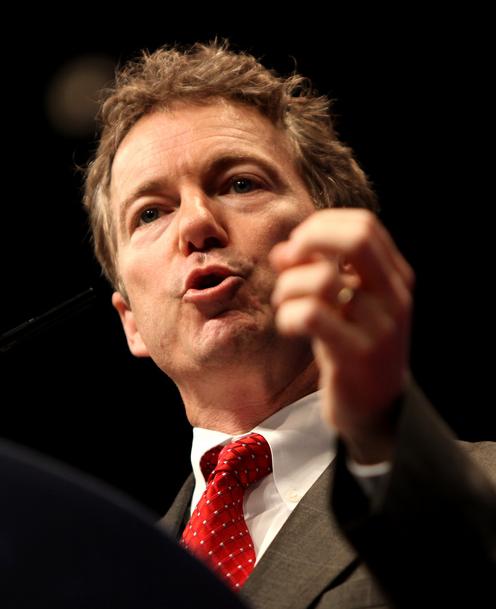
Sen. Rand Paul (R-Ky.) announced today that he plans to place a “hold” on Fed Chair nominee Janet Yellen. By doing so, Paul sets himself up to perform another filibuster as he did against the nomination of CIA head John Brennan last February. It’s not clear at all that Paul will filibuster Yellen if Harry Reid ignores his “hold” and proceeds with the nomination. Paul’s demanding a vote on his bill to audit the Fed, something that his father pushed for years.

A filibuster will be another negative mark against the Republican party as Americans believe more and more that the party is unable to govern. This will lead many in the party to push him to allow her nomination to go forward. If the establishment comes out strongly in favor of allowing her to proceed, Paul will have a tough decision to make.

One argument against a filibuster is that Janet Yellen would be the first ever women chairman of the Fed and filibustering her would look terrible. It’s conventional wisdom that the Republican Party has a gender problem. Women don’t like the GOP. If the party cannot find a way to reverse that description, it will have a hard time taking back the presidency in 2016. That means it will have to nominate a candidate who has a strong track record on gender issues, or at least not a bad one. By filibuster Yellen, Paul reduces his chances of being that person. Not just will Yellen be the first woman to head the Fed, she is unquestionably qualified, has a huge amount of experience and has a terrific track record. Paul does not doubt any of that, of course. He simply wants a vote on his bill. But that doesn’t matter. What matters is the optics of his actions and those optics aren’t good. He’ll be filibustering the most-qualified Fed Chair nominee in recent history, who also happens to be the first woman nominee.

Except that doesn’t matter. Few issues affect a general election. A filibuster against a Fed nominee three years earlier will almost certainly be meaningless. Nearly half the country doesn’t know who Yellen is. That number will certainly rise, but most people vastly underrate rate the importance of the Federal Reserve. They don’t care who runs the place.

On the other hand, a filibuster offers Paul a chance to keep pace in the race for Tea Party support. The Tea Party is having a collective orgy over Sen. Ted Cruz’s (R-Tx.) filibuster* and government shutdown. Paul smartly avoided that fight and thus hasn’t infuriated the establishment, but it did allow Cruz to seize control of the right wing. Paul needs to strike back and this offers him a rare opportunity where the issue before the Senate relates directly to a topic he’s passionate about. He’s doesn’t get many chances where he can draw national attention to audit the Fed. Like drone strikes, this is an issue where Paul is the leader. It’s perfectly timed for him to demonstrate to the Tea Party that he is equally as defiant as Cruz is and will fight tooth-and-nail against the Obama administration.

Cruz earned Tea Party support for his government shutdown antics, but lost the establishment. Rand Paul still has that support, but he has to compete with Cruz in the primary. If he can earn an equal support from the Tea Party as Cruz does, it will set him up to be the senate leader for the Republican nomination. But if the establishment becomes enraged at Paul for filibustering Yellen, it will put him in the same position as Cruz and be a boon for the Republican governors eying the presidency. Paul has a tough decision to make.

*I know it was technically not a filibuster. Whatever.