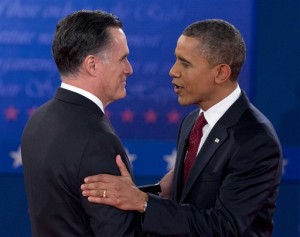
“Who Won” the Debate

President Obama and Mitt Romney squared off in their second presidential debate Tuesday.

Before I jump into the snap polls from after the debate, it’s worth remembering what it means to “win” a debate. It means that voters come away afterwards more likely to vote for you than your opponent. In the end, that’s the winner of the debate.

For instance, Public Policy Polling conducted an instant poll after the debate last night in Colorado and found that 48% of voters declared Obama the winner while 44% of them gave it to Governor Romney. So a slight win for Obama right? Wrong. You can read it that way but that’s not very useful. The same poll found that 37% of voters were more likely to voter for Obama after the debate and  36% more likely to vote for Romney. That’s a tie.

Now, I expect this debate to offset some of the ground Romney gained in the first debate. If that’s the case, then Obama did win. But based off individual polls, if voters are equally as likely to vote for Obama and Romney after last night’s debate as they were before it, then the debate is a draw.

As for the CNN poll that found a 46% to 39% advantage for President Obama, it also is a bit misleading. The poll also found “[o]ne-quarter of debate-watchers said the event made them more likely to vote for Obama, and an equal amount said it made them more likely to vote for Romney. Half said it would have no effect on their vote.” Once again, a draw.

I haven’t been able to find more details on the CBS poll that gave Obama a 37%-30% victory.

The main point is that it doesn’t matter who voters say won. It matters who they are more likely to vote for after the debate. The initial (and likely very noisy) polls indicate that Obama and Romney tied last night. I actually don’t think this is the case – I do think the President won and it will show up marginally in the polls the next few days. Just keep this in mind as you read more polls on “who won” last night. (Image via)

The Question I Want to See Asked Tonight

It goes to Romney:

Are there any tax expenditures on savings and investment that you would eliminate or reduce and if so, what are they?

If the answer, is no, well then the math simply does not add up for his plan to be feasible.

But if the answer is yes, then things get more interesting. The Tax Policy Center’s analysis of Romney’s tax plan found that it either had to raise taxes by $86 billion on the middle class or else not be revenue neutral. The numbers couldn’t add up.

But Alex Brill at the American Enterprise Institute dug into the numbers and found some areas where Romney’s plan could possibly gain revenue without raising taxes on the middle class. Some are legitimate complaints. Some aren’t.

In Brill’s analysis, the numbers come out to a $1 billion tax cut for the middle class. But it includes the specific assumption that Romney will eliminate tax deductions for high earners on savings and investment. Specifically, Brill and AEI colleague Matt Jensen found $45 billion from the exclusion of interest on state and local bonds and the exclusion of inside buildup on life-insurance products. But, these are tax exclusions on savings and investment.

If Romney refuses to eliminate those exclusions, then even under the AEI analysis, the math doesn’t add up. It’d be a $44 billion tax increase on the middle class.

So, which is it Governor Romney, eliminate those tax exclusions or raise taxes on the middle class?

Foreign Policy Debate

The day has come. In just a few hours, I and 15 of my classmates will take part in a public debate on President Obama and Governor Romney’s foreign policy strategies. We are split up into two teams of eight and have been studying their policies inside and out. This debate is also our midterm and is worth 30 percent of our grade. Two surrogates – one from each campaign – are coming down to moderate the debate and it will also be streamed online here. The debate runs from 5:30 –  7:30 and for those on campus, it’s in Von Canon in the Bryan Center.