Do Judicial Foreclosures Cut Down on Fraud?

In my class on housing policy today, we spent some time discussing judicial vs. non-judicial foreclosures and the reasoning behind the different processes. I’m a bit new (and a bit behind) to all of this so let’s break it down a bit:

A judicial foreclosure state requires a lender to file a number of documents with the court to kick off the foreclosure process. The homeowner is sent a notice of the filing and receives the opportunity to contest the sale. Judicial foreclosures can drag on for months and are subject to much scrutiny. A non-judicial foreclosure state requires a lender to file a notice of default and notify the homeowner of it as well. The homeowner still can object to the foreclosure and take the matter to court, but otherwise the court is not involved at all. It does not examine any paperwork or scrutinize the foreclosure. This process is much quicker and less costly to lenders.

Our conversation in class today was kicked off by the following graph:
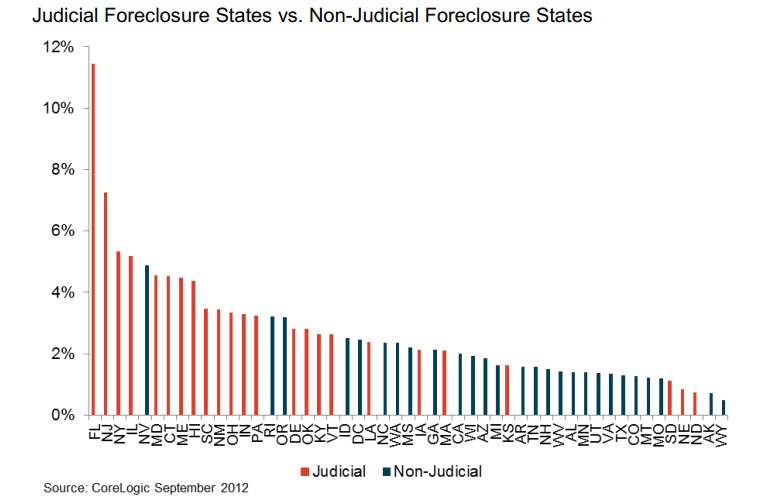
 

foreclosuresThe left axis shows the percent of existing mortgages currently in the foreclosure process. Clearly, there are a lot more foreclosures in process in judicial states than in non-judicial states. However, this is just because the process takes so much longer. When the foreclosure process drags on for months, there are bound to be a higher percent of mortgages in the foreclosure process than there are in states where the process takes just weeks. This wasn’t particularly surprising.

We then discussed the reasoning behind judicial vs. non-judicial foreclosures. After all, if judicial foreclosures take longer and are more costly, why even have them? The answer is consumer protection. Over the past few years, we’ve seen a huge amount of foreclosure fraud. In judicial states, the courts inspect all the documents of a foreclosure to try to eliminate as much fraud as possible. In non-judicial states, the courts only inspect all the documents if the borrower contests the foreclosure. That requires the borrower to have enough knowledge of the foreclosure process to notice fraud – something very few borrowers are capable or knowledgeable enough to do. Continue reading “Do Judicial Foreclosures Cut Down on Fraud?”

No, the Talking Filibuster is Not a Solution

The New York Times editorial page came out in favor of the talking filibuster today (not the first time), but I don’t see how forcing Senators to stand on the floor and talk continuously would help at all. Here’s the Times:

Several younger senators, led by Jeff Merkley of Oregon and Tom Udall of New Mexico, say that if pressed, a majority of the Senate would support their plan for the talking filibuster. But older senators aren’t so sure, and have reportedly persuaded Harry Reid, the majority leader, to back off the idea. With the experience of having been in the minority themselves, these Democrats are fearful of losing a powerful tool should Republicans ever return to power in the chamber.

That would squander a moment for change. Supermajorities were never intended to be a routine legislative barrier; they should be reserved for the most momentous bills, and the best way to make that happen is to require that objectors work hard for their filibuster, assembling a like-minded coalition and being forthright about their concerns rather than hiding in the shadows or holding up a bill with an e-mailed note.

Certainly, we need filibuster reform. But the talking filibuster isn’t the solution. It would just create more dysfunction. Republicans are not going to stop filibustering bills if they are forced to take the floor and talk continuously. They will just go and talk. The Senate would have the same number of filibusters as it has now, except it would waste even more time. Who does this help? It gives Republican Senators less time to study up on the issues and talk to their constituents (they aren’t going to cut back on fundraising). Democrats don’t receive anything in return – the same number of bills are still filibustered.

Luckily, the talking filibuster does not currently seem like it’ll be part of the final bill:

Reid and Senate Republican Leader Mitch McConnell (Ky.) are close to reaching a deal to speed the pace of work in the Senate, but some of the details remain unresolved.

The agreement between Reid and McConnell is not expected to include the talking filibuster, which would require senators who want to block action on legislation to actually hold the floor and debate for hours on end.

We’ll have to wait and see what comes out in the next few days to judge the final legislation, but I’m happy to see that the talking filibuster is currently not part of the deal.

Reaction to Obama’s Second Inauguration

Just a quick post on my thoughts on President Obama’s second inaugural address.

Like many liberals, I enjoyed the President’s speech a lot. I loved hearing Obama explicitly say he wants to take on climate change. I loved the explicit comment on LGBT couples and equal rights. I loved the focus on economic inequality and the need to promote free, fair markets.

President Obama is sworn in as President of the United States.

President Obama is sworn in as President of the United States.

In the end though, the speech did not say much new and it doesn’t change the congressional obstruction the President faces. Republicans aren’t going to agree to cap-and-trade because Obama mentioned climate change in his inaugural address (see his 2009 inaugural address). So, the only thing I’m left with in the end is that the speech doesn’t matter.

How many of the President’s speeches have truly mattered? The bully pulpit is a lot less powerful than people think, especially when you’re facing an opponent (the Tea Party) who won’t be swayed by changes in public opinion. The more Obama promotes ideas the Tea Party doesn’t agree with (even if the public supports those ideas), the more Tea Party Congressmen will attempt to block all legislation. The only thing that works against such an opponent is leverage, as seen in the final fiscal cliff deal and the House Republican’s new willingness to pass a three-month debt ceiling increase.

On the opposite side, liberals were certainly happy with the ideas and values the President outlined. Hearing those ideas in such an important, public address reignites hope they will become the major accomplishments of Obama’s second term. But the political realities are the same and no speech is going to change anything. If anything, it’s only going to anger Republicans more and increase their obstructionism. Thinking of this speech as a major turning point in Obama’s time in office or the moment where Republicans will finally come around to working with the President is naive. Obstructionism will reign once again. In just a few short months, Democrats and Republicans will be bickering over a new continuing resolution to fund the government and we will risk a government shutdown. That was true yesterday and it’s true today. It’s true tomorrow as well and no speech is going to change that. (Image via)