Rand Paul is Willing To Breach the Debt Ceiling

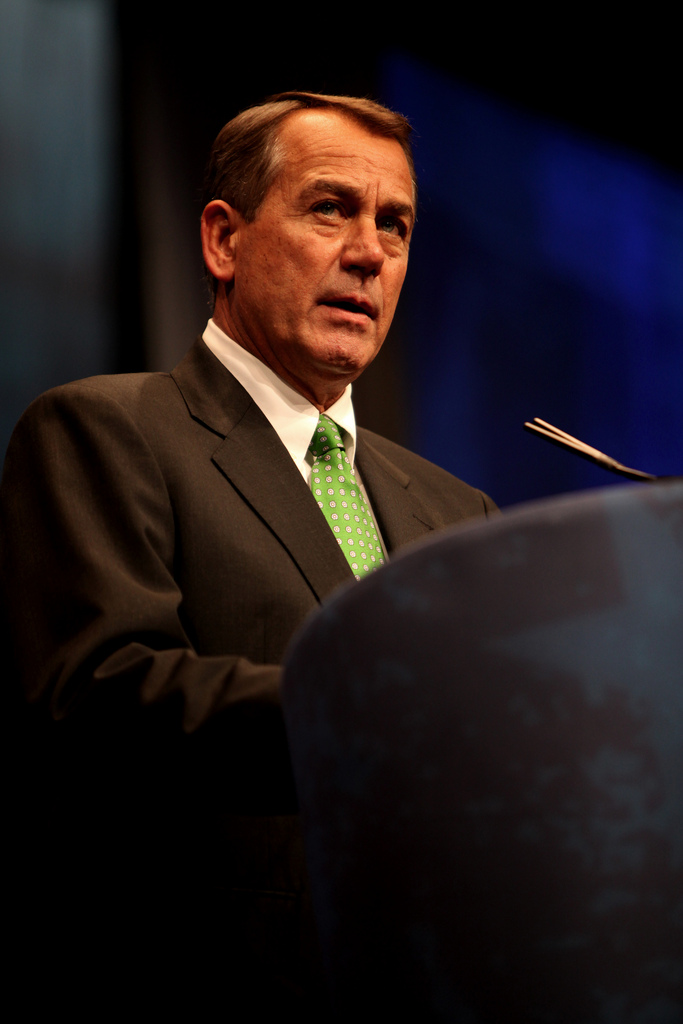
Republican Senator Rand Paul (R-KY) has been a rising star in the GOP the past couple of months, particularly after his drone filibuster. He’s been the leading libertarian voice, following in his father’s footsteps, but with a more populist tone that could give him a legitimate shot at the Republican nomination in 2016. However, he is very, very confused about how harmful breaching the debt ceiling would be. Here’s what Paul said on Glenn Beck’s radio show this afternoon:

With the debt ceiling, I’ve always been willing to go through the deadline. I’m willing to go a month, two months, three months, as long as it takes. And I think we could use that leverage to bring the Democrats to the negotiating table.

AHHHHHHH. I honestly don’t understand how Paul can think this. By all accounts, he’s a smart, hard-working guy who believes in what he says. But he can’t possibly think that breaching the debt ceiling for three months would be acceptable? That would be a disaster of unheard of proportions. Our interest rates would rise significantly, increasing the cost of our debt by trillions of dollars in the long-term. Vital government services that keep the country going would stop. Three months of that could lead to anarchy.

And this was all after Paul said that he doesn’t want a government shutdown, because it would be bad for the Republican Party. Undoubtedly, Paul understands that a government shutdown would be bad for the country as well. But does he really think that breaching the debt ceiling for 90 days is more acceptable than a government shutdown?

Maybe Paul is bluffing here so that Republicans will be in a better position to extort the President.  Maybe he is trying to shore up support from the base. I don’t know. But the casualness with which Paul speaks about breaching the debt ceiling and causing an international financial crisis is alarming. I truly hope he doesn’t believe what he’s saying.

Credit to Ted Cruz

8571621936_5b104ae4df_b
As you’ve no doubt heard, Senator Ted Cruz (R-TX) is performing a pre-arraigned filibuster (I’m going to call it a filibuster) against the House passed continuing resolution that defunds Obamacare. Cruz has no chance of stopping the actual bill from moving forward since Republicans are not going to vote against cloture (allowing debate on the bill to proceed) and Majority Leader Harry Reid (D-NV) will strip the defunding language from it in an amendment that only needs 51 votes to pass (can’t be filibustered). Cruz’s filibuster here is entirely a political stunt. But that’s part of what makes it so impressive.

Many conservatives today are upset that the mainstream media isn’t paying as much attention to Cruz as it did to Wendy Davis’s filibuster in the Texas State Senate in June. As you may remember, Davis’s filibuster was futile too. She was able to run out the clock on that legislative session, but soon after, Governor Rick Perry (R-TX) called for another special legislative session and the bill passed anyways. Davis was soon a national liberal hero and is considering running for governor.

Here’s the thing: Cruz’s filibuster is more impressive than Davis’s. 

Both Cruz and Davis were standing up for something they believed in, though they knew they were doomed to fail. They had grassroots supports and were entirely committed to their goals. However, Davis had the backing of the Democratic establishment and her Democratic colleagues. She didn’t risk alienating her fellow Democrats. On the contrary, it was certain to make her a national sensation.

The same is not true of Cruz. Before he began his filibuster, his Republican colleagues pleaded with him not to waste time and talk all night. They told him that doing so was give the House basically no time to pass a CR once the bill got back to them. It would hurt the party politically. Those senators have a point. That may happen, but Cruz ignored them anyways.

He’s also alienating Republican donors, something he’ll need if he runs for president in 2016. Those donors see Cruz’s filibuster as a cheap, parliamentary trick that accomplishes nothing and eventually puts the House in a tight stop.

Furthermore, his filibuster increases the chance of a government shutdown, as the party leadership pointed out to him. Like everyone, Cruz does not want a government shutdown, but he also knows this is his last chance to stop Obamacare. His filibuster will have no tangible accomplishments, but increases the risk of a fiscal crisis.

And despite all of that opposition – from the Republican establishment, Republican leadership and Republican donors – Cruz decided to filibuster the bill. He decided to risk alienating those key supporters to demonstrate his opposition to Obamacare. Say what you will about Cruz doing so just to gain political points, but he’s also risking a lot. He was already adored by the base. If he hadn’t performed this filibuster, the Tea Party may have been disappointed in him, but they wouldn’t have turned on him. He could’ve talked for a couple of hours, yielded the floor and allowed the vote on cloture to proceed. It wouldn’t have angered McConnell and donors and it would have made his point.But he decided to talk all night.

The base is going to LOVE this and rightfully so. Cruz really is bucking the establishment to stand up for what he believes in. Because of that, it’s unclear if his filibuster helps his presidential ambitions. It’s certainly not a good policy move. Liberals fell in love with Wendy Davis, but she never had to choose between siding with her colleagues and donors or standing up for what she believed in. Cruz had that choice and he chose to stick by his principles. He deserves credit for that.

Debt Ceiling Extortion

I have no doubt that Congress will raise the debt ceiling. Republicans simply have no choice, but to accept defeat and move on. The United States government pays its bills. Period.

Beyond that though, it’s remarkable how idiotic this argument has become.

6871657289_732d519477_b

Republicans cannot hold the debt ceiling hostage.

In 2011, the last time debt ceiling brinksmanship almost caused an international financial crisis, Republicans were screaming that any debt ceiling increase must be offset by equal spending cuts. The entire goal was to reduce the deficit. While playing chicken with the debt ceiling was irresponsible then, there was at least a bit of logic in terms what Republicans were holding hostage and their ransom demands.

This time though, Republicans are holding the debt ceiling hostage while demanding a one-year delay in Obamacare. There is no connection between the two. Republicans are using the debt ceiling to extort the President. Worse, some Republicans seem ready to breach the debt ceiling if Obama does not back down and agrees to delay his signature legislative achievement. This is where things get absurd.

If we do breach the debt ceiling, it will likely have a significant, long-term negative impact on our debt. Rates on U.S. Treasury notes are lower than any other bond because investors are 100% confident that the U.S. will repay its creditors. The chance that a debtor doesn’t pay its creditor is called credit risk. Companies and countries close to bankruptcy have high credit risks. But the United States is never close to bankruptcy because the dollar is the world’s reserve currency and the U.S. can print its own money. It can always pay back its creditors. That’s why interest rates on Treasury bills are so low. But, if we breach the debt ceiling, that non-zero credit risk rises substantially. Suddenly, it becomes a very real possibility that the U.S. could not pay its creditors. Even if Treasury prioritizes bond payments so it does not technically default on its debts, the act of breaching the debt ceiling will likely shock investors and force them to increase the risk assessment of Treasury notes. That means considerably higher-interest rates for the U.S. in the long-term and thus higher interest payments.

In 2011, J.P. Morgan estimated that rates on Treasury Bills would rise 50 basis points if we breached the debt ceiling. They predicted that it in the long-term, that would add $75 billion per year to the deficit.  Compare that to the sequester, which was the result of the 2011 debt ceiling deal. It cut spending by $1.1 trillion over 10 years. Breaching the debt ceiling would effectively undo nearly three-quarters of those cuts in the form of increased interest payments.

So, in 2011, Republicans were so concerned about the deficit that they took the debt ceiling hostage to extract $1.1 trillion in spending cuts.
Now, Republicans are so concerned about Obamacare that they’ve taken the debt ceiling hostage and risked adding $750 billion to our long-term debt.

If Republicans were so worried our long-term debt two years ago, why are they willing to undo most of those spending cuts this time? Does that seem like Republicans actually care about our debt and are using the debt ceiling as a principle to get our fiscal house under control? Or does it seem more like an irresponsible, reckless party risking a global financial collapse in order to extort the President?

That’s why President Obama and Senate Democrats cannot and will not negotiate on the debt ceiling. There is nothing principled about Republican arguments here. The debt ceiling is simply a mechanism to hold the President hostage and force his hand. That’s unacceptable. Enough with debt-ceiling histrionics. Our democracy does not work that way.