Did the Fiscal Cliff Hurt the Economy?

Today’s jobs report was decidedly mediocre and unremarkable – the economy added 157,000 jobs in January. The Bureau of Labor Statistics also revised its November and December estimates up a decent bit as well. This seems to rebuke the idea that uncertainty surrounding the Fiscal Cliff held back the economy. After all, we continued to gain jobs at a similar pace as we had during the previous 10 months. The Fiscal Cliff didn’t seem to have a significant effect, right? That’s Matt Yglesias’s take:

With today’s jobs report out, it’s worth remembering that back during the lame duck session, the Fix the Debt crowd was constantly braying about the dire consequences of failing to reach a major budget deal. They said that not only would full implementation of the cliff be a Keynesian drag on the economy but also that fire and brimstone would rain down upon us if markets weren’t assured that Congress has a credible plan to tackle long-term fiscal challenges.

Well, Congress had no plan. They agreed to small tax hikes and a bit of new stimulus via unemployment insurance, randomly kicked the can on the sequester, did nothing to reform the tax code and nothing to settle entitlements. And everything’s … fine.

Not great, mind you. But a January jobs report showing normal growth, no bond market freakout, no interest rate spikes, and some nice upward revisions to data from the lame duck period. Uncertainty didn’t matter. Confidence didn’t matter. Strong fundamentals and decent monetary policy from the Federal Reserve have us on a track for O.K.-but-not-spectacular growth, and you should expect that to continue.

Everything is fine, but that doesn’t mean that the economy wouldn’t be better right now if Democrats and Republicans had come together and agreed on a big deal. Certainly, all the pundits screaming that the world would fall apart if we didn’t get a grand bargain were wrong. We are doing fine without a grand bargain. But that doesn’t mean the Fiscal Cliff didn’t harm the economy. Maybe we would’ve added 300,000 jobs in December and January if we reached a more comprehensive deal.

So, I disagree with Yglesias’s post that uncertainty and confidence didn’t matter. I think they did, even if just slightly, but it’s impossible to know how much they mattered without knowing what the economy would be like in an alternate universe where we had a major deal. Until then, it remains a mystery.
Do Judicial Foreclosures Cut Down on Fraud?

In my class on housing policy today, we spent some time discussing judicial vs. non-judicial foreclosures and the reasoning behind the different processes. I’m a bit new (and a bit behind) to all of this so let’s break it down a bit:

A judicial foreclosure state requires a lender to file a number of documents with the court to kick off the foreclosure process. The homeowner is sent a notice of the filing and receives the opportunity to contest the sale. Judicial foreclosures can drag on for months and are subject to much scrutiny. A non-judicial foreclosure state requires a lender to file a notice of default and notify the homeowner of it as well. The homeowner still can object to the foreclosure and take the matter to court, but otherwise the court is not involved at all. It does not examine any paperwork or scrutinize the foreclosure. This process is much quicker and less costly to lenders.

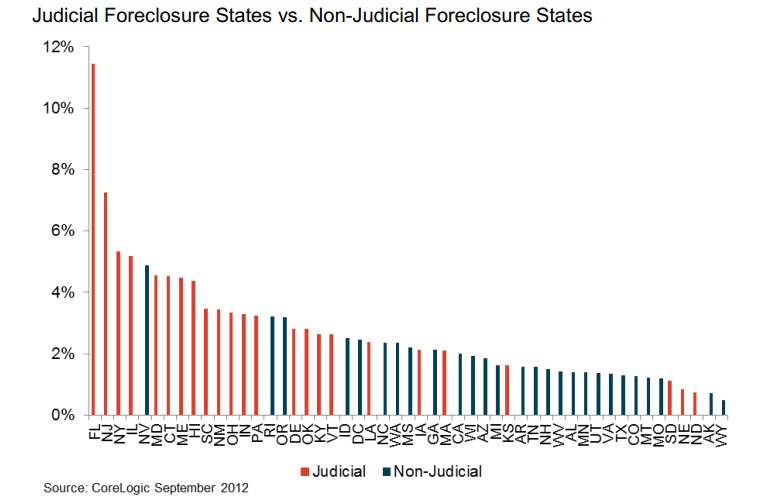
Our conversation in class today was kicked off by the following graph:


foreclosuresThe left axis shows the percent of existing mortgages currently in the foreclosure process. Clearly, there are a lot more foreclosures in process in judicial states than in non-judicial states. However, this is just because the process takes so much longer. When the foreclosure process drags on for months, there are bound to be a higher percent of mortgages in the foreclosure process than there are in states where the process takes just weeks. This wasn’t particularly surprising.

We then discussed the reasoning behind judicial vs. non-judicial foreclosures. After all, if judicial foreclosures take longer and are more costly, why even have them? The answer is consumer protection. Over the past few years, we’ve seen a huge amount of foreclosure fraud. In judicial states, the courts inspect all the documents of a foreclosure to try to eliminate as much fraud as possible. In non-judicial states, the courts only inspect all the documents if the borrower contests the foreclosure. That requires the borrower to have enough knowledge of the foreclosure process to notice fraud – something very few borrowers are capable or knowledgeable enough to do. Continue reading “Do Judicial Foreclosures Cut Down on Fraud?”

No, the Talking Filibuster is Not a Solution

The New York Times editorial page came out in favor of the talking filibuster today (not the first time), but I don’t see how forcing Senators to stand on the floor and talk continuously would help at all. Here’s the Times:

Several younger senators, led by Jeff Merkley of Oregon and Tom Udall of New Mexico, say that if pressed, a majority of the Senate would support their plan for the talking filibuster. But older senators aren’t so sure, and have reportedly persuaded Harry Reid, the majority leader, to back off the idea. With the experience of having been in the minority themselves, these Democrats are fearful of losing a powerful tool should Republicans ever return to power in the chamber.

That would squander a moment for change. Supermajorities were never intended to be a routine legislative barrier; they should be reserved for the most momentous bills, and the best way to make that happen is to require that objectors work hard for their filibuster, assembling a like-minded coalition and being forthright about their concerns rather than hiding in the shadows or holding up a bill with an e-mailed note.

Certainly, we need filibuster reform. But the talking filibuster isn’t the solution. It would just create more dysfunction. Republicans are not going to stop filibustering bills if they are forced to take the floor and talk continuously. They will just go and talk. The Senate would have the same number of filibusters as it has now, except it would waste even more time. Who does this help? It gives Republican Senators less time to study up on the issues and talk to their constituents (they aren’t going to cut back on fundraising). Democrats don’t receive anything in return – the same number of bills are still filibustered.

Luckily, the talking filibuster does not currently seem like it’ll be part of the final bill:

Reid and Senate Republican Leader Mitch McConnell (Ky.) are close to reaching a deal to speed the pace of work in the Senate, but some of the details remain unresolved.

The agreement between Reid and McConnell is not expected to include the talking filibuster, which would require senators who want to block action on legislation to actually hold the floor and debate for hours on end.

We’ll have to wait and see what comes out in the next few days to judge the final legislation, but I’m happy to see that the talking filibuster is currently not part of the deal.