A Missed Opportunity

20120831-102703.jpg

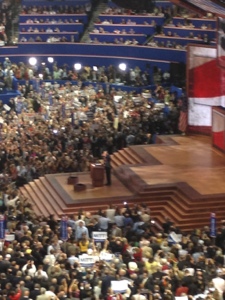
Romney speaks at the RNC.

The Republican National Convention wrapped up last night with Mitt Romney giving the keynote address and Clint Eastwood adding the…um entertainment. I was not able to attend the first night, but last night was certainly much more exciting and interesting than the previous evening.

The reason? The night wasn’t full of politicians. It was full of people who knew Romney personally. Ted & Pat Oparowsky spoke about the care and compassion Romney showed their family, and in particular, their son, who was diagnosed with cancer at just 14 years old. Next, Pam Finlayson gave a moving speech about her daughter, who was born three and a half months premature and died just over a year ago at the age of 26. She told the quiet crowd how Romney had frequently cared for her two-year-son while her daughter was in the hospital and when she was unable to prepare a Thanksgiving meal, the Romneys stepped right in and showed up at her door, meal in hand.

The crowd was silent during these great speeches and many were wiping tears off their cheeks after them.

A number of other individuals – from Romney’s days as a pastor, his time at Bain and his term as Massachusetts governor – gave a tremendous picture of Romney as a smart, caring man.

Then, just before the networks cut in, a video played throughout the arena about the Romney family and Mitt’s parents. It had numerous old family photos and videos from Mitt’s father, George Romney. It had interviews with the Mitt’s sons, about how they always used to cause trouble as a kid and they would never go to their dad to ask for money (always their mother).The video was nothing short of adorable.

Then prime time came and out walked Clint Eastwood to a huge ovation. Then Clint Eastwood spent the majority of his speech talking to a chair (with an invisible Obama in it of course). I don’t think it was disrespectful but it was incredibly strange. From inside the arena, it felt weird. When I re-watched in on TV later, it was even weirder. I really cannot figure this one out. Eastwood had no teleprompter or notes. He went on stage and said what he wanted to – and it showed.

The empty chair routine was certainly awkward. I’m not sure why anyone at the RNC approved of the idea (or let Eastwood sneak a chair onstage). But it was a huge missed opportunity. The Oparowsky’s story, Pam Finlayson’s moving speech or the video of Romney’s family would have been perfect to humanize Mitt and show a complete different side of him to a huge audience.

Instead, the world saw an 82-year-old Clint Eastwood talk to a chair. It was a huge mistake.

As for Romney’s speech itself, it was solid and effective. But it was not a game changer. It was policy-light, rhetoric-strong. His top lines of the night were certainly:

If you felt that excitement when you voted for Barack Obama, shouldn’t you feel that way now that he’s President Obama? You know there’s something wrong with the kind of job he’s done as president when the best feeling you had was the day you voted for him.

And:

I wish President Obama had succeeded because I want America to succeed.

Romney was mostly his strong, confident self for most of the speech. He grew a bit emotional when talking about his parents but quickly transitioned to his time as Governor.

Overall, Romney was exactly who we know him to be: a presidential-looking, confident man that just cannot seem to connect to the average person.

That’s what makes the inclusion of Eastwood and the exclusion of the humanizing videos and speeches about Mitt such a huge missed opportunity. Those stories could have helped him connect with the average voter more than any speech could. But the millions of viewers in prime time didn’t get to see them and that may go down as one of the biggest mistakes of this election.


A Referendum on Campaigning

I’ve been away from the blog for a bit the past week, enjoying the end of my summer and I wanted to stay away from the Paul Ryan show. The blogosphere has covered him and the Ryan Budget profusely so I don’t have much to add. More and more I believe that his election is not going to be that close. Obama won’t win by as much as he did in 2008, but I just don’t see it being all that tight and Romney’s selection of Paul Ryan as his running mate has only strengthened my view. Why? Because Ryan is controversial, his budget isn’t popular and he’s just not as wonky as people think. Real Clear Politics’s excellent conservative blogger Sean Trende said as much in his article evaluating Romney’s choice.

But let’s assume for a second that Obama does win by a decent margin. Such a victory is important not just because it allows the President and Democrats four more years to implement their policies. It is also important because it sends two positive messages for futures campaigns:

1. Money doesn’t buy elections. Obama will get outspent handily in this election. There’s no doubt about that. But what if all the tens of millions of dollars that Sheldon Adelson puts in to Romney’s campaign becomes worthless? What about all the other big money donors? If Obama wins relatively easily, maybe next time, they will be more hesitant in opening their wallets. This matters less for the presidential election than for down ticket races. In the end, those down ticket races are where money matters. If we can remove some of the money from those races – where Republicans have a huge advantage in cash – it will be a big victory for the country. Right now, too many candidates just don’t have a chance because they just don’t have the resources. How many moderate Republicans has the Club for Growth taken out with their vast swaths of money? Well, maybe an Obama win can help reverse this trend. It certainly can’t hurt.

2. Vagueness doesn’t work either.  I feel bad for Romney. He has so little to run on now because the Republican party has lurched so far to the right. And to make up for that, Romney has been incredibly vague in all of his policies. In fact, they can barely be called policies. This cannot be the standard for presidential campaigns. Candidates need to lay out their platforms and allow the media and public to judge them. Right now, Romney isn’t allowing this happen. Ultimately, I don’t believe Romney really had much of a choice, but an Obama win would certainly ensure that future candidates cannot just skirt the issues. (More on this to come).

Many pundits have declared that Romney’s selection of Ryan will make this election “about the issues.” Yes and no. Yes, voters around the country will be able to read countless articles on Obama’s policies and the Ryan Budget. They will get a chance to vote on the issues. But for those of us who follow Washington closely, there isn’t really anything new. Both Obama’s policies and the Ryan Budget have been thoroughly dissected. Ultimately, there’s just not that much more policy-wise to add to the discussion. Now, the election is all about messaging those plans to the voters.

But this election is also a referendum on what works in campaigns. Does a huge money advantage ensure victory? What about vague policies? What about both of those in the midst of a weak economic recovery? The framework for future campaigns lies with the answers to these questions and it’s important that future campaigns aren’t run to maximize money and minimize serious policy proposals. For those reasons, an Obama victory offers more than just a victory on the issues (as would a Romney victory). It offers a victory on how to campaign. And since I believe Romney’s selection of Ryan will only increase the chances of the President winning a second term, I’m certainly happy with Romney’s choice.

Yglesias’s Faulty Economics

Matt Yglesias just penned a post in defense of Mitt Romney’s tax plan but I think he mixes up the economics quite a bit. He writes:

The good thing about taxes is they raise revenue, which can be used to do useful things. The bad thing about taxes is they may be a drag on economic growth. But here there are two considerations. One is the “incentive effect” of taxes—higher taxes mean less incentive to do economically valuable things. The other is the “income effect”—less money in your pocket means more incentive to do economically valuable things. The genius of Romney’s plan is that by eliminating deductions it leaves middle class families with less money in their pockets (so a pro-growth income effect) while also lowering the tax rate they pay on a marginal dollar of additional earnings (so a pro-growth incentive effect). Basically it’s a huge win. You get a bunch of revenue in a way that bolsters the country’s growth prospects.

Let’st start at the beginning. The first part about taxes raising revenue and hurting growth is correct. But then it gets murky. Yglesias writes “higher taxes mean less incentive to do economically valuable things” and just a line later says, “less money in your pocket means more incentive to do economically valuable things.” But higher taxes means less money in your pocket. They are different ways of saying the same thing. Yet, Yglesias comes to different conclusions for their effects on economic growth.

I understand his train of thought here. A lower marginal tax rate allows people to keep a larger amount of their income. However, fewer deductions allows them to keep a smaller amount of their income. And if the middle class pays more taxes overall (as Romney’s plan does), that means they are keeping a lower share of their income overall and paying a higher effective tax rate. However, this says nothing about whether people will work more or less (which is what I assume Yglesias means by “do economically valuable things”).

Here, there are two different effects: the “income effect” and “substitution effect.” The income effect says that because  the middle class has less after-tax income, people will work more to make-up for their lost earnings. The substitution effect, on the other hand, says that because the middle class will keep a smaller percent of each dollar they earn (remember, overall they are paying more in taxes), they will work less. The question is, which effect dominates the other? If the income effect is a larger, people will work more (or do more economically valuable things). If the opposite is true though, people will work less (or do less economically valuable things).

But we don’t necessarily know which one  would dominate; it depends on a number of different things. So it is wrong to say that it bolsters the country’s growth prospects.

Nevertheless, I agree with the rest of Yglesias’s post that using the extra revenue to pay for a lower effective tax rate on high-income earners is a bad idea. In fact, Romney’s tax plan has a number of major flaws, not to mention that it is mathematically impossible. And given that it doesn’t necessarily improve the country’s growth prospects (which are also more complicated than just the middle-class), it’s tough to defend any aspect of Romney’s plan.