Life Rant: The Importance of Competition

It’s been a busy few weeks with the Duke-UNC game, midterms and my job search, but I’m back and will be posting more over the next few weeks. First up: a rant I’ve been meaning to deliver.

I don’t’ think anyone really doubts the benefits of competition in markets these days, but sometimes life gives you very clear reminders of how important competition is. I’ve had two in just the past few days (these borderline on major whines so feel free to skim/not read):

1. I’m currently at school at Duke University in Durham, North Carolina and live in an apartment off-campus. The only option for internet and cable TV is Time Warner Cable. For those of you have used Time Warner, you probably know how incredibly frustrating every part of the company is. Now, the area around my apartment is under construction and it has disrupted various services while my roommates and I have lived there. For months now, the cable will go out numerous times a day. The TV screen will suddenly go blue and we will have to unplug various cords, jiggle the box or just wait it out. There isn’t any obvious cause for its failures and when we called Time Warner to come check it out, the tech didn’t even both coming and instead just informed us it was due to the construction and we could get a significant break on our payments. In addition, our internet has gone out at various times for hours at a time. It even went out in the middle of finals week for a full day. Now, you can call us just whiny college students, but we’re paying a decent amount of money for a service that fails a huge amount of the time. Is it that absurd to expect our internet and TV consistently?
frustrationSo, we called Time Warner to discuss that option. Let’s just say that Time Warner’s customer service was less than satisfactory. They sent us back and forth between different departments for an hour and finally offered us a $20 rebate, when we were looking for much, much more. Finally, we reached someone who offered us a month of free service, which was closer to what we were looking for. The manager politely told us that for a greater rebate, they’d have to send a service technician out to examine our setup again (they didn’t have much of a record of their tech’s first “visit”). We agreed and scheduled a meeting for the following day. Shockingly, no one arrived and we never heard from Time Warner. They’ll be getting another call this week.

If we could, we would dump Time Warner in a heartbeat and pick up a competitor. Unfortunately, no such competitor exists. I’d love to write a guest column in the Duke student newspaper recommending that anyone living off-campus bypass Time Warner and choose some other provider. I’d love to at least use that as a threat against Time Warner. Unfortunately, we can’t do that. Is there any clearer example of why competition matters? Time Warner can offer us sub-par internet, cable TV, maintenance and customer service, because we have no choice in the matter.* Continue reading “Life Rant: The Importance of Competition”
Did the Fiscal Cliff Hurt the Economy?

Today’s jobs report was decidedly mediocre and unremarkable – the economy added 157,000 jobs in January. The Bureau of Labor Statistics also revised its November and December estimates up a decent bit as well. This seems to rebuke the idea that uncertainty surrounding the Fiscal Cliff held back the economy. After all, we continued to gain jobs at a similar pace as we had during the previous 10 months. The Fiscal Cliff didn’t seem to have a significant effect, right? That’s Matt Yglesias’s take:

With today’s jobs report out, it’s worth remembering that back during the lame duck session, the Fix the Debt crowd was constantly braying about the dire consequences of failing to reach a major budget deal. They said that not only would full implementation of the cliff be a Keynesian drag on the economy but also that fire and brimstone would rain down upon us if markets weren’t assured that Congress has a credible plan to tackle long-term fiscal challenges.

Well, Congress had no plan. They agreed to small tax hikes and a bit of new stimulus via unemployment insurance, randomly kicked the can on the sequester, did nothing to reform the tax code and nothing to settle entitlements. And everything’s … fine.

Not great, mind you. But a January jobs report showing normal growth, no bond market freakout, no interest rate spikes, and some nice upward revisions to data from the lame duck period. Uncertainty didn’t matter. Confidence didn’t matter. Strong fundamentals and decent monetary policy from the Federal Reserve have us on a track for O.K.-but-not-spectacular growth, and you should expect that to continue.

Everything is fine, but that doesn’t mean that the economy wouldn’t be better right now if Democrats and Republicans had come together and agreed on a big deal. Certainly, all the pundits screaming that the world would fall apart if we didn’t get a grand bargain were wrong. We are doing fine without a grand bargain. But that doesn’t mean the Fiscal Cliff didn’t harm the economy. Maybe we would’ve added 300,000 jobs in December and January if we reached a more comprehensive deal.

So, I disagree with Yglesias’s post that uncertainty and confidence didn’t matter. I think they did, even if just slightly, but it’s impossible to know how much they mattered without knowing what the economy would be like in an alternate universe where we had a major deal. Until then, it remains a mystery.

Do Judicial Foreclosures Cut Down on Fraud?

In my class on housing policy today, we spent some time discussing judicial vs. non-judicial foreclosures and the reasoning behind the different processes. I’m a bit new (and a bit behind) to all of this so let’s break it down a bit:

A judicial foreclosure state requires a lender to file a number of documents with the court to kick off the foreclosure process. The homeowner is sent a notice of the filing and receives the opportunity to contest the sale. Judicial foreclosures can drag on for months and are subject to much scrutiny. A non-judicial foreclosure state requires a lender to file a notice of default and notify the homeowner of it as well. The homeowner still can object to the foreclosure and take the matter to court, but otherwise the court is not involved at all. It does not examine any paperwork or scrutinize the foreclosure. This process is much quicker and less costly to lenders.

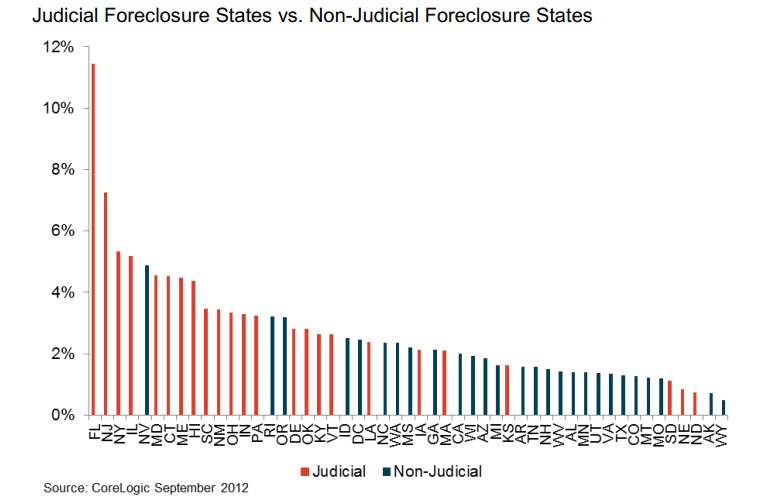
Our conversation in class today was kicked off by the following graph:


foreclosuresThe left axis shows the percent of existing mortgages currently in the foreclosure process. Clearly, there are a lot more foreclosures in process in judicial states than in non-judicial states. However, this is just because the process takes so much longer. When the foreclosure process drags on for months, there are bound to be a higher percent of mortgages in the foreclosure process than there are in states where the process takes just weeks. This wasn’t particularly surprising.

We then discussed the reasoning behind judicial vs. non-judicial foreclosures. After all, if judicial foreclosures take longer and are more costly, why even have them? The answer is consumer protection. Over the past few years, we’ve seen a huge amount of foreclosure fraud. In judicial states, the courts inspect all the documents of a foreclosure to try to eliminate as much fraud as possible. In non-judicial states, the courts only inspect all the documents if the borrower contests the foreclosure. That requires the borrower to have enough knowledge of the foreclosure process to notice fraud – something very few borrowers are capable or knowledgeable enough to do. Continue reading “Do Judicial Foreclosures Cut Down on Fraud?”